
Predictive Top Down Parsing - Free MCQ Test with solutions for GATE CSE
MCQ Practice Test & Solutions: Predictive Top Down Parsing (10 Questions)
You can prepare effectively for Computer Science Engineering (CSE) Compiler Design with this dedicated MCQ Practice Test (available with solutions) on the important topic of "Predictive Top Down Parsing". These 10 questions have been designed by the experts with the latest curriculum of Computer Science Engineering (CSE) 2026, to help you master the concept.
Test Highlights:
- - Format: Multiple Choice Questions (MCQ)
- - Duration: 10 minutes
- - Number of Questions: 10
Sign up on EduRev for free to attempt this test and track your preparation progress.

Detailed Solution: Question 1
Detailed Solution: Question 2

Which of the following derivations does a top-down parser use while parsing an input string?
Detailed Solution: Question 3
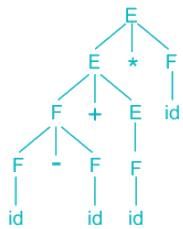
Given the following expression grammar:E -> E * F | F + E | FF -> F – F | idWhich of the following is true?
Detailed Solution: Question 4
Which one of the following is true at any valid state in shift-reduce parsing?
Detailed Solution: Question 5
In the context of abstract-syntax-tree and control-flow-graph.Which one of the following is true?
Detailed Solution: Question 6
List-I List-II
A. Lexical analysis 1. Graph coloring
B. Parsing 2. DFA minimization
C. Register allocation 3. Post-order traversal
D. Expression evaluation 4. Production tree
A B C D
A. Lexical analysis 1. Graph coloring
B. Parsing 2. DFA minimization
C. Register allocation 3. Post-order traversal
D. Expression evaluation 4. Production tree
Detailed Solution: Question 7
Which of the following statements is/are correct?
A. SLR parser is more powerful than LALR parser.
B. Canonical LR parser is more powerful than LALR parser.
C. LALR parser is more powerful than Canonical LR parser.
Detailed Solution: Question 8
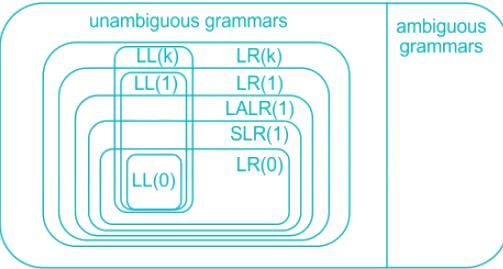
Consider the following grammar G.
S → F ⎪ H
F → p ⎪ c
H → d ⎪ c
Which one is true?
S1: All strings generated by G can be parsed with help of LL (1).
S2: All strings generated by G can be parsed with help of LR (1).
S → F ⎪ H
F → p ⎪ c
H → d ⎪ c
Which one is true?
S1: All strings generated by G can be parsed with help of LL (1).
Detailed Solution: Question 9
What is the maximum number of reduce moves that can be taken by a bottom-up parser for a grammar with no epsilon- and unit-production to parse a string with n tokens?
Detailed Solution: Question 10
26 videos|92 docs|30 tests |
