
An Empire Across Three Continents- Assertion-Reason & Source Based Questions
MCQ Practice Test & Solutions: Test: An Empire Across Three Continents- Assertion-Reason & Source Based Questions - 1 (10 Questions)
You can prepare effectively for UPSC Lucent For GK with this dedicated MCQ Practice Test (available with solutions) on the important topic of "Test: An Empire Across Three Continents- Assertion-Reason & Source Based Questions - 1". These 10 questions have been designed by the experts with the latest curriculum of UPSC 2026, to help you master the concept.
Test Highlights:
- - Format: Multiple Choice Questions (MCQ)
- - Duration: 20 minutes
- - Number of Questions: 10
Sign up on EduRev for free to attempt this test and track your preparation progress.

Directions : In the following questions, a statement of Assertion (A) is followed by a statement of Reason (R). Mark the correct choice as:
Assertion (A): There was a close interaction between Greek and Islamic traditions in the region.
Reason (R): The Mongol Empire of Genghis Khan and his successors is a good example of how an empire could be maintained by military assets.
Detailed Solution: Question 1
Read the following extract carefully and answer the following question by choosing the correct option:
To sum up, the emperor, the aristocracy and the army were the three main players in the political history of the empire. The success of individual Emperors depended on their control of the army, and when the armies were divided, the result usually was civil war. Except for one notorious year 69 CE, when four emperors mounted the throne in quick succession, the first two centuries were on the whole free from civil war and in this sense relatively stable. Succession to the throne was based as far as possible on the family descent, either natural or adaptive, and even the army was strongly wedded to the principal. For example, Tiberius 14-37 CE, the second in the long line of Roman Emperors, was not the natural son of Augustus, the ruler who found the Principate, but Augustus adopted him to ensure a smooth transition.
Q. On which the factor did the success of emperor depend upon?
Detailed Solution: Question 2

Read the following extract carefully and answer the following question by choosing the correct option:
To sum up, the emperor, the aristocracy and the army were the three main players in the political history of the empire. The success of individual Emperors depended on their control of the army, and when the armies were divided, the result usually was civil war. Except for one notorious year 69 CE, when four emperors mounted the throne in quick succession, the first two centuries were on the whole free from civil war and in this sense relatively stable. Succession to the throne was based as far as possible on the family descent, either natural or adaptive, and even the army was strongly wedded to the principal. For example, Tiberius 14-37 CE, the second in the long line of Roman Emperors, was not the natural son of Augustus, the ruler who found the Principate, but Augustus adopted him to ensure a smooth transition.
Q. What do you think the term “Republic” refers to in the history of the Roman Empire?
Detailed Solution: Question 3
Read the following extract carefully and answer the following question by choosing the correct option:
The famine prevalent for many successive years in many provinces has clearly displayed for men any understanding of the effect of malnutrition in generating illness. The city dwellers, as it was their custom to collect and store enough grain for the whole next year immediately after the harvest, carried off all the wheat, barley, beans and lentils, and left to the peasants, various kind of pulses after taking quite a large proportion of these to the city. After consuming what was left in the course of winter, the country people had to resort to unhealthy food in the spring; they ate twigs and shoots of trees and bushes and bulbs and roots of inedible plants….
Q. What did the city dwellers do?
Detailed Solution: Question 4
Read the following extract carefully and answer the following question by choosing the correct option:
The famine prevalent for many successive years in many provinces has clearly displayed for men any understanding of the effect of malnutrition in generating illness. The city dwellers, as it was their custom to collect and store enough grain for the whole next year immediately after the harvest, carried off all the wheat, barley, beans and lentils, and left to the peasants, various kind of pulses after taking quite a large proportion of these to the city. After consuming what was left in the course of winter, the country people had to resort to unhealthy food in the spring; they ate twigs and shoots of trees and bushes and bulbs and roots of inedible plants….
Q. As per the extract, what are the effects of malnutrition due to famine?
Detailed Solution: Question 5
Read the following extract carefully and answer the following question by choosing the correct option:
A major difference between the two superpowers and their respective empires was that the Roman Empire was culturally much more diverse than that of Iran. The Parthians and later the Sasanians, the dynasties that ruled Iran in this period, ruled over a population that was largely Iranian. The Roman Empire, by contrast, was a mosaic of territories and cultures that were chiefly bound together by a common system of government. Many languages were spoken in the empire, but for the purposes of administration Latin and Greek were the most widely used, indeed the only languages. The upper classes of the east spoke and wrote in Greek, those of the west in Latin, and the boundary between these broad language areas ran somewhere across the middle of the Mediterranean, between the African provinces of Tripolitania (which was Latin speaking) and Cyrenaica (Greek-speaking). All those who lived in the empire were subjects of a single ruler, the emperor, regardless of where they lived and what language they spoke.
Q. Parthians and Sasanians were what?
Detailed Solution: Question 6
Read the following extract carefully and answer the following question by choosing the correct option:
A major difference between the two superpowers and their respective empires was that the Roman Empire was culturally much more diverse than that of Iran. The Parthians and later the Sasanians, the dynasties that ruled Iran in this period, ruled over a population that was largely Iranian. The Roman Empire, by contrast, was a mosaic of territories and cultures that were chiefly bound together by a common system of government. Many languages were spoken in the empire, but for the purposes of administration Latin and Greek were the most widely used, indeed the only languages. The upper classes of the east spoke and wrote in Greek, those of the west in Latin, and the boundary between these broad language areas ran somewhere across the middle of the Mediterranean, between the African provinces of Tripolitania (which was Latin speaking) and Cyrenaica (Greek-speaking). All those who lived in the empire were subjects of a single ruler, the emperor, regardless of where they lived and what language they spoke.
Q. Tripolitania is in :
Detailed Solution: Question 7
Study the below picture of Roman Empire carefully and answer the following question by choosing the correct option:
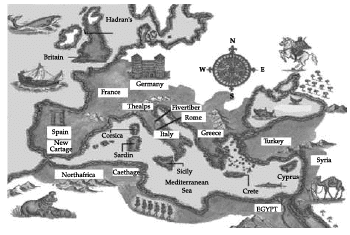
Q. What constituted the heart of the empire?
Detailed Solution: Question 8
When did the Roman Empire become a Republic?
Detailed Solution: Question 9
Find out from the following pairs which one is correctly matched:
640 videos|1072 docs|422 tests |
