Computer Science Engineering (CSE) Exam  >  Computer Science Engineering (CSE) Test  >  Database Management System (DBMS)  >  Test: B+ Tree - Computer Science Engineering (CSE) MCQ

B+ Tree - Free MCQ Practice Test with solutions, GATE CSE (CSE) Database


MCQ Practice Test & Solutions: Test: B+ Tree (10 Questions)

You can prepare effectively for Computer Science Engineering (CSE) Database Management System (DBMS) with this dedicated MCQ Practice Test (available with solutions) on the important topic of "Test: B+ Tree". These 10 questions have been designed by the experts with the latest curriculum of Computer Science Engineering (CSE) 2026, to help you master the concept.

Test Highlights:

  • - Format: Multiple Choice Questions (MCQ)
  • - Duration: 30 minutes
  • - Number of Questions: 10

Sign up on EduRev for free to attempt this test and track your preparation progress.

Test: B+ Tree - Question 1

Which one of the following data structures are preferred in database-system implementation?

Detailed Solution: Question 1

The database-system implementations use B+ -tree data structure because they can be used for multilevel indexing.

Test: B+ Tree - Question 2

What is the maximum number of keys that a B+ -tree of order 3 and of height 3 have?

Detailed Solution: Question 2

A B+ tree of order n and height h can have at most nh – 1 keys. Therefore maximum number of keys = 33 -1 = 27 -1 = 26.

Test: B+ Tree - Question 3

Statement 1: When a node is split during insertion, the middle key is promoted to the parent as well as retained in right half-node.
Statement 2: When a key is deleted from the leaf, it is also deleted from the non-leaf nodes of the tree.

Detailed Solution: Question 3

During the split, the middle key is retained in the right half node and also promoted to parent node. When a key is deleted from the leaf, it is retained in non-leaves, because it can be still a valid separator between keys in nodes below.

Test: B+ Tree - Question 4

Which of the following is false?

Detailed Solution: Question 4

A B+ -tree always grows upwards. And In a B+tree – i)The path from the root to every leaf node is of the same length, so the tree is balanced. ii) Leaves are linked, so allow sequential searching. iii) An index is built with a single key per block of data rather than with one key per data record, so it is shallower than B-tree.

Test: B+ Tree - Question 5

Which of the following is true?

Detailed Solution: Question 5

The B+ -tree being a variation of B-tree allows rapid random access. In a B+ -tree the leaves are linked together, so it also provides rapid sequential access.

Test: B+ Tree - Question 6

Which of the following is false?

Detailed Solution: Question 6

A B+ -tree has larger fanout and therefore have a depth smaller than that of corresponding B-tree.

Test: B+ Tree - Question 7

Efficiency of finding the next record in B+ tree is ____

Detailed Solution: Question 7

In a B+ -tree finding the next recored (successor) involves accessing an additional leaf at most. So, the efficiency of finding the next record is O(1).

Test: B+ Tree - Question 8

Which of the following is true?

Detailed Solution: Question 8

The B+ -tree being a variation of B-tree allows rapid random access. In a B+ -tree the leaves are linked together, so it also provides rapid sequential access.

Test: B+ Tree - Question 9

Which one of the following statements is NOT correct about the B+ tree data structure used for creating an index of a relational database table?

Detailed Solution: Question 9
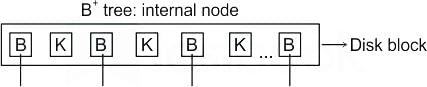
Properties of B+ trees:

  • B+ tree is height balance tree.
  • Non leaf node has pointer to a node (leaf or non-leaf) and not pointer to data record
  • Key value in each node is in sorted order.
  • Leaf node has pointer to next leaf node.

Structure of non-leaf(internal) node of B+ tree:

Structure of leaf of B+ tree:

Option b is not correct.

Test: B+ Tree - Question 10

Consider the following query :

SELECT E.eno, COUNT(*)
FROM Employees E
GROUP BY E.eno

If an index on eno is available, the query can be answered by scanning only the index if

Detailed Solution: Question 10

A clustered index is when a file is organized so that ordering of the data records is the same as or close to the ordering of data entries in the index.  Alternative 1 by definition is clustered.  An index that uses Alternative2 or3 can be a clustered index only if the data records are sorted on the search key field.
A clustered index offers much better range query performance, but essentially the same equality search performance (modulo duplicates) as an unclustered index. Further, a clustered index is typically more expensive to maintain than an unclus­tered index. Therefore, we should make an index be clustered only if range queries are important on its search key. At most one of the indexes on a relation can be clustered, and if range queries are anticipated on more than one combination of fields, we have to choose the combination that is most important and make that be the search key of the clustered index.

62 videos|101 docs|35 tests
Information about Test: B+ Tree Page
In this test you can find the Exam questions for Test: B+ Tree solved & explained in the simplest way possible. Besides giving Questions and answers for Test: B+ Tree, EduRev gives you an ample number of Online tests for practice
Download as PDF
