UPSC Exam  >  UPSC Test  >  Lucent For GK  >  Test: Biodiversity And Environment - UPSC MCQ

Biodiversity And Environment - Free MCQ Practice Test with solutions, UPSC


MCQ Practice Test & Solutions: Test: Biodiversity And Environment (25 Questions)

You can prepare effectively for UPSC Lucent For GK with this dedicated MCQ Practice Test (available with solutions) on the important topic of "Test: Biodiversity And Environment". These 25 questions have been designed by the experts with the latest curriculum of UPSC 2026, to help you master the concept.

Test Highlights:

  • - Format: Multiple Choice Questions (MCQ)
  • - Duration: 30 minutes
  • - Number of Questions: 25

Sign up on EduRev for free to attempt this test and track your preparation progress.

Test: Biodiversity And Environment - Question 1

Which of the following is/are the characteristic(s) of Tropical Deciduous Forests?

(i) Trees shed their leaves in the dry season to conserve water

(ii) The hardwood trees found in these forests are sal, teak and Sheesham

(iii) Tigers, lions, elephants and monkeys are common animals

Detailed Solution: Question 1
  • Tropical Deciduous Forests thrive where the rainfall is between 70cm And 200 cm.

  • The trees in these forests shed their leaves for about six to eight weeks in summer.

  • They are also called the monsoon forests.

Test: Biodiversity And Environment - Question 2

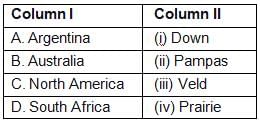
Match column I with column II

Detailed Solution: Question 2

  • The Pampas are fertile South American lowlands, covering more than 750,000 km2, that include the Argentine provinces of Buenos Aires, La Pampa, Santa Fe, Entre Ríos and Córdoba; most of Uruguay.

  • The Darling Downs is a farming region on the western slopes of the Great Dividing Range in southern Queensland, Australia.

  • Prairies are ecosystems considered part of the temperate grasslands, savannas, and Lands typically referred to as “prairies” tend to be in North America.

  • Veld is the name given to various types of open country in Southern Africa that is used for pasturage and farmland. To most South African farmers today, the “veld” refers to the land they work, much of which has long since ceased to be “natural.”

Test: Biodiversity And Environment - Question 3


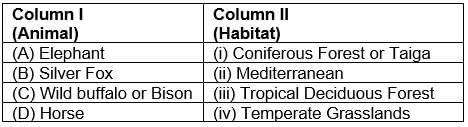
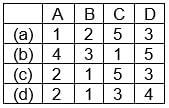
Match the animal with its habitat and accordingly select the correct alternative:

Detailed Solution: Question 3

(A) Elephant: iii) Tropical Deciduous Forest

(B) Silver Fox: ii) Mediterranean

(C) Wild buffalo or Bison: iv) Temperate Grasslands

(D) Horse: i) Coniferous Forest or Taiga

Test: Biodiversity And Environment - Question 4

Which type of soil is found in the coniferous forests?

Detailed Solution: Question 4

  • Podzol or Podsol type of soil is found in the coniferous forests. In soil science, podzols are the typical soils of coniferous, or boreal forests.

  • They are also typical soils of eucalypt forests and heathlands in southern Australia, while in Western Europe podzols develop on heathland, which is often a construct of human interference through grazing and burning.

Test: Biodiversity And Environment - Question 5

Ebony and Mahogany trees are associated with

Detailed Solution: Question 5

  • Ebony and Mahogany trees are associated with Tropical evergreen forests. Tropical evergreen forests are usually found in areas receiving more than 200 cm of rainfall and having a temperature of 15 °C to 30 °C.

  • They occupy about seven per cent of the Earth’s land surface and harbour more than half of the planet’s terrestrial plants and animals.

  • Tropical evergreen forests are dense, multi-layered, harbour many types of plants & animals.

Test: Biodiversity And Environment - Question 6

The percentage of forest cover is the highest in

Detailed Solution: Question 6

The forest cover : Europe>South America>North America>Africa> Asia>Oceania

Test: Biodiversity And Environment - Question 7

The wide treeless grassy plains in South America are called

Detailed Solution: Question 7

  • The wide treeless grassy plains in South America are called Pampas.

  • The Pampas are fertile South American lowlands, covering more than 750,000 km2, that include the Argentine provinces of Buenos Aires, La Pampa, Santa Fe, Entre Ríos and Córdoba, most of Uruguay, and the southernmost Brazilian State, the Rio Grande do Sul.

Test: Biodiversity And Environment - Question 8

Sal trees are the typical species of [NDA 2009-II]

Detailed Solution: Question 8

The trees in Monsoon Forests shed their leaves for about six to eight weeks in summer on account of a long dry spell. The rainfall suited for such forests is between75 to 200 cm. Sal is of the dry deciduous variety of tropical monsoon forest.

Test: Biodiversity And Environment - Question 9

Which one of the following statements on biosphere reserves is not correct?

Detailed Solution: Question 9
Nanda Devi Biosphere Reserve is located in Uttarakhand. It was inscribed a World Heritage Site by UNESCO in 1988

Test: Biodiversity And Environment - Question 10

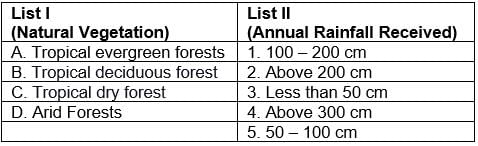
Match the following

Codes:

Detailed Solution: Question 10

Test: Biodiversity And Environment - Question 11

Over 90% of the world’s biomass is in

Detailed Solution: Question 11

Biomass is the mass of living biological organisms in a given area or ecosystem at a given time. Over 90% of the Biomass is in Oceans.

Test: Biodiversity And Environment - Question 12

The vegetation type characterized by

(i) a large expanse of grassland with scattered trees and shrubs,

(ii) lying between the tropical rainforest and tropical steppes and deserts and

(iii) flat-topped trees is called

Detailed Solution: Question 12

  • A Savanna is a rolling grassland scattered with shrubs and isolated trees, which can be found between a tropical rainforest and desert biome.

  • Savannas are also known as tropical grasslands. These types of grassland are found in a wide band on either side of the equator on the edges of tropical rainforests.

Test: Biodiversity And Environment - Question 13

Spruce and Cedar are tree varieties of

Detailed Solution: Question 13

Spruce and Cedar are tree varieties of temperate coniferous forest.

Test: Biodiversity And Environment - Question 14

Which one of the following is the correct sequence about various levels of organization of the Biosphere?

Detailed Solution: Question 14

Organism → Population → Ecosystem → Biosphere

Test: Biodiversity And Environment - Question 15

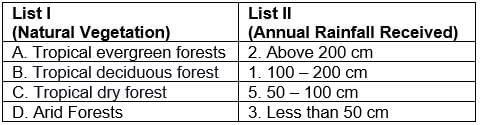
Match List-I and List-II and select the correct answer using the code given below the
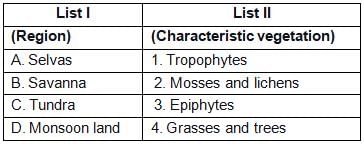
Codes:
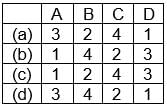
Detailed Solution: Question 15
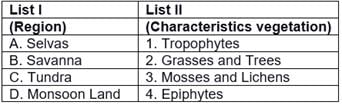
Test: Biodiversity And Environment - Question 16

Taiga forests are characteristics of—

Detailed Solution: Question 16

Taiga forests are characteristics of the Temperate region.

Test: Biodiversity And Environment - Question 17

Which one of the following countries is devoid of Glossopteris flora?

Detailed Solution: Question 17

Glossopteris flora is found in Australia, India and South Africa. They are not found in Norway.

Test: Biodiversity And Environment - Question 18

Which of the following is the odd one out of the group?

Detailed Solution: Question 18

Savanna has a transitional type of climate which is bounded between equatorial rain forest and semi-arid and subtropical humid climate. Others are called mid-latitude grasslands.

Test: Biodiversity And Environment - Question 19

Which one of the following is not an abiotic resource?

Detailed Solution: Question 19

Biotic Resources: These are obtained from the biosphere and have life such as human beings, flora, and fauna, fisheries,  livestock, etc.

Abiotic Resources: All those things which are composed of non-living things are called abiotic resources. For example, rocks and metals.

Test: Biodiversity And Environment - Question 20

The most abundant source of energy is

Detailed Solution: Question 20

A most abundant source of energy is solar power energy. It is the cleanest and most abundant renewable energy source available.

Test: Biodiversity And Environment - Question 21

The Yellowstone National Park is located in

Detailed Solution: Question 21

  • The Yellowstone National Park is located in the USA. Yellowstone National Park is a national park located primarily in the U.S. state of Wyoming, although it also extends into Montana and Idaho.

  • It was established by the U.S. Congress and signed into law by President Ulysses S. Grant on March 1, 1872.

Test: Biodiversity And Environment - Question 22

Consider the following statements and select the correct answer from the codes given below:

Assertion (A): The production of rubber is decreasing in the Amazon.

Reason (R): Equatorial climate is favourable for rubber plantation.

Codes:

Detailed Solution: Question 22

  • Cultivation of rubber in Brazil, its native habitat, was severely hindered by blight in the early 20th century.

  • At present, most of the world’s natural rubber is produced by Rubber trees descended from rubber seedlings transplanted from South America to the south and south-east Asia.

  • The most severe disease is the South American Leaf Blight (SALB).

  • This Disease is endemic throughout the rubber growing areas in the Americas. It also poses a major global threat.

  • Several fungicides can control the fungus. Some Species are not susceptible to the disease, and some strains of susceptible species are resistant.

  • Crown budding or grafting of resistant plants onto productive trees can be used to control spread.

Test: Biodiversity And Environment - Question 23

Which one of the following is a temperate desert?

Detailed Solution: Question 23

Patagonian Desert is a temperature desert. The Patagonian Desert, also known as the Patagonia Desert or the Patagonian Steppe, is the largest desert in Argentina and is the 8th largest desert in the world by area, occupying 673,000 square kilometres.

Test: Biodiversity And Environment - Question 24

Which one of the following is not a tropical desert?

Detailed Solution: Question 24

The Gobi is not a tropical desert. It is a temperate desert partly located in northern China and partly in Mongolia.

Test: Biodiversity And Environment - Question 25

Consider the following statements and select the correct answer

from codes given below:

Assertion (A): Tropical areas get more insolation than the temperate area.

Reason (R): Tropical areas have a larger length of the day than the temperate areas.

Codes:

Detailed Solution: Question 25

The solar radiation is intense and to a great extent, diffuse due to haze. It, therefore, demands generous shading devices. The haze may cause sky glare which can also be reduced by large shading devices.

640 videos|1072 docs|422 tests
Information about Test: Biodiversity And Environment Page
In this test you can find the Exam questions for Test: Biodiversity And Environment solved & explained in the simplest way possible. Besides giving Questions and answers for Test: Biodiversity And Environment, EduRev gives you an ample number of Online tests for practice
640 videos|1072 docs|422 tests
Download as PDF