You can prepare effectively for NEET Biology Class 11 with this dedicated MCQ Practice Test (available with solutions) on the important topic of "Test: Biomolecules - 1". These 22 questions have been designed by the experts with the latest curriculum of NEET 2026, to help you master the concept.
Test Highlights:
Sign up on EduRev for free to attempt this test and track your preparation progress.
Detailed Solution: Question 1
Topic in NCERT: Fats and oils (lipids)
Line in NCERT: "oils have lower melting point (e.g., gingelly oil) and hence remain as oil in winters."
Identify the biomolecule shown in the structural diagram given below.
Detailed Solution: Question 2
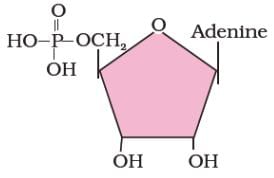
Topic in NCERT: Nucleic acids
Line in NCERT: "living organisms have a number of carbon compounds in which heterocyclic rings can be found. some of these are nitrogen bases adenine, guanine, cytosine, uracil, and thymine. when found attached to a sugar, they are called nucleosides. if a phosphate group is also found esterified to the sugar they are called nucleotides. adenosine, guanosine, thymidine, uridine and cytidine are nucleosides. adenylic acid, thymidylic acid, guanylic acid, uridylic acid and cytidylic acid are nucleotides."
Detailed Solution: Question 3
Topic in NCERT: Structure of proteins
Line in NCERT: "adult human haemoglobin consists of 4 subunits."
Detailed Solution: Question 4
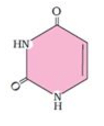
Topic in NCERT: Nucleic acids
Line in NCERT: "living organisms have a number of carbon compounds in which heterocyclic rings can be found. some of these are nitrogen bases adenine, guanine, cytosine, uracil, and thymine. when found attached to a sugar, they are called nucleosides."
Proteins are polymers of amino acids that are connected by __________
Detailed Solution: Question 5
Detailed Solution: Question 6
Topic in NCERT: Temperature and ph
Line in NCERT: "high temperature destroys enzymatic activity because proteins are denatured by heat."
Detailed Solution: Question 7
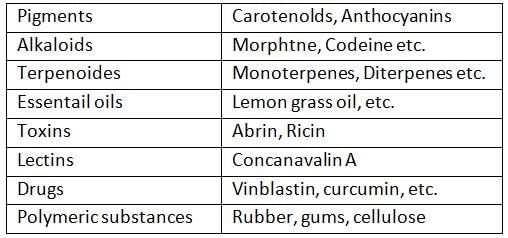
Topic in NCERT: Table 9.3 some secondary metabolites
Line in NCERT: "abrin, ricin"
Detailed Solution: Question 8
Topic in NCERT: Amino acids
Line in NCERT: "aromatic amino acids (tyrosine, phenylalanine, tryptophan)."
Which of the following nitrogenous base produces nucleoside only with ribose sugar?
Detailed Solution: Question 9
Topic in NCERT: Nitrogen bases
Line in NCERT: "uracil (pyrimidine)"
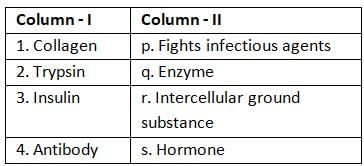
Detailed Solution: Question 10
Detailed Solution: Question 11
Topic in NCERT: Temperature and ph
Line in NCERT: "low temperature preserves the enzyme in a temporarily inactive state whereas high temperature destroys enzymatic activity because proteins are denatured by heat."
Detailed Solution: Question 12
Topic in NCERT: Polysaccharides
Line in NCERT: "plant cell walls are made of cellulose."
Directions: In the following question, two statements are given. One is assertion and the other is reason. Examine the statements carefully and mark the correct option.
Assertion: Both amino group and acidic group act as substituents on the same carbon called α-amino acids.
Reason: Amino acids are inorganic compounds containing an amino group.
Detailed Solution: Question 13
Topic in NCERT: Amino acids
Line in NCERT: "amino acids are organic compounds containing an amino group and an acidic group as substituents on the same carbon i.e., the α-carbon."
Assertion (A): The formation of the enzyme-substrate complex is a transient phenomenon crucial for catalysis.
Reason (R): The transition state structure is the most stable state during the conversion of substrate to product.
Detailed Solution: Question 14
Topic in NCERT: Factors affecting enzyme activity
Line in NCERT: "the formation of the es complex is essential for catalysis."
Which of the statements given above is/are correct?
i. Polysaccharides are composed of long chains of monosaccharides and can be classified as homopolymers or heteropolymers.
ii. Cellulose is a homopolymer made only of glucose and forms complex helical structures.
iii. Starch serves as an energy reserve in plants and can form helical structures that bind iodine, producing a blue color.
iv. Glycogen, found in animals, is a linear polysaccharide that does not have branches.
Detailed Solution: Question 15
Topic in NCERT: Polysaccharides
Line in NCERT: "polysaccharides are long chains of sugars. they are threads (literally a cotton thread) containing different monosaccharides as building blocks. for example, cellulose is a polymeric polysaccharide consisting of only one type of monosaccharide i.e., glucose. cellulose is a homopolymer. starch is a variant of this but present as a store house of energy in plant tissues."
Which of the following statements given above is/are correct?
i. In the absence of any enzyme, the formation of H2CO3 is very slow, with about 200 molecules produced in an hour.
ii. Carbonic anhydrase accelerates the reaction rate by approximately 10 million times, producing about 600,000 molecules of H2CO3 every second.
iii. The metabolic pathway from glucose to pyruvic acid involves ten enzyme-catalyzed reactions.
iv. Under anaerobic conditions in skeletal muscle, pyruvic acid is formed instead of lactic acid.
Detailed Solution: Question 16
Topic in NCERT: Enzymes and metabolic pathways
Line in NCERT: "in the absence of any enzyme this reaction is very slow, with about 200 molecules of h2co3 being formed in an hour. however, by using the enzyme present within the cytoplasm called carbonic anhydrase, the reaction speeds dramatically with about 600,000 molecules being formed every second."
"this very metabolic pathway with one or two additional reactions gives rise to a variety of metabolic end products. in our skeletal muscle, under anaerobic conditions, lactic acid is formed. under normal aerobic conditions, pyruvic acid is formed."
"glucose becomes pyruvic acid through ten different enzyme catalysed metabolic reactions."
Which of the following statements regarding nucleic acids is/are correct?
i. Nucleic acids are comprised of polynucleotides that contain ribose or deoxyribose sugars.
ii. The building blocks of nucleic acids are amino acids.
iii. The nitrogenous bases adenine, guanine, uracil, cytosine, and thymine are found in nucleic acids.
iv. DNA is a type of nucleic acid that contains ribose sugar.
Detailed Solution: Question 17
Which of the statements given above is/are correct?
i. Enzymes require cofactors for catalytic activity, and the protein portion is known as the apoenzyme.
ii. Prosthetic groups are loosely associated with the apoenzyme and can be easily removed.
iii. Coenzymes are transiently associated with the apoenzyme and often derived from vitamins.
iv. Metal ions serve as cofactors and are essential for the activity of certain enzymes.
Detailed Solution: Question 18
Topic in NCERT: Co-factors
Line in NCERT: "enzymes are composed of one or several polypeptide chains. however, there are a number of cases in which non-protein constituents called co-factors are bound to the enzyme to make the enzyme catalytically active. in these instances, the protein portion of the enzymes is called the apoenzyme. three kinds of cofactors may be identified: prosthetic groups, co-enzymes and metal ions."
"prosthetic groups are organic compounds and are distinguished from other cofactors in that they are tightly bound to the apoenzyme."
"co-enzymes are also organic compounds but their association with the apoenzyme is only transient, usually occurring during the course of catalysis."
"a number of enzymes require metal ions for their activity which form coordination bonds with side chains at the active site and at the same time form one or more coordination bonds with the substrate."
"catalytic activity is lost when the co-factor is removed from the enzyme which testifies that they play a crucial role in the catalytic activity of the enzyme."
Which type of enzyme catalyzes the transfer of a group (other than hydrogen) between substrates?
Detailed Solution: Question 19
Topic in NCERT: Classification and nomenclature of enzymes
Line in NCERT: "transferases: enzymes catalysing a transfer of a group, g (other than hydrogen) between a pair of substrate s and s' e.g., s-g+s' → s+s'- g"
Assertion (A): Competitive inhibitors bind to the active site of an enzyme, preventing substrate binding.
Reason (R): Due to its close structural similarity with the substrate, the inhibitor competes with the substrate for the substratebinding site of the enzyme
Detailed Solution: Question 20
Which of the following statements regarding the catalytic cycle of enzyme action is/are correct?
i. The substrate binds to the active site of the enzyme, fitting perfectly into it.
ii. The enzyme changes shape to fit more tightly around the substrate after binding occurs.
iii. The enzyme-product complex is formed when the active site breaks the chemical bonds of the substrate.
iv. The enzyme remains permanently altered after releasing the products of the reaction.
Detailed Solution: Question 21
Topic in NCERT: Enzyme action and catalysis
Line in NCERT: "1. first, the substrate binds to the active site of the enzyme, fitting into the active site. 2. the binding of the substrate induces the enzyme to alter its shape, fitting more tightly around the substrate. 3. the active site of the enzyme, now in close proximity of the substrate breaks the chemical bonds of the substrate and the new enzyme- product complex is formed."
Detailed Solution: Question 22
142 videos|410 docs|135 tests |