
Boundary Layer Level - 2 - Free MCQ Practice Test with solutions, GATE
MCQ Practice Test & Solutions: Test: Boundary Layer Level - 2 (10 Questions)
You can prepare effectively for Mechanical Engineering Fluid Mechanics for Mechanical Engineering with this dedicated MCQ Practice Test (available with solutions) on the important topic of "Test: Boundary Layer Level - 2". These 10 questions have been designed by the experts with the latest curriculum of Mechanical Engineering 2026, to help you master the concept.
Test Highlights:
- - Format: Multiple Choice Questions (MCQ)
- - Duration: 25 minutes
- - Number of Questions: 10
Sign up on EduRev for free to attempt this test and track your preparation progress.

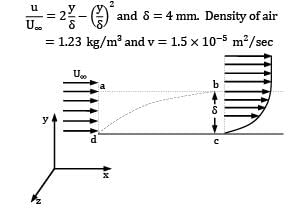
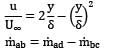
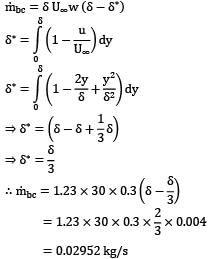
Air is flowing over a thin flat plate which is 1 m long and 0.3 m wide. At the leading edge, the flow is assumed to be uniform and U∞ = 30 m⁄s . The flow condition is independent of z (see Fig.). Using the control volume abcd, calculate the mass flow rate across the surface ab. (in kg/s, upto 3 decimal places). The velocity profile at bc is given by
Detailed Solution: Question 1
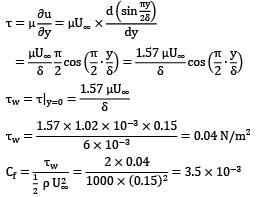
Water flows over a flat plate at a free stream velocity of 0.15 m/s. There is no pressure gradient and the laminar boundary layer is 6 mm thick. Assume a sinusoidal velocity profile
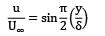
For the flow conditions stated above, calculate the skin friction coefficient. (upto 4 decimal places) [μ = 1.02 × 10⁻³kg/ms, ρ = 1000 kg/m3]
Detailed Solution: Question 2

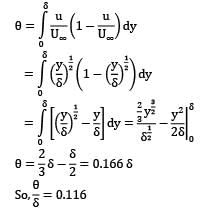
What is the ratio of momentum thickness to the boundary layer thickness δ when the layer velocity profile is given by

Where u is velocity at height y above surface and U∞ is free stream velocity of flow.
Detailed Solution: Question 3
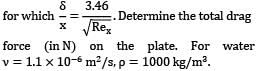
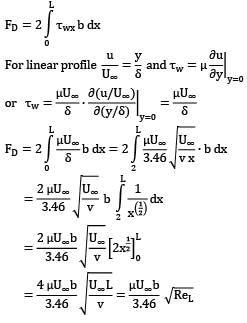
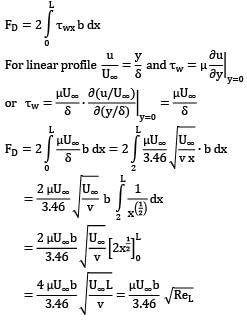
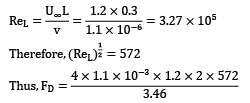
Water at 15°C flows over a flat plate at a speed of 1.2 m/s. The plate is 0.3 m long and 2 m wide. The boundary layer on each surface of the plane is laminar. Assume the velocity profile is approximated by a linear expression
Detailed Solution: Question 4
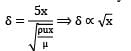
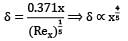
Consider the following statements pertaining to boundary layer on a flat plate
1. The thickness of laminar boundary layer at a distance x from the leading edge varies as x1⁄2
2. The thickness of turbulent boundary layer at a distance x from the leading edge varies as x4⁄5
3. Boundary layer is laminar when Reynolds number is less than 5 × 10⁵
Which of the above statements are correct?
Detailed Solution: Question 5
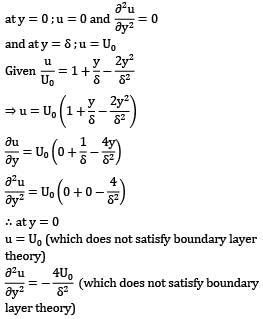
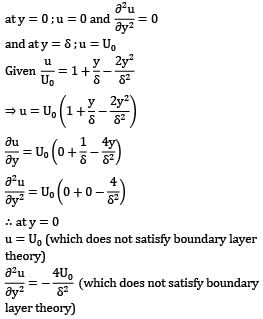
Examine whether or not the following velocity profiles satisfy the essential boundary conditions for velocity distribution in laminar boundary layer on a flat plate
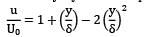
Where u is the velocity at height y above the surface, U0 is the free stream velocity and δ is the nominal boundary layer thickness.
Detailed Solution: Question 6
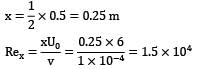
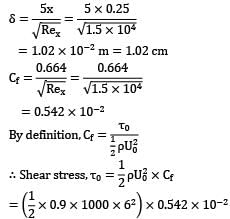
A plate 0.5 m × 0.2 m has been placed longitudinally in a stream of crude oil which flows with undisturbed velocity of 6 m⁄s.
Given that oil has a specific gravity 0.9 and kinematic viscosity 1 stroke, calculate the boundary layer thickness and shear stress at the middle of plate.
Detailed Solution: Question 7
What is the commonly used boundary layer control method to prevent separation?
Detailed Solution: Question 8
Which one of the following is correct? For flow of an ideal fluid over a cylinder, from the front stagnation point.
Detailed Solution: Question 9
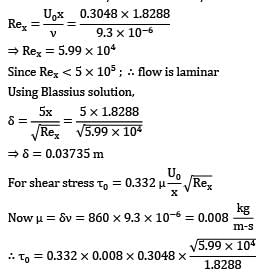
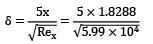
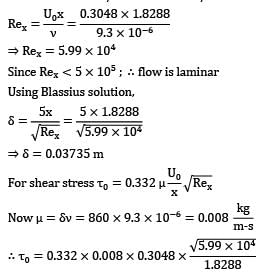
Crude oil at 21°C (ν = 9.3 × 10⁻⁶ m2 /s, S = 0.86) with a free-stream velocity of 0.3048 m/s flows past a thin, flat plate that is 1.2192 m wide and 1.8288 m long in a direction parallel to the flow. The flow is laminar. Determine the boundary-layer thickness and the wall shear stress at the trailing edge of the plate.
Detailed Solution: Question 10

|
56 videos|148 docs|75 tests
|
