UPSC Exam  >  UPSC Test  >  CSAT Preparation  >  Test: Calendars- 1 - UPSC MCQ

Calendars- 1 - UPSC Free MCQ Test with solutions


MCQ Practice Test & Solutions: Test: Calendars- 1 (10 Questions)

You can prepare effectively for UPSC CSAT Preparation with this dedicated MCQ Practice Test (available with solutions) on the important topic of "Test: Calendars- 1". These 10 questions have been designed by the experts with the latest curriculum of UPSC 2026, to help you master the concept.

Test Highlights:

  • - Format: Multiple Choice Questions (MCQ)
  • - Duration: 10 minutes
  • - Number of Questions: 10

Sign up on EduRev for free to attempt this test and track your preparation progress.

Test: Calendars- 1 - Question 1

If 15 March 1816 was Friday, what day of the week would 15th April 1916 be?

Detailed Solution: Question 1

We are given that 15th March 1816 was a Friday.

Now we know that 100 years have 5 odd days. So till 15th March 1916, we will be having 5 odd days. 

So if we move from 15th March 1816 to 15th March 1916, we will encounter 5 odd days.

Now from 15th March 1916 to 15th April 1916 there would be 3 odd days.

So total number of odd days = 5 + 3 = 8

8 mod 7 = 1

So 15th April 1916 would be Friday + 1 = Saturday

Test: Calendars- 1 - Question 2

A year 1991 is having a same calendar as that of the year X. Which of the following is a possible valueof X.

Detailed Solution: Question 2
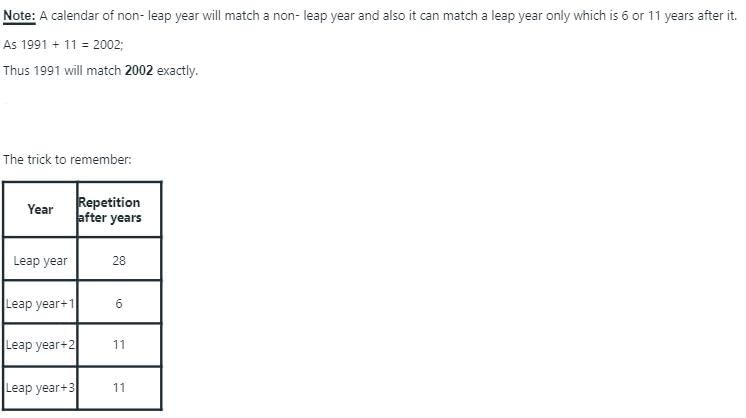
Test: Calendars- 1 - Question 3

If 28th August 1946 was a Wednesday, what day of the week was 31 August 1961?

Detailed Solution: Question 3

It is given that 28th August 1946 was Wednesday.

From 28th August 1946 to 28th August 1961, we have 4 leap years and 11 normal years.

So the number of odd days would be 11*1 + 4*2 = 19

Now the date which is asked is 31 Aug 1961. So if we move from 28th August to 31st August, we will have 3 more odd days.

So total number of odd days = 5 + 3 = 8

Now 8 mod 7 = 1 .

So 31st August 1961 would be Wednesday + 1 = Thursday.

Test: Calendars- 1 - Question 4

If 09/12/2001 (DD/MM/YYYY) happens to be Sunday, then 09/12/1971 would have been a

Detailed Solution: Question 4

Option B - Thursday.

There are 30 years between the two dates.

The leap years from 1972 to 2000 inclusive are 1972, 1976, 1980, 1984, 1988, 1992, 1996, 2000; total 8 leap years.

Number of ordinary years = 22.

Total odd days = 22 × 1 + 8 × 2 = 22 + 16 = 38, and 38 ≡ 3 (mod 7) odd days.

A span of 3 odd days advances the weekday by 3 days; therefore the earlier date is 3 days before the later weekday. Given the later date is Sunday, the earlier weekday is Sunday - 3 days = Thursday.

Hence the required day is Thursday (Option B).

Test: Calendars- 1 - Question 5

In 2016, Mohan celebrated his birthday on Friday. Which will be the first year after 2016 when Mohan will celebrate his birthday on a Wednesday? (He was not born in January or February)

Detailed Solution: Question 5

Since it has been mentioned that Mohan was not born in February, so he can’t be born on 29th Feb.

Hence He will celebrate his next birthday on a Wednesday in the year for which the sum of the odd days becomes 5 or a multiple of 5.

By his birthday in 2017, there will be 1 odd day.

By his birthday in 2018, there will be 2 odd days.

By his birthday in 2019, there will be 3 odd days.

By his birthday in 2020, there will be 5 odd days, as 2020 is a leap year.

So in 2020 He will celebrate his birthday on Wednesday.

Test: Calendars- 1 - Question 6

If 10th May, 1997 was a Monday, what was the day on Oct 10, 2001?

Detailed Solution: Question 6

In this question, the reference point is May 10, 1997 and we need to find the number of odd days from May 10, 1997 up to Oct 10, 2001.

► Now, from May 11, 1997 - May 10, 1998 = 1 odd day
► May 11, 1998 - May 10, 1999 = 1 odd day
► May 11, 1999 - May 10, 2000 = 2 odd days (2000 was leap year)
► May 11, 2000 - May 10, 2001 = 1 odd day
► Thus, the total number of odd days up to May 10, 2001 = 5.
► The remaining 21 days of May will give 0 odd days.
► In June, we have 2 odd days; in July, 3 odd days; in August, 3 odd days; in September,2 odd days and up to 10th October, we have 3 odd days. Hence, total number of odd days = 18 i.e. 4 odd days.
Since, May 10, 1997 was a Monday, and then 4 days after Monday would be Friday. So, Oct 10, 2001 was Friday.

Test: Calendars- 1 - Question 7

Find the leap year?

Detailed Solution: Question 7

Remember the leap year rule:

  • Every year divisible by 4 is a leap year, if it is not a century.
  • Every 4th century is a leap year, but no other century is a leap year.
  • 800,1200 and 2000 comes in the category of 4th century (such as 400,800,1200,1600,2000 etc).

Hence, 800,1200 and 2000 are leap years.

Test: Calendars- 1 - Question 8

The century can end with:

Detailed Solution: Question 8

  • 100 years contain 5 odd days.
    ∴ Last day of 1st century is Friday.
  • 200 years contain (5 x 2) ≡ 3 odd days.
    ∴ Last day of 2nd century is Wednesday.
  • 300 years contain (5 x 3) = 15 ≡ 1 odd day.
    ∴ Last day of 3rd century is Monday.
  • 400 years contain 0 odd day.
    ∴ Last day of 4th century is Sunday.

This cycle is repeated.
∴ Last day of a century cannot be Tuesday or Thursday or Saturday.

Test: Calendars- 1 - Question 9

What was the day on February 9, 1979?

Detailed Solution: Question 9

  • We know that in 1600 years, there will be 0 odd days. And in the next 300 years, there will be 1 odd day.
  • From 1901 to 1978 we have 19 leap years and 59 non-leap years.
  • So, the total number of odd days up to 31st Dec. 1978 is 19 x 2 + 59 = 97. On dividing 97 by 7 we get 6 as the remainder, which is the total number of odd days in these years.
  • So, till 31st Dec. 1978 we have 1 + 6 = 7 odd days, which forms one complete week. Now, in 1979, we have 3 odd days in January, and 2 odd days in the month of February (up to 9th Feb).
  • So, the total odd days are 3 + 2 = 5.
  • Hence, 9th February 1979 was a Friday.

Test: Calendars- 1 - Question 10

Which calendar year will be same as the year 2008?

Detailed Solution: Question 10

For every 28 years, the calendars will same,
so the years 2008,2036 have the same calendar as 1980.

150 videos|303 docs|137 tests
Information about Test: Calendars- 1 Page
In this test you can find the Exam questions for Test: Calendars- 1 solved & explained in the simplest way possible. Besides giving Questions and answers for Test: Calendars- 1, EduRev gives you an ample number of Online tests for practice
150 videos|303 docs|137 tests
Download as PDF