JEE Exam  >  JEE Test  >  Chapter-wise Tests Main & Advanced  >  Test: Catalysis (Old NCERT) - JEE MCQ

Catalysis (Old NCERT) - Free MCQ Practice Test with solutions, JEE Chapter


MCQ Practice Test & Solutions: Test: Catalysis (Old NCERT) (10 Questions)

You can prepare effectively for JEE Chapter-wise Tests for JEE Main & Advanced with this dedicated MCQ Practice Test (available with solutions) on the important topic of "Test: Catalysis (Old NCERT)". These 10 questions have been designed by the experts with the latest curriculum of JEE 2026, to help you master the concept.

Test Highlights:

  • - Format: Multiple Choice Questions (MCQ)
  • - Duration: 15 minutes
  • - Number of Questions: 10

Sign up on EduRev for free to attempt this test and track your preparation progress.

Test: Catalysis (Old NCERT) - Question 1

A catalyst has no effect on

Detailed Solution: Question 1

In the presence of a catalyst, both the forward and reverse reaction rates will speed up equally, thereby allowing the system to reach equilibrium faster. However, it is very important to keep in mind that the addition of a catalyst has no effect whatsoever on the final equilibrium position of the reaction
A catalyst is not consumed in chemical reactions

Test: Catalysis (Old NCERT) - Question 2

When body temperature is high, doctors advice consumption of light food. This is because

Detailed Solution: Question 2

As the temperature increases, so does the rate of reaction. But very high temperatures denature enzymes.The enzyme activity gradually increases with temperature up to around 37oC, or body temperature.

Test: Catalysis (Old NCERT) - Question 3

In heterogenous catalysis of a gaseous reactants over solid catalyst

Detailed Solution: Question 3

The correct answer is Option A.
The reactant gases adsorb on the surface of the catalyst and reaction occurs on the surface itself.

Test: Catalysis (Old NCERT) - Question 4

Which one is not true about catalyst ?

Detailed Solution: Question 4

The correct answer is Option D.

The catalyst is unchanged chemically at the end of a reaction. During the reaction between the chemical intermediates and the reactants, the catalyst is regenerated.
The catalyst accelerated the reaction. A catalyst is a substance which speeds up a reaction but is chemically unchanged at the end of the reaction.
In a reversible reaction, the catalyst  does not alter the equilibrium position but increases the rate by decreasing activation energy and temperature.
A small amount of catalyst is often sufficient to bring about a large change in reaction. Catalytic action is a chemical reaction between the catalyst and a reactant, forming chemical intermediates that are able to react more readily with each other or with another reactant to form the desired end product.

Test: Catalysis (Old NCERT) - Question 5

Catalyst only

Detailed Solution: Question 5

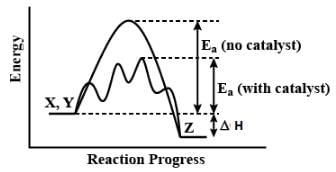
The Effect of Catalysts on the Activation Energy Barrier. Catalysts provide a new reaction pathway in which a lower A.E. is offered. A catalyst increases the rate of a reaction by lowering the activation energy so that more reactant molecules collide with enough energy to surmount the smaller energy barrier.

Test: Catalysis (Old NCERT) - Question 6

Which of the following is the best example of shape selective catalysis?

Detailed Solution: Question 6

The catalytic reaction that depends upon the structure of pores of the catalyst and the size of the reactant and product molecules is called shape/selective catalysis. Zeolites are good shape selective catalysts because of their honeycomb structure. 

Test: Catalysis (Old NCERT) - Question 7

Homogeneous catalyst is the one

Detailed Solution: Question 7

The correct answer is option C
Homogeneous catalysts are those which exist in the same phase (gas or liquid ) as the reactants, while heterogeneous catalysts are not in the same phase as the reactants. Typically, heterogeneous catalysis involves the use of solid catalysts placed in a liquid reaction mixture.

Test: Catalysis (Old NCERT) - Question 8

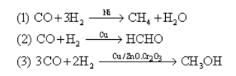
Study the following reactions.

Which characteristic of catalyst is represented by them.?

Detailed Solution: Question 8

Selectivity is the ability to direct the reaction to get a particular product. Here we change the catalyst and we obtain different products with reactant remaining the same.

Test: Catalysis (Old NCERT) - Question 9

In Rosenmund reduction, barium sulphate:

Detailed Solution: Question 9

The rosenmund reaction is catalyzed by palladium on barium sulfate. Barium sulfate reduces the activity of palladium due to its low surface area meaning it decreases the reducing power of palladium in order to prevent over-reduction of the acid.

Test: Catalysis (Old NCERT) - Question 10

Why are enzymes highly specific?

Detailed Solution: Question 10

The correct answer is Option B.

Enzymes are highly selective catalysts, meaning that each enzyme only speeds up a specific reaction. The molecules that an enzyme works with are called substrates. The substrates bind to a region on the enzyme called the active site. There are two theories explaining the enzyme-substrate interaction.
 

446 docs|929 tests
Information about Test: Catalysis (Old NCERT) Page
In this test you can find the Exam questions for Test: Catalysis (Old NCERT) solved & explained in the simplest way possible. Besides giving Questions and answers for Test: Catalysis (Old NCERT), EduRev gives you an ample number of Online tests for practice
Download as PDF