NEET Exam  >  NEET Test  >  Chemistry Class 12  >  Test : Chemistry Class 12 Mini Mock - 5 - NEET MCQ

Test : Chemistry Class 12 Mini Mock - 5 NEET MCQs & solutions - Free


Full Mock Test & Solutions: Test : Chemistry Class 12 Mini Mock - 5 (45 Questions)

You can boost your NEET 2026 exam preparation with this Test : Chemistry Class 12 Mini Mock - 5 (available with detailed solutions).. This mock test has been designed with the analysis of important topics, recent trends of the exam, and previous year questions of the last 3-years. All the questions have been designed to mirror the official pattern of NEET 2026 exam, helping you build speed, accuracy as per the actual exam.

Mock Test Highlights:

  • - Format: Multiple Choice Questions (MCQ)
  • - Duration: 45 minutes
  • - Total Questions: 45
  • - Analysis: Detailed Solutions & Performance Insights

Sign up on EduRev for free and get access to these mock tests, get your All India Rank, and identify your weak areas to improve your marks & rank in the actual exam.

Test : Chemistry Class 12 Mini Mock - 5 - Question 1

Which of the following is correct?

Detailed Solution: Question 1

a) Any aldehyde gives secondary alcohol on reduction

  • Aldehydes (RCHO) are reduced to primary alcohols (RCH₂OH) using reducing agents like NaBH₄ or LiAlH₄. Secondary alcohols are obtained from ketones, not aldehydes.
  • Incorrect.

b) Reaction of vegetable oil with H₂SO₄ gives glycerine

  • Vegetable oils are triglycerides. Hydrolysis (saponification) with a base (like NaOH) or enzymatic processes yields glycerine (glycerol) and fatty acids. H₂SO₄ is not typically used for this purpose; it may cause other reactions like sulfonation.
  • Incorrect.

c) C₂H₅OH, iodine with NaOH gives iodoform

  • The iodoform test requires a compound with a methyl ketone group (RCOCH₃) or a compound that can be oxidized to one, like ethanol (C₂H₅OH). Ethanol reacts with I₂ and NaOH to form iodoform (CHI₃) via oxidation to acetaldehyde and further reaction.
  • Correct.

d) Sucrose on reaction with NaCl gives invert sugar

  • Sucrose hydrolyzes to invert sugar (a mixture of glucose and fructose) under acidic conditions (e.g., with HCl) or enzymes (invertase). NaCl, a neutral salt, does not catalyze this reaction.
  • Incorrect.

Correct answer: c) C₂H₅OH, iodine with NaOH gives iodoform.

Test : Chemistry Class 12 Mini Mock - 5 - Question 2

The number of moles of oxygen in one litre of air containing 21% oxygen by volume, in standard conditions, is [1995]

Detailed Solution: Question 2
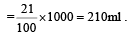
Percentage volume of oxygen = 21%. (Given)
∵ 100 ml of air contains = 21ml of O2
∴ Volume of oxygen in one litre of air

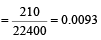
Therefore no. of moles 

(∵ volume of 1 litre of gas at S.T.P. is 22400 ml)

Test : Chemistry Class 12 Mini Mock - 5 - Question 3

Directions: In the following questions, A statement of Assertion (A) is followed by a statement of Reason (R). Mark the correct choice as.

Assertion (A): Aromatic 1° amines can be prepared by Gabriel Phthalimide synthesis.

Reason (R): Aryl halides do not undergo nucleophilic substitution with anion formed by phthalimide.

Detailed Solution: Question 3
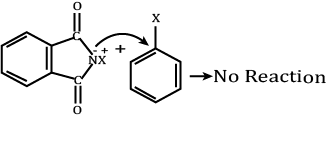
Aromatic primary amines cannot be prepared by Gabriel phthalimide synthesis as it  is used for the preparation of aliphatic primary amines and not aromatic primary amines.

When phthalimide is treated with aqueous or ethanolic potassium hydroxide, it forms its potassium salt. This salt, when heated with an alkyl halide and then subjected to alkaline hydrolysis, yields the corresponding primary amine.


Aromatic primary amines cannot be prepared by this method because aryl halides do not undergo nucleophilic substitution with the anion formed by phthalimide.


So, the assertion is wrong.
Reason: 
Aryl halides do not undergo nucleophilic substitution with anion formed by phthalimide.

So, the reason is wrong.

Hence, both assertion and reason are wrong.

Test : Chemistry Class 12 Mini Mock - 5 - Question 4

The correct IUPAC name of [Fe(C5H5)2] is

Detailed Solution: Question 4

The correct answer is option B.

The I.U.P.A.C. name for Fe(C5H5)2 is bis(η5 -cyclopentadienyl) iron(II) 
The oxidation state of iron is +2 and is written in parenthesis in roman numerals. Two cyclopentadienyl ligands are coordinated to Fe. The prefix bis indicates 2. η5 indicates that the cyclopentadienyl ligands are penta coordinates.

Test : Chemistry Class 12 Mini Mock - 5 - Question 5

Solid iodine is an example of

Detailed Solution: Question 5

 Solid iodine is a molecular solid.

Test : Chemistry Class 12 Mini Mock - 5 - Question 6

 Kohlrausch’s Law shows that:

Detailed Solution: Question 6

The correct answer is option A

Kohlrausch's law states that the equivalent conductivity of an electrolyte at infinite dilution is equal to the sum of the conductances of the anions and cations. If a salt is dissolved in water, the conductivity of the solution is the sum of the conductances of the anions and cations.
Hence, at infinite dilution the ionic conductivity of ions is additive.

Test : Chemistry Class 12 Mini Mock - 5 - Question 7

The reduction potential of an element A is -2.71V. What can be concluded from this?

Detailed Solution: Question 7

Reduction potential means to accept electrons to reduce oneself.
 A + e- → A- ∆Ereduction = +ve value
Since, the reduction potential is negative, it means that the reaction will reverse to make ∆E value +ve. So the reaction becomes,
A → A+ + e- 
This becomes oxidation of A. So oxidation of A will be easy. 

Test : Chemistry Class 12 Mini Mock - 5 - Question 8

 A foreign substance that increase the speed of a chemical reaction is called

Detailed Solution: Question 8

Catalyst: Substances which alter  the rate of a chemical reaction and themselves remain chemically and quantitatively unchanged  after the reaction are known as catalysts and the phenomenon is known as catalysis.

Test : Chemistry Class 12 Mini Mock - 5 - Question 9

Which of the following statement is not correct? [2001]

Detailed Solution: Question 9

La (OH)3 is more basic than Li (OH)3. In lanthanides the basic character of hydroxides decreases as the ionic radius decreases.

Test : Chemistry Class 12 Mini Mock - 5 - Question 10

Which among the following is an example of photochemistry used in our daily life?

Detailed Solution: Question 10

Photography is an example of photochemistry used in our daily life.

Test : Chemistry Class 12 Mini Mock - 5 - Question 11

Which base is present in RNA but not in DNA?

Detailed Solution: Question 11

In DNA, four bases have been found. They are adenine (A), guanine (G), cytosine (C) and thymine (T). The first three of these bases are found in RNA also but the fourth is uracil (U). RNA contains cytosine and uracil as pyrimidine bases while DNA has cytosine and thymine. Both have the same purine bases i.e. guanine and adenine.

Test : Chemistry Class 12 Mini Mock - 5 - Question 12

Only One Option Correct Type

This section contains multiple choice questions. Each question has four choices (a), (b), (c) and (d), out of which ONLY ONE is correct.

Q.

Cl2 gas is passed into a solution containing KF, Kl and KBr, and CHCI3 is added. There is a colour in CHCI3 (lower) layer. It is due to 

Detailed Solution: Question 12
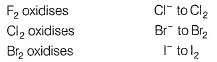
Based on electro chemical series, oxidising power of
F2 > Cl2 > Br2 > I2

On passing Cl2 in to a solution containing KF, Kl and KBr,
2KBr + Cl2 → 2KCI + Br2 (orange)
2KI + Cl→ 2KCI + l2 (violet)
2KI + Br2 → 2KBr + l2 (violet)
Br2 formed also oxidises Kl to l2 (violet)

Test : Chemistry Class 12 Mini Mock - 5 - Question 13

Which of the following is a tertiary halogenoalkanes?

Detailed Solution: Question 13

The carbon with which the Br is bonded with another 3 carbon atoms. So haloalkane is Tertiary Haloalkane.

Test : Chemistry Class 12 Mini Mock - 5 - Question 14

For an endothermic reaction, energy of activation is Ea and enthalpy of reaction of ΔH (both of these in kJ/mol). Minimum value of Ea will be. [2010]

Detailed Solution: Question 14
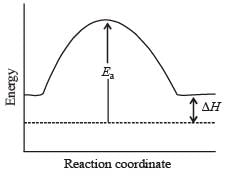
Ea  >  ΔH

Test : Chemistry Class 12 Mini Mock - 5 - Question 15

What is the correct increasing order of reactivity of the following in the SN2 reaction?

Detailed Solution: Question 15

 (IV) is most reactive as it is benzylic as well as electron withdrawing effect of — NO2 further increases the reactivity. (Ill) is least reactive due to resonance effect resulting in partial double bond character between carbon and chlorine. (I) is less reactive in SN2 reaction than II, due to greater steric hindrance in (I).

Test : Chemistry Class 12 Mini Mock - 5 - Question 16

The CFSE for octahedral [CoCI6]4- is 18000 cm-1. Then the CFSE for tetrahedral [CoCI4]2- will be

Detailed Solution: Question 16

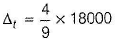
CFSE for [CoCI4]2- will be 
i.e.  = 8000cm-1

Test : Chemistry Class 12 Mini Mock - 5 - Question 17

Arrange the following alcohols, hydrocarbon and ether in order of their increasing boiling points Pentan – 1 – ol, n – butane, pentanal, ethoxyethane.

Detailed Solution: Question 17

Alcohols have higher boiling points than aldehydes.

Test : Chemistry Class 12 Mini Mock - 5 - Question 18

The element used in the production of photocells and solar cells and also used in xerox machines is

Detailed Solution: Question 18

Se is non-conductor in dark but acts as conductor when exposed to light.

Test : Chemistry Class 12 Mini Mock - 5 - Question 19

The best method for the separation of naphthalene and benzoic acid from their mixture is

Detailed Solution: Question 19

The best method for the separation of naphthalene and benzoic acid from their mixture is sublimation because it is applicable for those organic compounds which pass directly from solid to vapour state on heating and vice versa on cooling.
In these compounds naphthalene is volatile and benzoic acid is non-volatile due to the formation of dimer via hydrogen bonding (intermolecular).

Test : Chemistry Class 12 Mini Mock - 5 - Question 20

Ketones are reduced to the corresponding alcohols by catalytic hydrogenation to form

Detailed Solution: Question 20

  • Ketones are organic compounds featuring a carbonyl group (C=O) bonded to two carbon atoms.
  • During catalytic hydrogenation, the carbonyl group is reduced, adding hydrogen atoms.
  • This process converts the ketone to an alcohol.
  • The carbonyl carbon in a ketone is attached to two carbon groups, resulting in a secondary alcohol upon reduction.
  • Therefore, the reduction of ketones yields secondary alcohols.
  • Option A: secondary alcohols is the correct answer.

Test : Chemistry Class 12 Mini Mock - 5 - Question 21

Which of the following fertilizers has the highest nitrogen percentage ? [1993]

Detailed Solution: Question 21

Urea (46.6%N). % of N in other compound are : ( NH4)2 SO4 = 21.2%; CaCN2 = 35.0% and NH4 NO3 = 35.0%

Test : Chemistry Class 12 Mini Mock - 5 - Question 22

General electronic configuration of lanthanides is[2002]

Detailed Solution: Question 22

The Lanthanides are transition metals from Atomic numbers 58 (Ce) to 71(Lu).
Hence the electron configulation becomes : (n –2) f 1– 14 (n – 1) s2p6 d0 – 1 ns2.

Test : Chemistry Class 12 Mini Mock - 5 - Question 23

The relative lowering of the vapour pressure is equal to the ratio between the number of [1991]

Detailed Solution: Question 23

According to Raoult's law, the relative lowering in vapour pressure of a dilute solution is equal to the mole fraction of the solute present in the solution.

 mole fraction of solute

Test : Chemistry Class 12 Mini Mock - 5 - Question 24

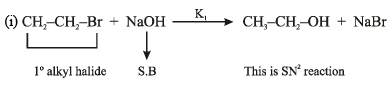
(i) CH3 – CH2 – Br + NaOH  CH3 – CH2 – OH + NaBr → reaction ... (i)

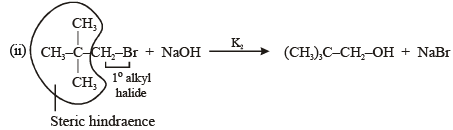
(ii)  + NaOH  (CH3)C – CH2 – OH + NaBr → reaction ... (ii)
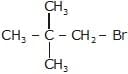
K1 & K2 are rate constant for above reaction correct relation is

Detailed Solution: Question 24


This reaction is not proceed in forward direction.

Test : Chemistry Class 12 Mini Mock - 5 - Question 25

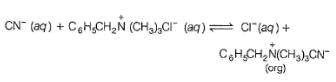
In the following two phase reaction, catalyst works by

C6H5CH2Br + KCN  C6H5CH2CN + KBr
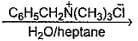
Detailed Solution: Question 25

By the following equilibrium

Cyanide ion is transferred to organic phase otherwise KCN is insoluble in organic solvents.

Test : Chemistry Class 12 Mini Mock - 5 - Question 26

The rate of formation of NO(g) in the reaction, 2NOBr(g) → 2NO(g) + Br2(g) was reported as 1.6 x 10⁻⁴ Ms-1. Thus, rate of the reaction is 

Detailed Solution: Question 26
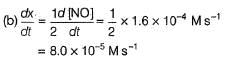
*Multiple options can be correct
Test : Chemistry Class 12 Mini Mock - 5 - Question 27

Which one of the following  arrangements does not give the correct picture of the trends indicated against it ? [2008]

Detailed Solution: Question 27

From the given options we find option (a) is correct. The oxidising power of halogens follow the order F2 > Cl2 > Br2 > I2 . Option (b) is incorrect because it in not the correct order of electron gain enthalpy of halogens. The correct order is Cl2 > F2 > Br2 > I2 . The low value of F2 than Cl2 is due to its small size. Option (c) is incorrect. The correct order of bond dissociation energies of halogens is Cl2 > Br2 > F2 > I2 . Option (d) is correct. It is the correct order of electronegativity values of halogens. Thus option (b) and (c) are incorrect.

Test : Chemistry Class 12 Mini Mock - 5 - Question 28

Harmful UV radiations emitted from the sun are prevented from reaching the earth by the presence of ozone in the

Detailed Solution: Question 28

Stratosphere layer strongly absorb harmful UV-radiations (λ. 255 nm).

Test : Chemistry Class 12 Mini Mock - 5 - Question 29

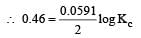
The equilibrium constant of the reaction:

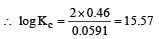
E° = 0.46 V at 298 K is [2007]

Detailed Solution: Question 29
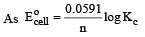
or  Kc = Antilog 15.57 = 3.7 × 10¹⁵ ≈ 4 × 10¹⁵

Test : Chemistry Class 12 Mini Mock - 5 - Question 30

Which of the following is a negative ligand?

Detailed Solution: Question 30

The cyclopentadienyl ligand, C5H5-, is a negative ligand commonly used in organometallic chemistry. It is notably found in the compound ferrocene.

This makes option B the correct answer.

View more questions
54 videos|290 docs|74 tests
Information about Test : Chemistry Class 12 Mini Mock - 5 Page
In this test you can find the Exam questions for Test : Chemistry Class 12 Mini Mock - 5 solved & explained in the simplest way possible. Besides giving Questions and answers for Test : Chemistry Class 12 Mini Mock - 5, EduRev gives you an ample number of Online tests for practice
54 videos|290 docs|74 tests
Download as PDF