NEET Exam  >  NEET Test  >  Topic-wise MCQ Tests  >  Test: Classification Systems (NCERT) - NEET MCQ

Classification Systems (NCERT) - Free MCQ Practice Test with solutions,


MCQ Practice Test & Solutions: Test: Classification Systems (NCERT) (15 Questions)

You can prepare effectively for NEET Topic-wise MCQ Tests for NEET with this dedicated MCQ Practice Test (available with solutions) on the important topic of "Test: Classification Systems (NCERT)". These 15 questions have been designed by the experts with the latest curriculum of NEET 2026, to help you master the concept.

Test Highlights:

  • - Format: Multiple Choice Questions (MCQ)
  • - Duration: 15 minutes
  • - Number of Questions: 15

Sign up on EduRev for free to attempt this test and track your preparation progress.

Test: Classification Systems (NCERT) - Question 1

Select the incorrect pair.

Detailed Solution: Question 1

Numerical Taxonomy which is now easily carried out using computers is based on all observable characteristics. Number and codes are assigned to all the characters and the data are then processed. In this way each character is given equal importance and at the same time hundreds of characters can be considered. Cytotaxonomy that is based on cytological information like chromosome number, structure, behaviour and chemotaxonomy that uses the chemical constituents of the plant to resolve confusions, are also used by taxonomists these days.

Topic in NCERT: Cytotaxonomy and Chemotaxonomy in Taxonomy

Line in NCERT: "Cytotaxonomy that is based on cytological information like chromosome number, structure, behaviour and chemotaxonomy that uses the chemical constituents of the plant to resolve confusions, are also used by taxonomists these days."

Test: Classification Systems (NCERT) - Question 2

______ systems of classification were based on natural affinities among the organisms.

Detailed Solution: Question 2

natural classification systems developed, which were based on natural affinities among the organisms and consider, not only the external features, but also internal features, like ultrastructure, anatomy, embryology and phytochemistry. Such a classification for flowering plants was given by George Bentham and Joseph Dalton Hooker.

Topic in NCERT: Classification Systems in Biology

Line in NCERT: "As against this, natural classification systems developed, which were based on natural affinities among the organisms and consider, not only the external features, but also internal features, like ultra-structure, anatomy, embryology and phytochemistry."

Test: Classification Systems (NCERT) - Question 3

Given below are three statements each with one blank. Select the option which correctly fill up the blanks in two statements

(i) _______ systems gave equal weightage to vegetative and sexual characteristics.

(ii) Number and codes are assigned to all the characters and the data are then processed in _______ taxonomy.

(iii) ________ systems assume that organisms belonging to the same taxa have a common ancestor.

Detailed Solution: Question 3

To solve the given question, the correct answer is:
 (i) - Artificial (iii) - Phylogenetic
The blank in the first statement refers to systems that assign equal weight to vegetative and sexual characteristics, which aligns with the concept of artificial systems in taxonomy. The third statement suggests systems that assume organisms within the same taxa share a common ancestor, which best fits the idea of phylogenetic systems.

Topic in NCERT: Classification Systems in Biology
Line in NCERT: "Such systems were artificial; they separated the closely related species since they were based on a few characteristics. Also, the artificial systems gave equal weightage to vegetative and sexual characteristics; this is not acceptable since we know that often the vegetative characters are more easily affected by environment." "Number and codes are assigned to all the characters and the data are then processed." "This assumes that organisms belonging to the same taxa have a common ancestor."

Test: Classification Systems (NCERT) - Question 4

Match each item in Column I with one in Column II and select the correct match as your answer from the coders given:
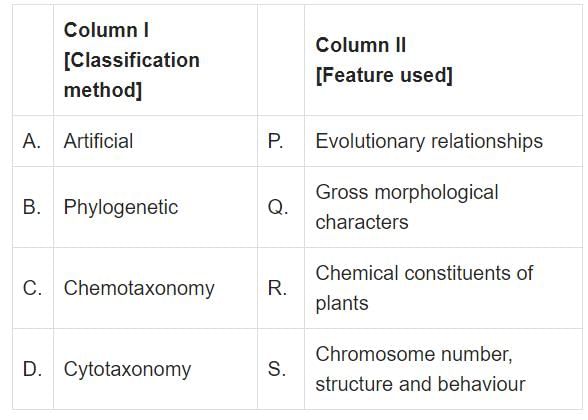
Detailed Solution: Question 4

A. Artificial - Q. Gross morphological characters
Artificial classification systems use easily observable characteristics for classification, which are primarily gross morphological characters.

B. Phylogenetic - P. Evolutionary relationships
Phylogenetic classification is based on evolutionary relationships among organisms.

C. Chemotaxonomy - R. Chemical constituents of plants
Chemotaxonomy involves the classification of organisms based on their chemical constituents, such as specific compounds found in plants.

D. Cytotaxonomy - S. Chromosome number, structure, and behavior
Cytotaxonomy uses chromosome number, structure, and behavior as features for classification.

So, the correct answer is: 1. A - Q, B - P, C - R, D - S

Test: Classification Systems (NCERT) - Question 5

Numerical Taxonomy

Detailed Solution: Question 5

To explain the concept of Numerical Taxonomy based on the provided options:
Carried out using computers: Numerical Taxonomy is a method that involves the classification of organisms based on quantitative measurements of their observable characteristics. Using computers streamlines the analysis of vast amounts of data efficiently.
Based on all observable characteristics: Numerical Taxonomy considers all available observable traits or characteristics of organisms for classification, allowing for a comprehensive analysis.
Number and codes assigned to all the characters: In this method, each observable characteristic is assigned a numerical code, facilitating data organization and comparison.
Therefore, the correct answer "All of these (D)" encompasses the essence of Numerical Taxonomy, involving computer-based analysis, consideration of all observable characteristics, and the assignment of numerical codes to each characteristic.

Topic in NCERT: Numerical Taxonomy
Line in NCERT: "Numerical Taxonomy which is now easily carried out using computers is based on all observable characteristics. Number and codes are assigned to all the characters and the data are then processed."

Test: Classification Systems (NCERT) - Question 6

Cytotaxonomy is 

Detailed Solution: Question 6

  • Cytotaxonomy integrates cytological information
  • Chromosome number, structure, and behavior are crucial
  • Chromosome number aids in species identification.
  • Chromosome structure reveals genetic relationships.
  • Chromosome behavior during cell division offers insights.                                                                                         

Option D is correct (All of these)

Topic in NCERT: Cytotaxonomy and Chemotaxonomy in Taxonomy

Line in NCERT: "Cytotaxonomy that is based on cytological information like chromosome number, structure, behaviour and chemotaxonomy that uses the chemical constituents of the plant to resolve confusions, are also used by taxonomists these days."

Test: Classification Systems (NCERT) - Question 7

Each character is given equal importance and at the same time hundreds of characters can be considered in 

Detailed Solution: Question 7

Numerical taxonomy evaluates resemblances and differences or primitiveness and advancement through statistical methods based on a large number of characters obtained from all disciplines of biology. This is followed by assigning them number and code of computer like plus (+) minus (-) followed by computer analysis.

Topic in NCERT: Numerical Taxonomy

Line in NCERT: "Numerical Taxonomy which is now easily carried out using computers is based on all observable characteristics. Number and codes are assigned to all the characters and the data are then processed. In this way each character is given equal importance and at the same time hundreds of characters can be considered."

Test: Classification Systems (NCERT) - Question 8

What is the basis of modern phylogenetic classification systems?

Detailed Solution: Question 8

Modern phylogenetic classification systems are based on evolutionary relationships between organisms, assuming that organisms within the same taxa have a common ancestor.

Topic in NCERT: PLANT KINGDOM

Line in NCERT: "At present phylogenetic classification systems based on evolutionary relationships between the various organisms are acceptable."

Test: Classification Systems (NCERT) - Question 9

Which among the following is incorrect about artificial classification of plantae kingdom?

Detailed Solution: Question 9

Answer: c
The earliest systems of classification used only gross superficial morphological characters such as habit, colour, number and shape of leaves, etc. They were based mainly on vegetative characters or on the androecium structure (system given by Linnaeus). Such systems were artificial; they separated the closely related species since they were based on a few characteristics. Also, the artificial systems gave equal weightage to vegetative and sexual characteristics; this is not acceptable since we know that often the vegetative characters are more easily affected by environment.

Test: Classification Systems (NCERT) - Question 10

In numerical taxonomy:

I:computers are used and all the observable characters are taken into consideration.

II:hundreds of characters can be considered together and each character is given equal importance.

Detailed Solution: Question 10

In numerical taxonomy:
- I: Computers are used, considering all observable characters.
- II: Considers hundreds of characters equally.
- Correct answer: C: Both I and II are correct.
- I: Computers help process vast data efficiently.
- II: Equal weight ensures fair representation of all characters.
This method aids in accurate classification by leveraging technology for comprehensive analysis while ensuring fair treatment of individual traits.

Topic in NCERT: Numerical Taxonomy

Line in NCERT: "Numerical Taxonomy which is now easily carried out using computers is based on all observable characteristics. Number and codes are assigned to all the characters and the data are then processed. In this way each character is given equal importance and at the same time hundreds of characters can be considered."

Test: Classification Systems (NCERT) - Question 11

Artificial systems of classification were based upon

Detailed Solution: Question 11

Artificial systems of classification were based upon morphological characters (such as habit, habitat, colour, number and shape of leaves, etc.) for grouping of organisms, They were mainly based on vegetative characters or on the androecium structure. These systems separated the closely related species since they were based only on a few characteristics. This was not acceptable because vegetative characters are more easily affected by environment.

Topic in NCERT: Classification Systems in Biology

Line in NCERT: "the earliest systems of classification used only gross superficial morphological characters such as habit, colour, number and shape of leaves, etc. They were based mainly on vegetative characters or on the androecium structure (system given by Linnaeus). Such systems were artificial; they separated the closely related species since they were based on a few characteristics."

Test: Classification Systems (NCERT) - Question 12

Natural system of classification differs from artificial system in

Detailed Solution: Question 12

The earliest systems of classification used only gross superficial morphological characters such as habit, colour, number and shape of leaves, etc. They were based mainly on vegetative characters or on the androecium structure (system given by Linnaeus). Such systems were artificial; they separated the closely related species since they were based on a few characteristics. Also, the artificial systems gave equal weightage to vegetative and sexual characteristics; this is not acceptable since we know that often the vegetative characters are more easily affected by environment. As against this, natural classification systems developed, which were based on natural affinities among the organisms and consider, not only the external features, but also internal features, like ultrastructure, anatomy, embryology and phytochemistry. Such a classification for flowering plants was given by George Bentham and Joseph Dalton Hooker.

Topic in NCERT: NATURAL CLASSIFICATION SYSTEMS

Line in NCERT: "As against this, natural classification systems developed, which were based on natural affinities among the organisms and consider not only the external features, but also internal features, like ultra-structure, anatomy, embryology and phytochemistry."

Test: Classification Systems (NCERT) - Question 13

Why were the earliest classification systems considered artificial?

Detailed Solution: Question 13

The earliest systems of classification used only gross superficial morphological characters such as habit, colour, number and shape of leaves, etc. They were based mainly on vegetative characters or on the androecium structure (system given by Linnaeus). Such systems were artificial; they separated the closely related species since they were based on a few characteristics.

Topic in NCERT: CLASSIFICATION SYSTEMS IN BIOLOGY

Line in NCERT: "Such systems were artificial; they separated the closely related species since they were based on a few characteristics."

Test: Classification Systems (NCERT) - Question 14

 Artificial classification of plant kingdom is based on _______

Detailed Solution: Question 14

Artificial classification is based on morphological structures of the plant i.e. artificial classification focuses on external structure of the plants than their internal structure.
Hence the correct option is "A"

Topic in NCERT: Classification Systems in Biology

Line in NCERT: "the earliest systems of classification used only gross superficial morphological characters such as habit, colour, number and shape of leaves, etc."

Test: Classification Systems (NCERT) - Question 15

Both external and internal featuresin the natural classification systems developed by whom for flowering plants?

Detailed Solution: Question 15

 natural classification systems developed, which were based on natural affinities among the organisms and consider,not only the external features, but also internal features, like ultrastructure, anatomy, embryology and phytochemistry. Such a classification for flowering plants was given by George Bentham and Joseph Dalton Hooker.

Topic in NCERT: Classification of Flowering Plants

Line in NCERT: "Such a classification for flowering plants was given by George Bentham and Joseph Dalton Hooker."

6 docs|803 tests
Information about Test: Classification Systems (NCERT) Page
In this test you can find the Exam questions for Test: Classification Systems (NCERT) solved & explained in the simplest way possible. Besides giving Questions and answers for Test: Classification Systems (NCERT), EduRev gives you an ample number of Online tests for practice
Download as PDF