
Colligative Properties (Osmotic Pressure) - Free MCQ Practice Test
MCQ Practice Test & Solutions: Test: Colligative Properties (Osmotic Pressure) (20 Questions)
You can prepare effectively for JEE Chapter-wise Tests for JEE Main & Advanced with this dedicated MCQ Practice Test (available with solutions) on the important topic of "Test: Colligative Properties (Osmotic Pressure)". These 20 questions have been designed by the experts with the latest curriculum of JEE 2026, to help you master the concept.
Test Highlights:
- - Format: Multiple Choice Questions (MCQ)
- - Duration: 30 minutes
- - Number of Questions: 20
Sign up on EduRev for free to attempt this test and track your preparation progress.

Only One Option Correct Type
This section contains 17 multiple choice questions. Each question has four choices (a), (b), (c) and (d), out of which ONLY ONE is correct
Q. Osmosis is involved in one or more processes.
I. Excretion of urine
II. Reverse osmosis
III. Evaporation
IV. Interchange of nutrients and waste products between tissue cells and their surroundings.
Select the correct processes.
This section contains 17 multiple choice questions. Each question has four choices (a), (b), (c) and (d), out of which ONLY ONE is correct
Q. Osmosis is involved in one or more processes.
I. Excretion of urine
II. Reverse osmosis
III. Evaporation
IV. Interchange of nutrients and waste products between tissue cells and their surroundings.
Select the correct processes.
Detailed Solution: Question 1
Osmotic pressure of insulin solution at 298 K is found to be 0.0072 atm at 298 K. Hence, height of water column due to this pressure is (density of mercury = 13.6 g mL-1)
Detailed Solution: Question 2

Which has maximum osmotic pressure at temperature T K?
Detailed Solution: Question 3
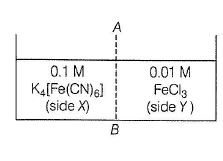
There is formation of Prussian blue when Fe3+ reacts with [Fe(CN)6]4-. Two solutions as shown are separated by a semipermeable membrane AB. Due to osmosis, there is
Detailed Solution: Question 4
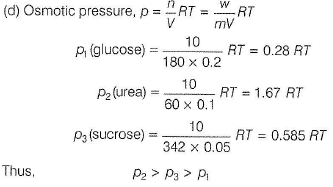
Three solutions of following in water are isothermal conditions as given:
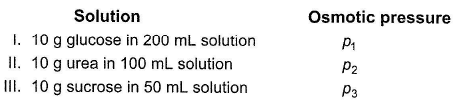
Thus,
Detailed Solution: Question 5
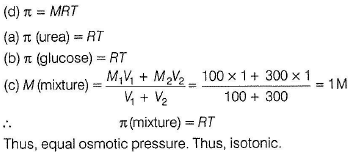
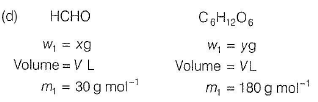
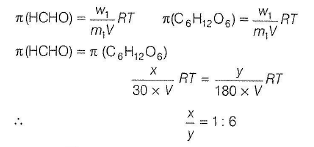
What will be the ratio of the masses of formalin (HCHO) and glucose (C6H1206) contained in equal volumes of solutions having the same osmotic pressure at the given temperature?
Detailed Solution: Question 6
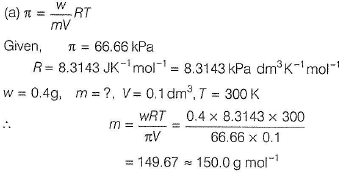
A solution containing 0.4 g of a non-volatile solute in 0.1 dm3 of the solution exerts an osmotic pressure of 66.66 kPa at 300 K. Thus, molar mass of the solute is
Detailed Solution: Question 7
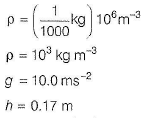
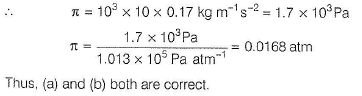
For a dilute aqueous solution, density is 1 .00 g cm3 and g (acceleration due to gravity) is 10.0 ms-2. Then, osmotic pressure set up at highest of 0.17 m is
Detailed Solution: Question 8
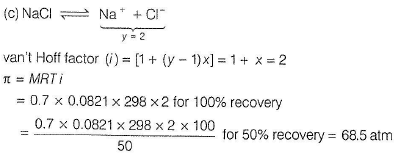
Sea water is approximately 0.70 M in NaCI. It can be desalinated by reverse osmosis. For 50% recovery, additional osmotic pressure required (on sea water side) at 298 K is
Detailed Solution: Question 9
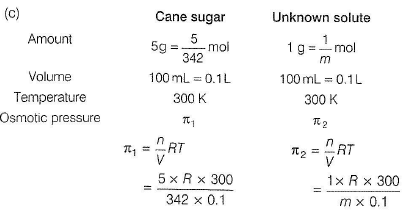
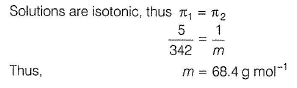
A 5% solution of cane sugar (molar mass = 342 g mol-1) is isotonic with 1 % of a solution of an unknown non-electrolyte solute at 300 K. The molar mass of unknown solute is (in g mol-1) [Aieee 2011]
Detailed Solution: Question 10
5.25% solution of a substance is isotonic with a 21 .5% solution of urea (NH2CONH2 )by weight of solution in the same solvent at 300 K. If the densities of both the solutions are assumed to be equal to 1.0 g cm-3 then, molar mass of the substance will be
Detailed Solution: Question 11
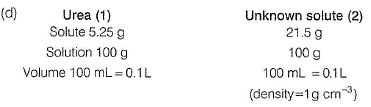
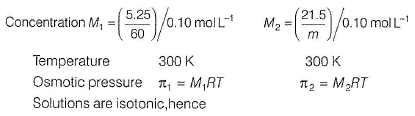
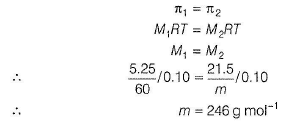
Freezing point of a biological fluid is - 0.56° C in aqueous solution.Kf (H20) = 1 .86° mol-1 kg. Thus, its osmotic pressure at 310 K is (assume molarity = molality)
Detailed Solution: Question 12
 mol kg-1
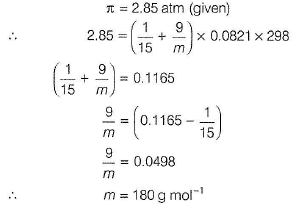
100 mL of a solution containing 0.4 g urea (NH2CONH2 and 0.9 g of another substance (X ) shows an osmotic pressure of 2.85 atm at 25° C. Molar mass of the substance (X)is
Detailed Solution: Question 13
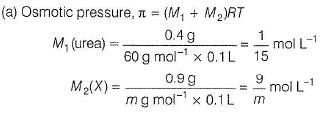
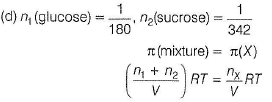
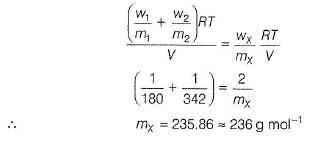
A solution containing 1 g of glucose and 1 g of sucrose in 1 L solution is found to be isotonic with a solution containing 2 g of another unknown solute (X) in 1 L solution at 300 K. Thus, molar mass of the solute X is
Detailed Solution: Question 14
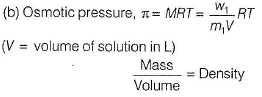
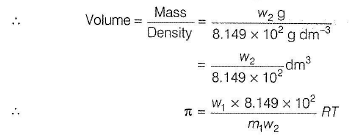
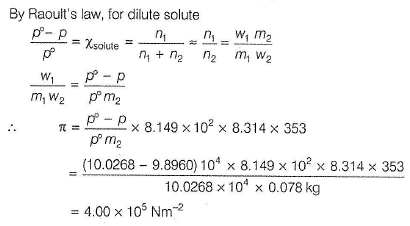
The vapour pressure of pure benzene at 353 K is 10.0268 x 10⁴ Nm-2 and that of a solution containing non-volatile solute in benzene is 9.8960 x 10⁴ Nm-2. (d of benzene = 8.149 x 10² g dm-3). Thus, osmotic pressure of the solution is
Detailed Solution: Question 15
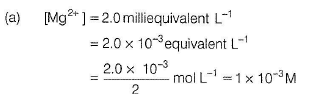
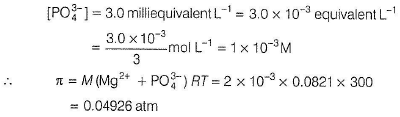
Blood plasma has following composition,
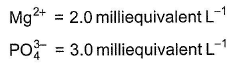
and other ions. What is the osmotic pressure set up at 300 K due to Mg2+and  ions?
ions?
ions?Detailed Solution: Question 16
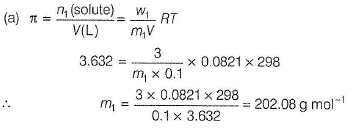
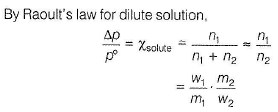
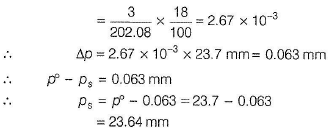
Osmotic pressure of 3% aqueous solution of a non-volatile, non-electrolyte solute A at 25° C is 3.632 atm. Thus, its vapour pressure is (  at 25° C is 23.7 mm) (assume dilute solution)
at 25° C is 23.7 mm) (assume dilute solution)Detailed Solution: Question 17
Statement Type
This section is based on Statement I and Statement II. Select the correct anser from the codes given below
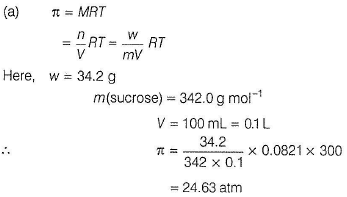
Q. Statement I : Osmotic pressure of 34.2% sucrose solution at 300 K is 30.0 atm.
Statement II : π = MRT is valid for dilute solution.
This section is based on Statement I and Statement II. Select the correct anser from the codes given below
Q. Statement I : Osmotic pressure of 34.2% sucrose solution at 300 K is 30.0 atm.
Statement II : π = MRT is valid for dilute solution.
Detailed Solution: Question 18
Matching List Type
Choices for the correct combination of elements from Column I and Column II are given as options (a), (b), (c) and (d), out of which one is correct
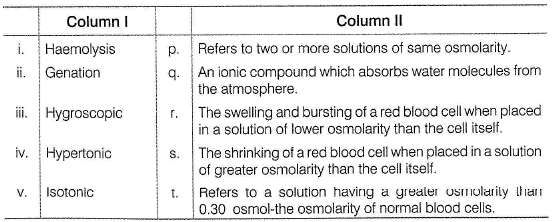
Q. Match the terms in Column I with the corresponding definition in Column II and select the answer from the codes given below.

Choices for the correct combination of elements from Column I and Column II are given as options (a), (b), (c) and (d), out of which one is correct
Q. Match the terms in Column I with the corresponding definition in Column II and select the answer from the codes given below.
Detailed Solution: Question 19
Comprehension Type
This section contains a passage describing theory, experiments, data, etc. Two questions related to the paragraph have been given. Each question has only one correct answer out of the given 4 options (a), (b), (c) and (d)
Passage
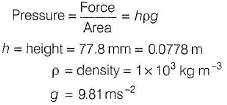
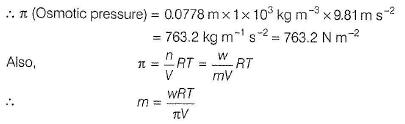
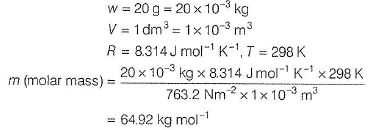
Consider the following arrangement in which a solution containing 20 g of haemoglobin in 1 L of the solution is placed in the right compartment and pure water is placed in the left compartment. At equilibrium, the height of the water in the right column is 77.8 mm in excess of the height of the solution in the left column at 298 K.
Q. Osmotic pressure of the solution is
This section contains a passage describing theory, experiments, data, etc. Two questions related to the paragraph have been given. Each question has only one correct answer out of the given 4 options (a), (b), (c) and (d)
Detailed Solution: Question 20
446 docs|929 tests |
