
Colligative Properties and Abnormal Molecular Masses - Free MCQ Practice
MCQ Practice Test & Solutions: Test: Colligative Properties and Abnormal Molecular Masses (15 Questions)
You can prepare effectively for JEE Chemistry for JEE Main & Advanced with this dedicated MCQ Practice Test (available with solutions) on the important topic of "Test: Colligative Properties and Abnormal Molecular Masses". These 15 questions have been designed by the experts with the latest curriculum of JEE 2026, to help you master the concept.
Test Highlights:
- - Format: Multiple Choice Questions (MCQ)
- - Duration: 20 minutes
- - Number of Questions: 15
Sign up on EduRev for free to attempt this test and track your preparation progress.

What is the van't Hoff factor of Ferric Sulphate (Assume  ionization)
ionization)Detailed Solution: Question 1

 (complete ionization)
 Relative lowering of vapour pressure is directly proportional to
Detailed Solution: Question 2

When common salt is dissolved in water:
Detailed Solution: Question 3
Camphor is used as solvent to determine the molecular mass of non-volatile solute by Rast method because for camphor
Detailed Solution: Question 4
 of an aqueous solution of a protein contains its
  . The osmotic pressure of this solution at
  is found to be
  bar. The molar mass of protein will be
Detailed Solution: Question 5




The difference between the boiling point and freezing point of an aqueous solution containing sucrose (molecular 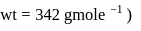 in
in  of water is
  . If
. If  and
and  of water are
  and
and  respectively, the weight of sucrose in the solution is about
in of water is . If and of water are and respectively, the weight of sucrose in the solution is aboutDetailed Solution: Question 6



 i.e.,
i.e.,  moles in
  water
water moles in
  water
water
A solution containing 1.8 g of a compound (empirical formula CH2O) in 40 g of water is observed to freeze at −0.465∘C. The molecular formula of the compound is (Kf of water = 1.86 kg K mol−1)
Detailed Solution: Question 7






Freezing point of an aqueous solution is  . If the values of
  and
and  of water are respectively
  and
and  , then the elevation of boiling point of the solution in
  is
is
Detailed Solution: Question 8




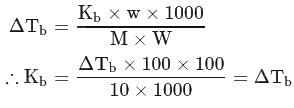
If the elevation in boiling point of a solution of  of solute
  . wt.
. wt.  in
in  of water is
  , the ebullioscopic constant of water is
of solute . wt. in of water is , the ebullioscopic constant of water isDetailed Solution: Question 9
Which one of the following statements is incorrect?
Detailed Solution: Question 10
 and
and  atm are the osmotic pressures of
  (mass/volume) solutions of urea, fructose, sucrose and
  respectively at certain temperature. The correct order of their magnitudes is :
Detailed Solution: Question 11
 ;
;



 (effective)


Which of the following has been arranged in the increasing order of freezing point?
Detailed Solution: Question 12
 , higher the
  value and lower the freezing point.




1.0  aqueous solution of
  freezes at
  . Assuming complete ionization of the hydrated complex, which of the following isomers conforms to the observation
  for water
 ?
?
Detailed Solution: Question 13



A living cell contains a solution which is isotonic with  glucose solution. What osmotic pressure develops when the cell is placed in
  solution at
Detailed Solution: Question 14


 ionized
 number of ions afterionization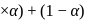




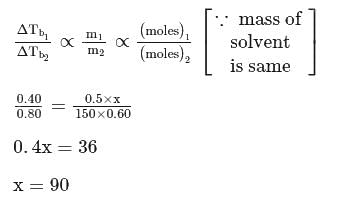
A solution of 0.5 g of a solute (molar mass = 150 g mol−1) in 50 g of a solvent yields a boiling point elevation of 0.40 K. Another solution of 0.60 g of an unknown solute in the same mass of solvent exhibits a boiling point elevation of 0.8 K. The molar mass of unknown solute is :
Detailed Solution: Question 15
335 videos|699 docs|300 tests |
