
Collision Theory, Energy of Activation - Free MCQ Practice Test with solutions,
MCQ Practice Test & Solutions: Test: Collision Theory, Energy of Activation (20 Questions)
You can prepare effectively for JEE Chemistry for JEE Main & Advanced with this dedicated MCQ Practice Test (available with solutions) on the important topic of "Test: Collision Theory, Energy of Activation". These 20 questions have been designed by the experts with the latest curriculum of JEE 2026, to help you master the concept.
Test Highlights:
- - Format: Multiple Choice Questions (MCQ)
- - Duration: 20 minutes
- - Number of Questions: 20
Sign up on EduRev for free to attempt this test and track your preparation progress.

A first order reaction is half-completed in 45 minutes. How long does it need for  of the reaction to be completed?
Detailed Solution: Question 1
 further
 hours.
 At a certain temperature, the first order rate constant k1 is found to be smaller than the second order rate constant k2. If the energy of activation E1 of the first order reaction is greater than energy of activation E2 of the second order reaction, then with increase in temperature.
Detailed Solution: Question 2


A reaction which is of first order w.r.t. reactant  , has a rate constant
  . If we start with
 , when would [A] reach the value of
, has a rate constant . If we start with , when would [A] reach the value of Detailed Solution: Question 3

The rate of a first order reaction is 
 at
at  concentration of the reactant. The halflife of the reaction is
Detailed Solution: Question 4
 Products
 or
or 


For a first order reaction  the reaction rate at reactant concentration of
  is found to be
  . The half life period of the reaction is
Detailed Solution: Question 5





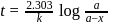
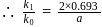
A reaction proceeds by first order,  of this reaction was completed in 32 min. The time required for
  completion is
Detailed Solution: Question 6
 reaction gets completed in 32
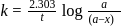
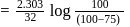

 to get the value of time required for
  completion of reaction

In the reaction  , rate constant is
 . If we start with
  of A then conc. of
  and B after 10 minuter are respectively.
Detailed Solution: Question 7



The half life for the virus inactivation if in the beginning  of the virus is inactivated per minute is (Given: The reaction is of first order)
Detailed Solution: Question 8



At  , if the rate constant of a first order reaction is
  , the time to reduce the initial concentration of the reactant to
  in seconds is :
Detailed Solution: Question 9
 th, we use the formula:
 , we have:
 , we get approximately 500 seconds.
The rate constant of a reaction with a virus is  . Time required for the virus to become
  inactivated is
Detailed Solution: Question 10


A Geigger Muller counter is used to study the radioactive process. In the absence of radioactive substance  , it counts 3 disintegration per second (dps). At the start in the presence of
  , it records 23 dps; and after 10 min 13 dps,
(i) What does it count after 
(ii) What is the halflife of A?
Detailed Solution: Question 11
 dps is zero error, hence


 recorded

The rate equation for a reaction,

is Rate  . If the initial concentration of the reactant is
  mol
mol  , the half-life period of the reaction is
Detailed Solution: Question 12

Half-lives of first-order and zeroth order reactions are same. Ratio of rates at the start of nreaction is
Detailed Solution: Question 13
 zeroth
 first
first 


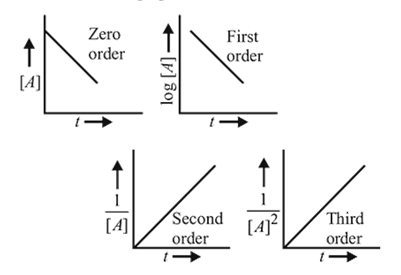
The plot of concentration of the reactant Vs time for a reaction is a straight line with a negative slope. The reaction follows a rate equation of
Detailed Solution: Question 14
The reaction  is started with
  of L. After 30 and 90 minutes
  and
and  of
of  respectively are left. The order of the reaction is
Detailed Solution: Question 15
 therefore
  is 30 minutes. In 90 minutes the amount is reduced to
  i.e.
i.e.  Here
Here  True for 1st order reaction.
The plot that represents the zero order reaction is:
Detailed Solution: Question 16
For a first order reaction, a plot of log(a−x) against time is a straight line with a negative slope equal to
Detailed Solution: Question 17
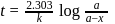


In the presence of an acid, the initial concentration of cane sugar was reduced from  to
to  in 5 hours and from
  to
to  in 10 hours. The reaction is of :
Detailed Solution: Question 18

For the decomposition of  at
at  , the following data were obtained
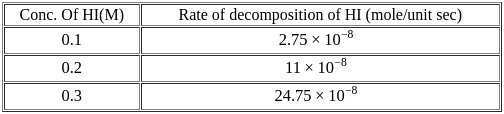
The order of reaction is :
at , the following data were obtainedThe order of reaction is :
Detailed Solution: Question 19
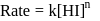



The hypothetical reaction  follows the following mechanism
  ,
,  The order of the overall reaction is
follows the following mechanism , The order of the overall reaction isDetailed Solution: Question 20
 ;
; (Fast);
 (Slow)
 put value of
  from Ist reaction since
  is intermediate
 Rate law equation
 Order
Order 
335 videos|699 docs|300 tests |
