
Concentration of Solutions, Vapour pressure - Free MCQ Practice Test
MCQ Practice Test & Solutions: Test: Concentration of Solutions, Vapour pressure (15 Questions)
You can prepare effectively for JEE Chemistry for JEE Main & Advanced with this dedicated MCQ Practice Test (available with solutions) on the important topic of "Test: Concentration of Solutions, Vapour pressure". These 15 questions have been designed by the experts with the latest curriculum of JEE 2026, to help you master the concept.
Test Highlights:
- - Format: Multiple Choice Questions (MCQ)
- - Duration: 20 minutes
- - Number of Questions: 15
Sign up on EduRev for free to attempt this test and track your preparation progress.

The molal elevation constant is the elevation in boiling point of
Detailed Solution: Question 1
Which of the following modes of expressing concentration is independent of temperature?
Detailed Solution: Question 2

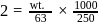
How many grams of concentrated nitric acid solution should be used to prepare  of
of  ? The concentrated acid is
of ? The concentrated acid is Detailed Solution: Question 3


 acid
acid 
Which of the following statements, regarding the mole fraction  of a component in solution, is correct?
Detailed Solution: Question 4
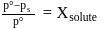
The vapour pressure of water at  is 17.24 mm Hg. When 20 g of a non-ionic, substance is dissolved in 100 g of water, the vapour pressure is lowered by 0.30 mm Hg. What is the molecular mass of the substance?
is 17.24 mm Hg. When 20 g of a non-ionic, substance is dissolved in 100 g of water, the vapour pressure is lowered by 0.30 mm Hg. What is the molecular mass of the substance?Detailed Solution: Question 5



Two liquids X and Y form an ideal solution at  , vapour pressure of the solution containing 1 mol of X and 3 mol of Y is
  . At the same temperature, if 1 mol of Y is further added to this solution, vapour pressure of the solution increases by
  . Vapour pressure (in mmHg) of X and Y in their pure states will be, respectively–
Detailed Solution: Question 6




Which of the following is not an ideal solution?
Detailed Solution: Question 7
 Ideal solution
 -dichlorobenzene
  Ideal solution
 Non-ideal solution
 Ideal solution
An azeotropic solution of two liquids has boiling point lower than either of them when it
Detailed Solution: Question 8
Which among the following will show maximum osmotic pressure?
Detailed Solution: Question 9
 in case of
  ,
,
Which of the following is not correct?
Detailed Solution: Question 10
A solution of acetone in ethanol
Detailed Solution: Question 11
An aqueous solution is  molal in KI. Which change will cause the vapour pressure of the solution to increase?
Detailed Solution: Question 12
 is diluted with water, concentration decreases, therefore the vapour pressure of the resulting solution increases.
 and
and  are the vapour pressure of pure liquid components,
  and
and  , respectively of an ideal binary solution. If
  represents the mole fraction of component
  , the total pressure of the solution will be.
Detailed Solution: Question 13




Which condition is not satisfied by an ideal solution?
Detailed Solution: Question 14
 of mixing should be zero.
 on mixing should be zero.
Which of the following is true regarding azeotropes?
Detailed Solution: Question 15
335 videos|699 docs|300 tests |
