CTET & State TET Exam  >  CTET & State TET Test  >  Mathematics & Pedagogy Paper 2 for CTET & TET Exams  >  Test: Constructions- 2 - CTET & State TET MCQ

Constructions- 2 - Free MCQ Practice Test with solutions, CTET Mathematics


MCQ Practice Test & Solutions: Test: Constructions- 2 (25 Questions)

You can prepare effectively for CTET & State TET Mathematics & Pedagogy Paper 2 for CTET & TET Exams with this dedicated MCQ Practice Test (available with solutions) on the important topic of "Test: Constructions- 2". These 25 questions have been designed by the experts with the latest curriculum of CTET & State TET 2026, to help you master the concept.

Test Highlights:

  • - Format: Multiple Choice Questions (MCQ)
  • - Duration: 25 minutes
  • - Number of Questions: 25

Sign up on EduRev for free to attempt this test and track your preparation progress.

Test: Constructions- 2 - Question 1

Two or more circles are concentric if they have same

Test: Constructions- 2 - Question 2

If two circles touches internally then distance between their centres is equal to

Test: Constructions- 2 - Question 3

Radius of a circle is ________ to tangent

Test: Constructions- 2 - Question 4

Two radii of same circle are always :

Test: Constructions- 2 - Question 5

A quadrilateral can be drawn.If the measures of its

Detailed Solution: Question 5

In a rectangle diagonals are equal. Five measurements can determine a quadrilateral uniquely. A quadrilateral can be constructed uniquely if the lengths of its four sides and a diagonal are given.A quadrilateral can be constructed uniquely if its two adjacent sides and three angles are given.

Test: Constructions- 2 - Question 6

The point in the plane of a triangle which is at equal perpendicular distances from the three sides of the triangle is its

Test: Constructions- 2 - Question 7

The orthocentere of an obtuse angled triangle lies

Test: Constructions- 2 - Question 8

On a ray AB with initial point A, Taking A as centre and some radius, draw an arc of a circle, which intersects AB, say at a point D. Taking D as centre and with the same radius as before, draw an arc intersecting the previously drawn arc, say at a point E. Draw the ray AC passing through E. Then, the measure of ∠CAB is

Test: Constructions- 2 - Question 9

If a 60°angle is bisected twice what will be measure of each angle that is constructed ?

Test: Constructions- 2 - Question 10

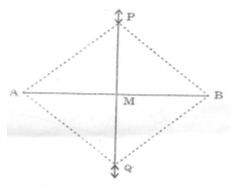
In the construction of the perpendicular bisector of a given line segment, as Shown in the figure below ΔPMA ≌ ΔPMB by which congruence criterion?
Test: Constructions- 2 - Question 11

An external bisector of an angle measuring 70° will divide the angle into two angles measuring

Test: Constructions- 2 - Question 12

In Δ ABC, which of the following information is needed to construct it if it is known that measure of ∠B = 60 and BC = 6 cm :

Test: Constructions- 2 - Question 13

Which of these triangles are possible to construct by knowing only its altitude?

Test: Constructions- 2 - Question 14

With the help of a ruler and a compass it is not possible to construct an angle of :

Test: Constructions- 2 - Question 15

With the help of a ruler and a compass it is not possible to construct an angle of

Test: Constructions- 2 - Question 16

It is not possible to construct a triangle whose sides are

Test: Constructions- 2 - Question 17

With the help of a ruler and a compass, it is possible to construct an angle of

Detailed Solution: Question 17

37.5° (option B) is constructible.

Construct an equilateral triangle to obtain a 60° angle. Bisect the 60° angle to get 30°.

Bisect 30° to obtain 15°, and bisect 15° to obtain 7.5°.

Place the constructed 30° and 7.5° adjacent to each other; their sum is 37.5°. Thus 37.5° can be constructed using ruler and compass.

40° is the central angle of a regular 9-gon (since 360°/9 = 40°); a regular 9-gon is not constructible with ruler and compass, so 40° is not obtainable by classical straightedge-and-compass constructions. The measures 35° and 45.7° are also not obtainable by the simple sequence of standard bisections and sums used above, so they are not constructible here.

Test: Constructions- 2 - Question 18

The construction of a triangle ABC with AB = 4 cm and ∠A = 60° is not possible when difference of BC and AC is equal to

Test: Constructions- 2 - Question 19

The construction of a triangle ABC with AB = 6 cm and ∠A = 60° is not possible when sum of BC and CA is equal to

Detailed Solution: Question 19

ANSWER :- b

Solution :- Given, BC = 6 cm and ∠A=60°

We know that, the construction of a triangle is possible, if sum of two sides is greater than the third side of the triangle i.e.,

AB - BC > AC

⇒  BC + AC > AB

⇒  BC + AC > 6

So, if BC + AC = 7 cm

Test: Constructions- 2 - Question 20

It is possible to construct a triangle ABC whose sides are

Test: Constructions- 2 - Question 21

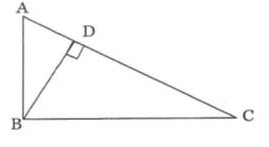
The angles ABC and BDC are right angles. If AD = 8 cm and DC = 32 cm the length of BD is
Test: Constructions- 2 - Question 22

If D is a mid point of the hypotenuse AC of a right triangle ABC, BD is equal to

Test: Constructions- 2 - Question 23

In Δ ABC if ∠B = ∠C = 300, which of the following is the longest side?

Test: Constructions- 2 - Question 24

In a Δ ABC if ∠A = 50° and ∠B = 70° then the shortest and the largest sides of the triangles are

Test: Constructions- 2 - Question 25

What is the supplementary angle of 108°?

83 videos|266 docs|69 tests
Information about Test: Constructions- 2 Page
In this test you can find the Exam questions for Test: Constructions- 2 solved & explained in the simplest way possible. Besides giving Questions and answers for Test: Constructions- 2, EduRev gives you an ample number of Online tests for practice
Download as PDF