
Covalent and Co-ordinate Bonding - Free MCQ Practice Test with solutions,
MCQ Practice Test & Solutions: Test: Covalent and Co-ordinate Bonding (15 Questions)
You can prepare effectively for JEE Chemistry for JEE Main & Advanced with this dedicated MCQ Practice Test (available with solutions) on the important topic of "Test: Covalent and Co-ordinate Bonding". These 15 questions have been designed by the experts with the latest curriculum of JEE 2026, to help you master the concept.
Test Highlights:
- - Format: Multiple Choice Questions (MCQ)
- - Duration: 20 minutes
- - Number of Questions: 15
Sign up on EduRev for free to attempt this test and track your preparation progress.

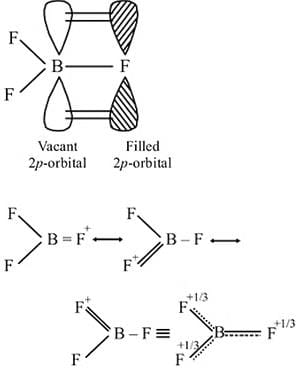
Among the following ions, the pπ−dπ overlap could be present in
Detailed Solution: Question 1
The bond dissociation energy of B−F in BF3 is 646 kJ mol−1 whereas that of C−F in CF4 is 515 kJ mol−1. The correct reason for higher B−F bond dissociation energy as compared to that of C−F is
Detailed Solution: Question 2

In  ion the formal charge on the oxygen atom of P−O bond is ___
ion the formal charge on the oxygen atom of P−O bond is ___Detailed Solution: Question 3
 ion, formal charge on each
  -atom of

Which of the following contains both covalent and ionic bond?
Detailed Solution: Question 4
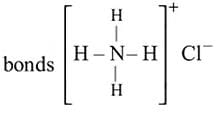
Which of the following species is a radical?
Detailed Solution: Question 5
 Odd electrons (seven valency electrons of nitrogen and eight valency electrons of oxygen), so this species work as radical.
  , the total electrons are
  (even), in case of nitro ion, total valency electrons are
  (even), In case of cyanide ion, total valency electrons are
  (even).
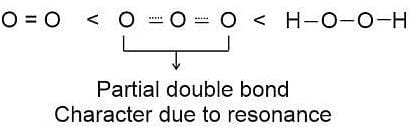
The correct order in which the O − O bond length increases in the following is-
Detailed Solution: Question 6
Which of the following Lewis dot structure of  is incorrect?
Detailed Solution: Question 7
 can be represented as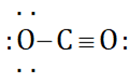
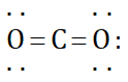 (Incorrect structure)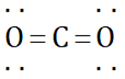
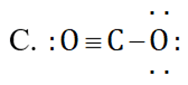
The molecules  and
and  are both covalent compounds, but
  is non polar whereas
  is polar. The reason for this is
and are both covalent compounds, but is non polar whereas is polar. The reason for this isDetailed Solution: Question 8
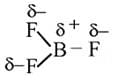
 hence it is non polar.
 is pyramidal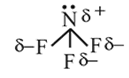
 hence it is polar.
The number and type of bonds in ion in  are:
are:
are:Detailed Solution: Question 9
 is
is 
 and two
  bonds
bondsIn  and
and  , the number of lone pairs on Xe are respectively
Detailed Solution: Question 10
 Total number of valence electrons of
  , two electrons shared with
  atoms, 6 electrons left hence 3 lone pairs, in
  shared with
  atoms 4 left hence 2 lone pairs; in
  shared with
  atoms 2 left hence 1 lone pair.
The number of  molecules participating in hydrogen bonding in
  is/are
Detailed Solution: Question 11
 is the represenation of given compound.
The maximum number of H-bonds in which water molecule can participate is
Detailed Solution: Question 12
 molecule, two H-bonds are formed with
  atom and two are formed with
  atoms of the
  molecule.
Which of the following molecules has highest dipole moment?
Detailed Solution: Question 13
 and
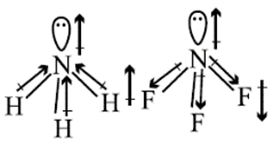
and  is zero because these are symmetrical molecules. Dipole moment of
  is greater than
  .
.
Which of the following has least covalent P − H bond?
Detailed Solution: Question 14
 bond will have ionic character due to electron attracting tendency of P-carrying positive charge and least covalent.
Which one of the following has longest covalent bond distance?
Detailed Solution: Question 15
332 videos|699 docs|300 tests |
