Electrical Engineering (EE) Exam  >  Electrical Engineering (EE) Test  >  Network Theory (Electric Circuits)  >  Test: Dot Convention in Magnetically Coupled Circuits - Electrical Engineering (EE) MCQ

Dot Convention in Magnetically Coupled Circuits - Free MCQ Practice Test


MCQ Practice Test & Solutions: Test: Dot Convention in Magnetically Coupled Circuits (15 Questions)

You can prepare effectively for Electrical Engineering (EE) Network Theory (Electric Circuits) with this dedicated MCQ Practice Test (available with solutions) on the important topic of "Test: Dot Convention in Magnetically Coupled Circuits". These 15 questions have been designed by the experts with the latest curriculum of Electrical Engineering (EE) 2026, to help you master the concept.

Test Highlights:

  • - Format: Multiple Choice Questions (MCQ)
  • - Duration: 45 minutes
  • - Number of Questions: 15

Sign up on EduRev for free to attempt this test and track your preparation progress.

Test: Dot Convention in Magnetically Coupled Circuits - Question 1

A series RLC circuit has a resonance frequency of 1 kHz and a quality factor Q = 100. If each of R, L and C is doubled from its original value, the new Q of the circuit is _____________

Detailed Solution: Question 1

Q = f0 / BW
And f0 = 1/2π (LC)0.5
BW = R/L
or, Q = 1R(L/C)0.5
When R, L and C are doubled, Q’ = 50.

Test: Dot Convention in Magnetically Coupled Circuits - Question 2

The switch in the circuit shown was on position X for a long time. The switch is then moved to position Y at time t=0. The current I(t) for t > 0 is ________
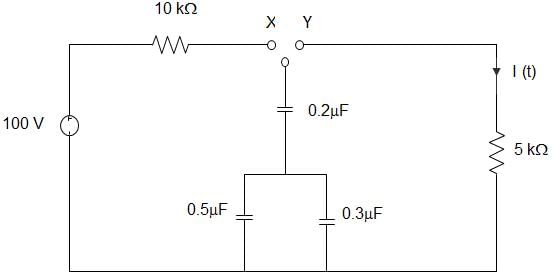
Detailed Solution: Question 2

VC (t = 0) = 100 V
At t ≥ 0,
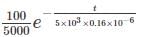
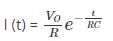
The discharging current 

= 0.2e-1250tu(t) mA.

Test: Dot Convention in Magnetically Coupled Circuits - Question 3

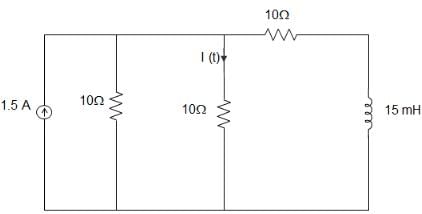
In the circuit shown below the current I(t) for t≥0+ (assuming zero initial conditions) is ___________
Detailed Solution: Question 3

I (t) = 1.5 / 3 = 0.5
LEQ = 15 mH
REQ = 5+10 = 15Ω

I (t) A – (A – B) e-t = 0.5 – (0.5-B) e-1000t
= 0.5(0.5 – 0.375) e-1000t
= 0.5 – 0.125 e-1000t
I (t) = 0.5-0.125e-1000t.

Test: Dot Convention in Magnetically Coupled Circuits - Question 4

For a unit step signal u (t), the response is V1 (t) = (1-e-3t) for t>0. If a signal 3u (t) + δ(t) is applied, the response will be (considering zero initial conditions)?

Detailed Solution: Question 4

For u (t) = 1, t > 0
V1 (t) = (1 - e-3t)

or, 

Ans, 

Now, for 

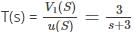
Response, H(s) = R(s)

Or, h (t) = 3 u (t).

Test: Dot Convention in Magnetically Coupled Circuits - Question 5

An ideal capacitor is charged to a voltage VO and connected at t=0 across an ideal inductor L. If ω = 1 / √LC, the voltage across the capacitor at time t > 0 is ________

Detailed Solution: Question 5

Voltage across capacitor will discharge through inductor up to voltage across the capacitor becomes zero. Now, inductor will start charging capacitor.
Voltage across capacitor will be decreasing from VO and periodic and is not decaying since both L and C is ideal.
∴ Voltage across the capacitor at time t > 0 is VO cos(ωt).

Test: Dot Convention in Magnetically Coupled Circuits - Question 6

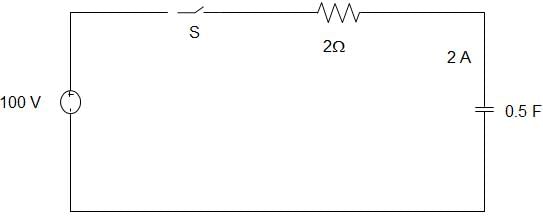
In the circuit given below, the capacitor initially has a charge of 10 C. The current in the circuit at t = 1 sec after the switch S is closed will be ___________
Detailed Solution: Question 6
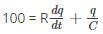
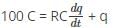
Using KVL, 

or, 

Now, 

Or, 100C – q = (100C – qo) e-t/RC

= 40e-1 = 14.7 A.

Test: Dot Convention in Magnetically Coupled Circuits - Question 7

A rectangular voltage wave of magnitude A and duration B is applied to a series combination of resistance R and capacitance C. The voltage developed across the capacitor is ____________

Detailed Solution: Question 7

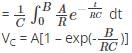
Hence, maximum voltage =
V [1 – exp (-B/RC)].

Test: Dot Convention in Magnetically Coupled Circuits - Question 8

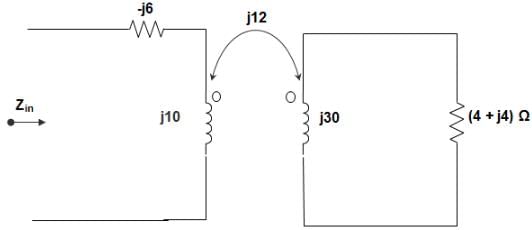
In the circuit given below, the input impedance ZIN of the circuit is _________
Detailed Solution: Question 8

ZIN = (-6j) || (ZA)

= 0.49 + j5.82

= 64.73 + j17.77 Ω.

Test: Dot Convention in Magnetically Coupled Circuits - Question 9

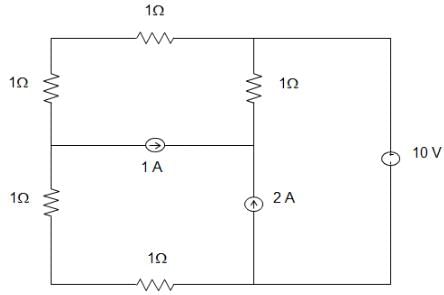
In the circuit shown, the voltage source supplies power which is _____________
Detailed Solution: Question 9

Let the current supplied by a voltage source.
Applying KVL in outer loop,
10 – (I + 3) × (I + 1) – (I + 2) × 2 = 0
10 – 2(I + 3) – 2(I - 2) = 0
Or, I = 0
∴ Power VI = 0.

Test: Dot Convention in Magnetically Coupled Circuits - Question 10

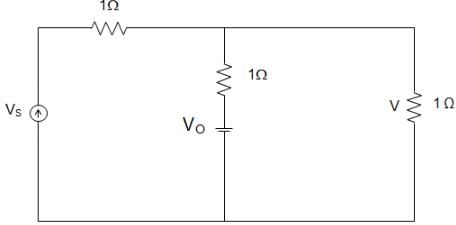
Initial voltage on capacitor VO as marked |VO| = 5 V, VS = 8 u (t), where u (t) is the unit step. The voltage marked V at t=0+ is _____________
Detailed Solution: Question 10

Applying voltage divider method, we get,

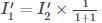
And,  

Now, 

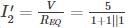
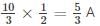
Hence, the net current in 1Ω resistance = I1 + I′1

∴ Voltage drop across 1Ω = 13/3×1
= 13/3 V.

Test: Dot Convention in Magnetically Coupled Circuits - Question 11

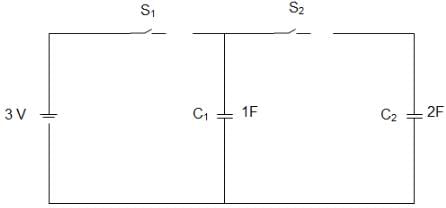
In the circuit given below, for time t < 0, S1 remained closed and S2 open., S1 is initially opened and S2 is initially closed. If the voltage V2 across the capacitor C2 at t = 0 is zero, the voltage across the capacitor combination at t = 0+ will be ____________
Detailed Solution: Question 11

When S1 is closed and S2 is open,
VC1 (0) = VC1 (0+) = 3V
When S1 is opened and S2 is closed, VC2 (0+) = VC2 (0+) = 3V.

Test: Dot Convention in Magnetically Coupled Circuits - Question 12

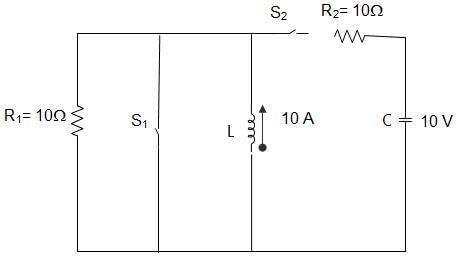
In the circuit given below, the switch S1 is initially closed and S2 is opened. The inductor L carries a current of 10A and the capacitor is charged to 10 V with polarities as shown. The current through L during t=0+ is _____________
Detailed Solution: Question 12
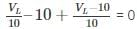
By KCL, we get,

Hence, 2 VL = 110
∴ VL = 55 V.

Test: Dot Convention in Magnetically Coupled Circuits - Question 13

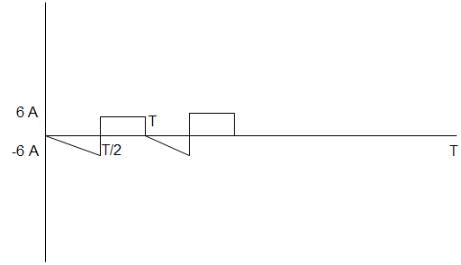
In the figure given below, what is the RMS value of the periodic waveform?
Detailed Solution: Question 13
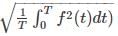

The rms value for any waveform is

= [6 + 18]1/2 = √24 = 2√ 6 A.

Test: Dot Convention in Magnetically Coupled Circuits - Question 14

In the circuit given below, the switch is closed at time t = 0. The voltage across the inductance just at t = 0+ is ______
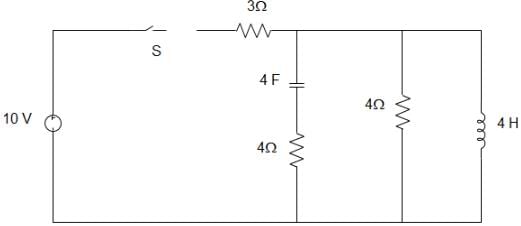
Detailed Solution: Question 14

A t = 0+,

∴ 

VL(0+) = 1 × 4 = 4 V.

Test: Dot Convention in Magnetically Coupled Circuits - Question 15

Two 300 μH coils in series without mutual coupling have a total inductance of

Detailed Solution: Question 15

Series Aiding:

The equivalent inductance of series aiding connection is:

Leq = L1 + L2 + 2M

Series Opposing:


The equivalent inductance of series opposing connection is:

Leq = L1 + L2 – 2M

Calculation:

Given,

L1 = 300 μH

L2 = 300 μH

M = 0 μH

The equivalent inductance for series addition is,

Leq = 300  + 300  + 2 x 0  = 600 μH

Important Points
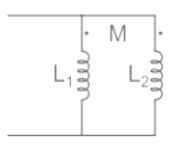
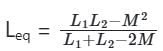
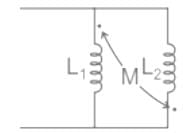
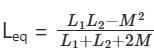
The equivalent inductance of the parallel aiding connection is:


The equivalent inductance of the parallel opposing connection is

74 videos|151 docs|62 tests
Information about Test: Dot Convention in Magnetically Coupled Circuits Page
In this test you can find the Exam questions for Test: Dot Convention in Magnetically Coupled Circuits solved & explained in the simplest way possible. Besides giving Questions and answers for Test: Dot Convention in Magnetically Coupled Circuits, EduRev gives you an ample number of Online tests for practice
Download as PDF