JEE Exam  >  JEE Test  >  Physics Main & Advanced  >  Test: Electric Dipole - JEE MCQ

Electric Dipole - Free MCQ Practice Test with solutions, JEE Physics


MCQ Practice Test & Solutions: Test: Electric Dipole (10 Questions)

You can prepare effectively for JEE Physics for JEE Main & Advanced with this dedicated MCQ Practice Test (available with solutions) on the important topic of "Test: Electric Dipole". These 10 questions have been designed by the experts with the latest curriculum of JEE 2026, to help you master the concept.

Test Highlights:

  • - Format: Multiple Choice Questions (MCQ)
  • - Duration: 10 minutes
  • - Number of Questions: 10

Sign up on EduRev for free to attempt this test and track your preparation progress.

Test: Electric Dipole - Question 1

Which of the following molecule has permanent dipole moment?​

Detailed Solution: Question 1

Ionic behavior implies dipole moment.

HCl is an ionic compound (H+Cl-)
CO2, CH4 and BF3  is a covalent compound

Test: Electric Dipole - Question 2

A dipole is said to be in stable equilibrium when angle between electric field and dipole moment is:​

Detailed Solution: Question 2

Stable equilibrium is attained when potential energy of the dipole system is minimum which is possible at an inclination of 0°.

Test: Electric Dipole - Question 3

What is the angle between the electric dipole moment and the electric field on the equatorial line of the dipole?

Detailed Solution: Question 3

On equatorial line, the direction of electric field is reversed to that of angle of axial line. Therefore, the angle between dipole moment and electric field is 180°.

Test: Electric Dipole - Question 4

An electric dipole is 

Detailed Solution: Question 4

An electric dipole is a separation of positive and negative charges. The simplest example of this is a pair of electric charges of equal magnitude but opposite sign, separated by some (usually small) distance. A permanent electric dipole is called an electret.

Test: Electric Dipole - Question 5

How does electric field strength change with distance from a short dipole?

Detailed Solution: Question 5

The electric field strength of a short dipole decreases as the distance from the dipole increases.

This relationship follows an inverse cube law, meaning the field strength is proportional to 1/r³ (where r is the distance).

As you move further away, the field becomes weaker more rapidly compared to point charges.

The dipole's field pattern is directional, meaning the field lines spread out from the positive to the negative charge.

Test: Electric Dipole - Question 6

An electric dipole consists of a positive and negative charge of 4 µC. Each placed at a distance of 5 mm. The dipole moment for the system is

Detailed Solution: Question 6

q= 4μc = 4 x 10⁻⁶c
2l = 5mm = 5 x 10⁻³m
Dipole moment  P = q.2l
= 4 x 10-6 x 5 x 10-3
= 20 x 10-9
= 2 x 10 x 10-9
= 2 x 10⁻⁸ c.m 

its direction is toward the positive charge.

Test: Electric Dipole - Question 7

Which of the following quantity is a scalar?

Detailed Solution: Question 7

Electric flux is a scalar quantity. It is a scalar because it is the dot product of two vector quantities, electric field and the perpendicular differential area.

Test: Electric Dipole - Question 8

For forming an electric dipole between two point charges separated by a small distance, the two point charges are of

Detailed Solution: Question 8

An electric dipole consists of two point charges of equal magnitude and opposite sign separated by a small distance.

The dipole moment is given by p = q · d, where q is the magnitude of one charge and d is the displacement vector from the negative to the positive charge; equal magnitudes give a well-defined dipole moment of magnitude qd.

Charges of the same sign or unequal magnitudes do not form the standard electric dipole used in electrostatics.

Therefore, option D is correct.

Test: Electric Dipole - Question 9

Positive and negative point charges of equal magnitude are kept at locations ( 0,0,a/2) and (0,0,-a/2) respectively. The work done by the electric field when another positive point charge is moved from (-a,0,0) to (0,a,0) is 

Detailed Solution: Question 9
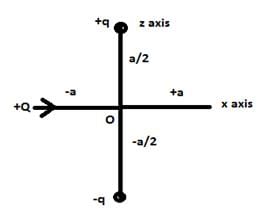
+Q charge is moving on equatorial line of dipole as shown in figure, since on equatorial line V=0,
Hence the potential difference is zero. So, W=0

Test: Electric Dipole - Question 10

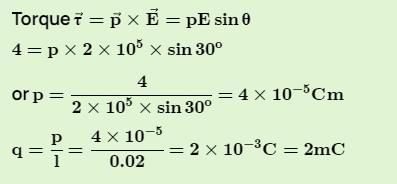
An electric dipole is placed at an angle of 30° with an electric field intensity 2 × 10⁵ N/C. It experiences a torque equal to 4 N m. The charge on the dipole, if the dipole length is 2 cm, is

Detailed Solution: Question 10
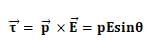
Torque on a dipole kept in external electric field is given by the expression,

258 videos|856 docs|206 tests
Information about Test: Electric Dipole Page
In this test you can find the Exam questions for Test: Electric Dipole solved & explained in the simplest way possible. Besides giving Questions and answers for Test: Electric Dipole, EduRev gives you an ample number of Online tests for practice
258 videos|856 docs|206 tests
Download as PDF