NEET Exam  >  NEET Test  >  Physics Class 12  >  Test: Electric Field Lines (NCERT) - NEET MCQ

Electric Field Lines (NCERT) - Free MCQ Practice Test with solutions, NEET


MCQ Practice Test & Solutions: Test: Electric Field Lines (NCERT) (10 Questions)

You can prepare effectively for NEET Physics Class 12 with this dedicated MCQ Practice Test (available with solutions) on the important topic of "Test: Electric Field Lines (NCERT)". These 10 questions have been designed by the experts with the latest curriculum of NEET 2026, to help you master the concept.

Test Highlights:

  • - Format: Multiple Choice Questions (MCQ)
  • - Duration: 10 minutes
  • - Number of Questions: 10

Sign up on EduRev for free to attempt this test and track your preparation progress.

Test: Electric Field Lines (NCERT) - Question 1

Electric field lines provide information about

Detailed Solution: Question 1

Electric field lines are essential for understanding various aspects of electric fields. They illustrate:

  • Field strength: The density of lines indicates how strong the electric field is; closer lines mean a stronger field.
  • Direction: The arrows on the lines show the direction a positive charge would move within the field.
  • Nature of charge: Lines emanate from positive charges and terminate at negative charges, visually representing their nature.

These characteristics together provide a comprehensive view of the electric field's behaviour and effects.

Test: Electric Field Lines (NCERT) - Question 2

Which of the following figure represents the electric field lines due to a single positive charge?

Detailed Solution: Question 2

The field lines of a single positive charge are radially outward.

Test: Electric Field Lines (NCERT) - Question 3

Which of the following figure represents the electric field lines due to a single negative charge?

Detailed Solution: Question 3

The field lines of single negative charge are radially inward.

Test: Electric Field Lines (NCERT) - Question 4

Which of the following figures correctly shows the top view sketch of the electric field lines for a uniformly charged hollow cylinder as shown in figure?

Detailed Solution: Question 4

For a uniformly charged hollow cylinder, the electric field lines are as shown in figure (b).

Test: Electric Field Lines (NCERT) - Question 5

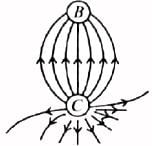
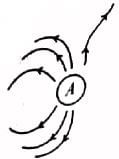
Figure shows the electric field lines around three point charges A, B and C. Which of the following charges are positive?


Detailed Solution: Question 5

In the given figure, the electric lines of force emanate from A and C. Therefore, charges A and C must be positive.

Test: Electric Field Lines (NCERT) - Question 6

Figure shows the electric field lines around three point charges A, B and C. which charge has the largest magnitude?
 

Detailed Solution: Question 6

From the given figure it is clear that, maximum number of electric lines of force are associated with charge C, so it must have the largest magnitude.

Test: Electric Field Lines (NCERT) - Question 7

Figure shows the electric field lines around three point charges A, B and C. which or regions of the figure could the electric field be zero?
 

Detailed Solution: Question 7

From the figure, it is clear that, there cannot be a neutral point between a positive and a negative charge. Neutral point can be only there between two like charges i.e„ A and C. As magnitude of charge A is smaller than the magnitude of charge C, therefore, neutral point would lie closer to the charge A.

Test: Electric Field Lines (NCERT) - Question 8

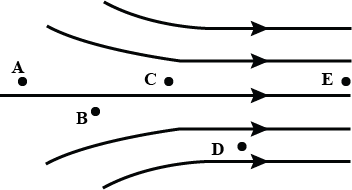
A non-uniform electric field is represented by the diagram. At which of the following points the electric field is greatest in magnitude?
Detailed Solution: Question 8

Electric field strength is maximum where the electric field lines are closer.

Test: Electric Field Lines (NCERT) - Question 9

Which of the following curves shown below cannot possibly represent electrostatic field lines?

Detailed Solution: Question 9

Perpendicular to the Surface of Conductors: Electrostatic field lines are always perpendicular (at 90 degrees) to the surface of a conductor. This is because conductors contain free charges that can move freely within the material. When an electric field is applied, these free charges redistribute themselves on the surface of the conductor until the electric field inside the conductor is zero. This redistribution causes the electric field at the surface to be perpendicular to the surface.

Test: Electric Field Lines (NCERT) - Question 10

Which of the following statements is not true about electric field lines?

Detailed Solution: Question 10

In a charge-free region, electric field lines can be taken to be continuous curves without any breaks.

74 videos|347 docs|82 tests
Information about Test: Electric Field Lines (NCERT) Page
In this test you can find the Exam questions for Test: Electric Field Lines (NCERT) solved & explained in the simplest way possible. Besides giving Questions and answers for Test: Electric Field Lines (NCERT), EduRev gives you an ample number of Online tests for practice
74 videos|347 docs|82 tests
Download as PDF