NEET Exam  >  NEET Test  >  Chemistry CUET UG Mock Test Series 2026  >  Test: Electrical Properties of Solids (Old NCERT) - NEET MCQ

Chemistry CUET UG Test: Electrical Properties of Solids (Old NCERT) Free


MCQ Practice Test & Solutions: Test: Electrical Properties of Solids (Old NCERT) (10 Questions)

You can prepare effectively for NEET Chemistry CUET UG Mock Test Series 2026 with this dedicated MCQ Practice Test (available with solutions) on the important topic of "Test: Electrical Properties of Solids (Old NCERT)". These 10 questions have been designed by the experts with the latest curriculum of NEET 2026, to help you master the concept.

Test Highlights:

  • - Format: Multiple Choice Questions (MCQ)
  • - Duration: 5 minutes
  • - Number of Questions: 10

Sign up on EduRev for free to attempt this test and track your preparation progress.

Test: Electrical Properties of Solids (Old NCERT) - Question 1

Which of the following shows correct range of conductivity?
(i) Conductors: 10to 107 ohm−1 m−1
(ii) Insulators: 10−6 to 104 ohm−1 m-1 
(iii) Semiconductors: : 10−10 to 10−6 ohm−1 m−1

Detailed Solution: Question 1

Conductors 104 to 107ohm−1m−1
Insulators : 10−20 to 10−10ohm−1m−1
Semiconductors : 10−6 to 104ohm−1m−1

Test: Electrical Properties of Solids (Old NCERT) - Question 2

Pure silicon and germanium behave as

Detailed Solution: Question 2

Pure Si and Ge are insulators because of the absence of any hole or free electron. They show semiconductor behaviour only after doping.

Test: Electrical Properties of Solids (Old NCERT) - Question 3

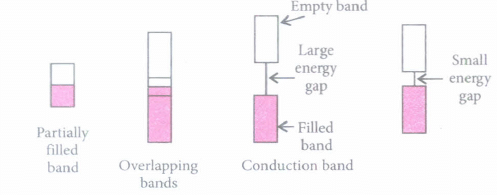
Three type of bands are shown in the figures given below showing the position of the valence band and conduction band. The figures A,B and C represent
Neet Chemistry - Solid State Chemistry chapter sample Question paper with  answer key | Medical Entrance Exam | online practise tests

Detailed Solution: Question 3

Conductors, semi-conductors and insulators can be defined on the basis of conduction band and valence band.In conductors, the conduction band and valence band overlap each other.
In semi-conductor, the energy gap between the conduction band and valence band ∼1eV.
In insulators, the energy gap between the conduction band and valence band >9eV.

Test: Electrical Properties of Solids (Old NCERT) - Question 4

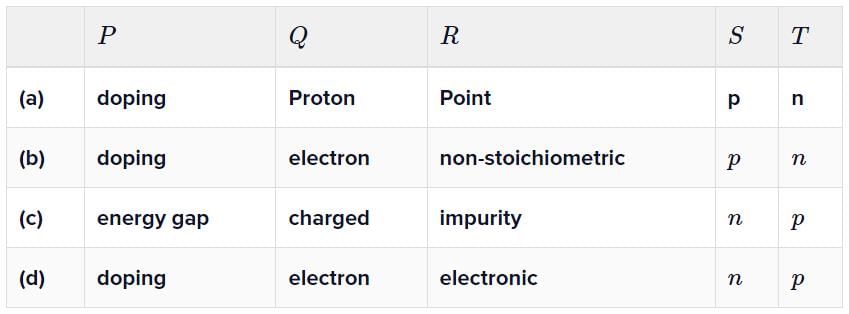
The conductivity of intrinsic semiconductors can be increased by adding a suitable impurity. This process is called (P). This can be done with an impurity which is (Q) rich or deficient as compared to the semiconductor. Such impurities introduce (R) defects in them. Electron rich impurities result in (S) type semiconductors while electron deficit impurities result in (T) type semiconductors.
Detailed Solution: Question 4

To increase the conductivity of intrinsic semiconductor, some impurities are added. This process is called doping (P). The impurity can be of two type - electron (Q) rich or deficient. Due to doping, electronic (R) defects are introduced in the matter. If the impurities are electron rich then it will lead to the formation of n-type (S) semiconductors and if the impurities are electron deficit then it will lead to the formation of p-type semiconductor (T).

Test: Electrical Properties of Solids (Old NCERT) - Question 5

To get n-type of semiconductor, germanium should be doped with

Detailed Solution: Question 5
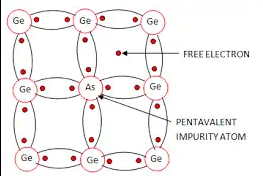
For germanium to be a N- type semiconductor, it should be doped with group 15 elements. This will lead to excess of electrons.

In the given options, only element which belongs to group 15 is Arsenic.

Test: Electrical Properties of Solids (Old NCERT) - Question 6

p−type semiconductors are formed when Si or Ge are doped with:

Detailed Solution: Question 6

For Si or Ge to be a p−type semiconductor, they have to be doped with trivalent elements. This will lead to electron scarcity, which is called as hole. For this reason, the elements should be of Group 13.

Test: Electrical Properties of Solids (Old NCERT) - Question 7

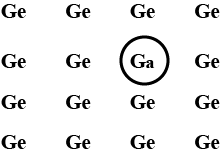
Which type of semiconductor is formed when grmanium is doped in the gallium as indicated in the figure?
Detailed Solution: Question 7

Impurity of lower group creates a positively charged hole. On applying potential difference , p-holes conduct electric current.

Test: Electrical Properties of Solids (Old NCERT) - Question 8

Which of the following statements is true about semiconductors?

Detailed Solution: Question 8

Intrinsic semiconductors are insulators at room temperature and become semiconductors when temperature is raised.

Test: Electrical Properties of Solids (Old NCERT) - Question 9

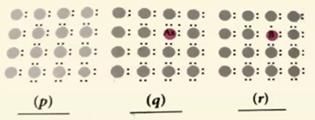
Observe the given figure carefully and fill in the blanks by choosing the correct option.
Detailed Solution: Question 9

In n-type semiconductor, Si and Ge are doped with group 15 elements. Since group 15 elements have five electrons in valence shell which is one more than Si or Ge i.e. four electrons. So, the material becomes electron rich and it becomes n- type.
In p-type semiconductor, Si and Ge are doped with group 13 elements. Since group 13 elements have three electrons in valence shell which is one less than 
Si or Ge i.e. four electrons. So, the material becomes electron deficit and it becomes p- type.  

Test: Electrical Properties of Solids (Old NCERT) - Question 10

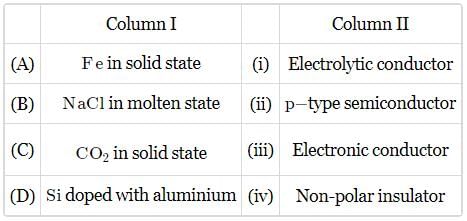
Match the column I with column II and mark the appropriate choice.
Detailed Solution: Question 10

Fe is a metallic solid. It has free electrons. So, it conducts electricity is solid state. It is called as electronic conductor.
In molten state, NaCl has free ions i.e. Na+ & Cl. These ions helps in flow of electric current. Molten NaCl is called as electrolytic conductor. In CO2, C and O are bonded by covalent bonds and there are no free electron in CO2. So, it is Non-Polar insulator.
Si is group 14 element having four electrons in valence shell and Al is 13 element having three electrons in valence shell. On doping Si with Al, it will form a electron deficit material. It is called as p-type semiconductor.

4 docs|163 tests
Information about Test: Electrical Properties of Solids (Old NCERT) Page
In this test you can find the Exam questions for Test: Electrical Properties of Solids (Old NCERT) solved & explained in the simplest way possible. Besides giving Questions and answers for Test: Electrical Properties of Solids (Old NCERT), EduRev gives you an ample number of Online tests for practice
Download as PDF