Electromagnetic Waves - 1 - Free MCQ Practice Test with solutions, GATE
MCQ Practice Test & Solutions: Test: Electromagnetic Waves - 1 (10 Questions)
You can prepare effectively for Electrical Engineering (EE) Topicwise Question Bank for Electrical Engineering with this dedicated MCQ Practice Test (available with solutions) on the important topic of "Test: Electromagnetic Waves - 1". These 10 questions have been designed by the experts with the latest curriculum of Electrical Engineering (EE) 2026, to help you master the concept.
Test Highlights:
- - Format: Multiple Choice Questions (MCQ)
- - Duration: 30 minutes
- - Number of Questions: 10
Sign up on EduRev for free to attempt this test and track your preparation progress.

Consider the following statements associated with an electromagnetic wave in free space:
- At every point in space, the electric field
 and th emagnetic vector field
  are perpendicular to each other and to the direction of propagation.
 - Velocity of propagation of wave in free space is equal to

 oscillate in phase opposition and the ratio of their amplitude is constant being equal to
- Whatever may be the frequency , the electromagnetic wave travels in space with velocity of light.
Which of the above statements are correct?
and th emagnetic vector field are perpendicular to each other and to the direction of propagation. oscillate in phase opposition and the ratio of their amplitude is constant being equal to Detailed Solution: Question 1
 = speed of light (3 x 10⁸ m/s). Hence statement-2 is not correct.
 oscillate in phase and the ratio of their amplitude is constant being equal to
 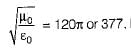 . Hence, statement-3 is not correct.
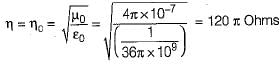
Intrinsic impedance or charcteristic impedance of the non-conducting medium in the free space is
Detailed Solution: Question 2

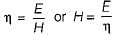
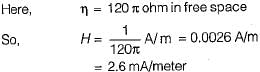
If the magnitude of  in a plane wave is 1 V/m, what is the magnitude of H for a plane wave in free space?
in a plane wave is 1 V/m, what is the magnitude of H for a plane wave in free space?Detailed Solution: Question 3
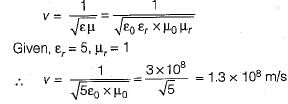
What is the velocity of a plane wave in a lossless medium having a relative permittivity of 5 and relative permeability of unity?
Detailed Solution: Question 4
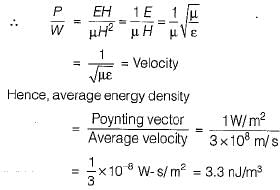
A plane wave in free space has an average Poynting vector of 1 Wm-2. The average energy density is
Detailed Solution: Question 5
Infree space  are respectively given by
  and
and  The value of β and H0 are respectively
are respectively given by and The value of β and H0 are respectivelyDetailed Solution: Question 6
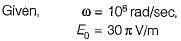
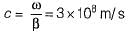
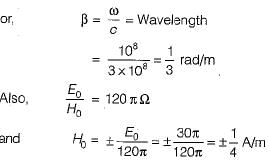
In a homogeneous non-conducting region where 
 The value of ∈r and ω are
The value of ∈r and ω areDetailed Solution: Question 7

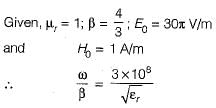
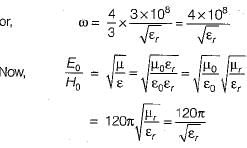
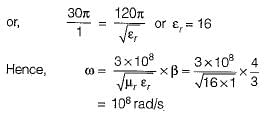

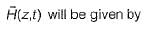
Detailed Solution: Question 8
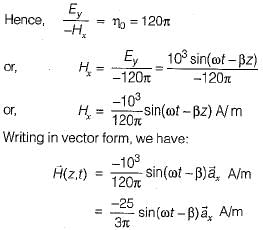
 we can find that direction of propagation is +z.
 must also lie in a + z direction, A must have the direction
Assertion (A): Uniform plane electromagnetic waves are transverse in nature.
Reason (R): Uniform plane electromagnetic
waves have components of  only in direction perpendicular to the direction of propagation and not in the direction of propagation.
Reason (R): Uniform plane electromagnetic
waves have components of
only in direction perpendicular to the direction of propagation and not in the direction of propagation.Assertion (A): The term  is sometimes referred to the loss tangent.
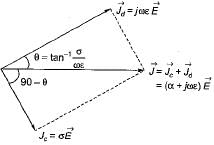
Reason (R): The two vectors Jc (conduction current density) and Jd (displacement current density) are 180° out of phase and are in the opposite direction in space.
is sometimes referred to the loss tangent.Reason (R): The two vectors Jc (conduction current density) and Jd (displacement current density) are 180° out of phase and are in the opposite direction in space.
Detailed Solution: Question 10