
Electromagnetic radiation, Bohr model - Free MCQ Practice Test with solutions,
MCQ Practice Test & Solutions: Test: Electromagnetic radiation, Bohr model (20 Questions)
You can prepare effectively for JEE Chemistry for JEE Main & Advanced with this dedicated MCQ Practice Test (available with solutions) on the important topic of "Test: Electromagnetic radiation, Bohr model". These 20 questions have been designed by the experts with the latest curriculum of JEE 2026, to help you master the concept.
Test Highlights:
- - Format: Multiple Choice Questions (MCQ)
- - Duration: 20 minutes
- - Number of Questions: 20
Sign up on EduRev for free to attempt this test and track your preparation progress.

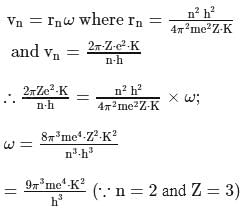
What is the angular velocity  of an electron occupying second orbit of
  ion?
ion?
of an electron occupying second orbit of ion?Detailed Solution: Question 1
The ion that is isoelectronic with CO is-
Detailed Solution: Question 2

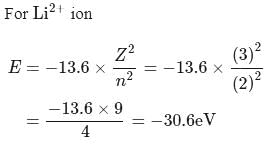
The energy of an electron in first Bohr orbit of  atom is
  . The energy value of electron in the excited state of
  is:
is:
atom is . The energy value of electron in the excited state of is:Detailed Solution: Question 3
The Bohr's energy equation for H atom reveals that the energy level of a shell is given by E = −13.58/n2eV. The smallest amount that an H atom will absorb if in ground state is
Detailed Solution: Question 4

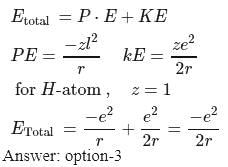
If the electron of a hydrogen atom is present in the first orbit, the total energy of the electron is
Detailed Solution: Question 5
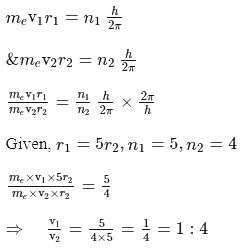
An electron, e1 is moving in the fifth stationary state, and another electron e2 is moving in the fourth stationary state. The radius of orbit of electron, e1 is five times the radius of orbit of electron, e2 calculate the ratio of velocity of electron e1(v1) to the velocity of electron e2(v2)
Detailed Solution: Question 6
In a hydrogen atom, if energy of an electron 1n ground state is 13.6.ev, then that in the 2nd excited state is
Detailed Solution: Question 7
 or
or 
What is the ratio of the atomic radius of the 5th orbit in chlorine atom and 3rd orbit in Helium atom?
Detailed Solution: Question 8
An electron in an atom jumps in such a way that its kinetic energy changes from  to
to  . The change in potential energy will be:
Detailed Solution: Question 9

What atomic number of an element "X" would have to become so that the 4 th orbit around X would fit inside the I Bohr orbit of H atom?
Detailed Solution: Question 10


If in Bohr's model, for unielectronic atom, time period of revolution is represented as  where n represents shell no. and
  represents atomic number then the value of
  will be :
Detailed Solution: Question 11

The energy of  in first orbit of
  is
is  . The energy of
  in first orbit of
  is:
is:
in first orbit of is . The energy of in first orbit of is:Detailed Solution: Question 12



If radius of second stationary orbit (in Bohr's atom) is  then radius of third orbit will be:
Detailed Solution: Question 13
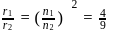
Detailed Solution: Question 14
The energy of an electron in first Bohr orbit of  -atom is
  . The possible energy value of electron in the excited state of
  is
is
Detailed Solution: Question 15


 and for
  ion,
ion, 
The kinetic energy of an electron in the second Bohr orbit of a hydrogen atom is [a0 is Bohr radius] :
Detailed Solution: Question 16


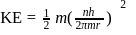

 Bohr orbit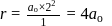
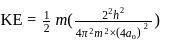

The potential energy of the electron present in the ground state of  ion is represented by:
Detailed Solution: Question 17

 , where
  atomic number of an atom
 ion is
The ratio of kinetic energy and total energy of an electron in Bohr orbit of hydrogen-like species is
Detailed Solution: Question 18

The speed of an electron in the first Bohr orbit is  . The speed of electron in the
  level of
  ion will be
. The speed of electron in the level of ion will beDetailed Solution: Question 19
 , we will have

Which of the following statements regarding Bohr theory of hydrogen atom is not correct?
Detailed Solution: Question 20
 around the nucleus in a stationary orbit of radius
  . The electrostatic force acting on the electron is balanced by the centrifugal force i.e.
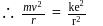 where
where 
 ... (1)
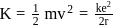 ... (2)
 (using (2))
335 videos|697 docs|300 tests |
