
Ellingham's Diagram & Its Applications: Thermodynamic Principles of Metallurgy
MCQ Practice Test & Solutions: Test: Ellingham's Diagram & Its Applications: Thermodynamic Principles of Metallurgy (Old NCERT) (25 Questions)
You can prepare effectively for JEE Chemistry for JEE Main & Advanced with this dedicated MCQ Practice Test (available with solutions) on the important topic of "Test: Ellingham's Diagram & Its Applications: Thermodynamic Principles of Metallurgy (Old NCERT)". These 25 questions have been designed by the experts with the latest curriculum of JEE 2026, to help you master the concept.
Test Highlights:
- - Format: Multiple Choice Questions (MCQ)
- - Duration: 35 minutes
- - Number of Questions: 25
Sign up on EduRev for free to attempt this test and track your preparation progress.

Only One Option Correct Type
Direction : This section contains 9 multiple choice questions. Each question has four choices (a), (b), (c) and (d), out of which ONLY ONE is correct.
Q.
Ellingham diagram represents a graph of
Detailed Solution: Question 1
ΔG° vsT plot in the Ellingham diagram slopes down for the reaction.
Detailed Solution: Question 2
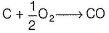

The following reactions take place in the blast furnace in the preparation of impure iron. Identify the reaction pertaining to the formation of the slag.
Detailed Solution: Question 3
Which metal has a greater tendency to form metal oxide?
Detailed Solution: Question 4
The main reaction occurring in blast furnace during the extraction of iron from haematite is
Detailed Solution: Question 5
Consider the following reactions at 10000° C,

Then choose the correct statement from the following.
Detailed Solution: Question 6
According to Ellingham diagrams the oxidation reaction of carbon and carbon monoxide may be used to reduce which one of the following oxides at the lowest temperature?
Detailed Solution: Question 7
The minimum voltage required to electrolyse alumina in the Hall-Heroult process is [Given,  (Al2O3) = - 1520 kJ/mol and
  (CO2) = 394 k J/mol]
(Al2O3) = - 1520 kJ/mol and (CO2) = 394 k J/mol]Detailed Solution: Question 8


Based on the given information (CaO) = - 604.2 kJ/mol and (Al2O3) = - 1582 kJ/mol, which of the following is feasible?
(CaO) = - 604.2 kJ/mol and (Al2O3) = - 1582 kJ/mol, which of the following is feasible?Detailed Solution: Question 9
One or More than One Options Correct Type
Direction : This section contains 5 multiple choice questions. Each question has four choices (a), (b), (c) and (d), out of which ONE or MORE THAN ONE are correct.
Q.
For the metallurgical process of which of the calcined ore can be reduced by carbon?
Detailed Solution: Question 10
For which oxide formation ΔG° is more negative than Gr2O3?
Detailed Solution: Question 11
 for Al2O3 and MgO is more negative than Cr2O3.
In the extraction of iron from haematite in blast furnace reducing agent
Detailed Solution: Question 12
Based on the given information,  (CaO) = -604.2 kJ/mol and (Al2O3) = - 1582 kJ/mol, which o f the following is correct?
(CaO) = -604.2 kJ/mol and (Al2O3) = - 1582 kJ/mol, which o f the following is correct?Detailed Solution: Question 13
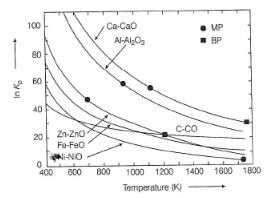
Consider the Ellingham diagram given below. Which metal(s) in the diagram can be extracted at 1100 K using coke as a reducing agent?
Detailed Solution: Question 14
Comprehension Type
Direction : This section contains a paragraph, describing theory, experiments, data, etc. Two questions related to the paragraph have been given. Each question has only one correct answer among the four given options (a), (b), (c) and (d).
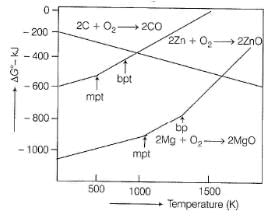
Passage
Q.
To make the reduction ZnO+ C → Zn + CO spontaneous, temperature should be
Detailed Solution: Question 15
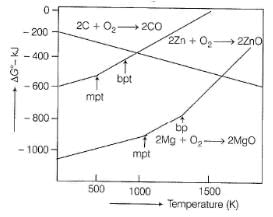
Passage
Q.
At 1100°C, which reaction is spontaneous to a maximum extent ?
Detailed Solution: Question 16
Matching List Type
Direction : Choices for the correct combination of elements from Column I and Column II are given as options (a), (b), (c) and (d), out of which one is correct.
Q.
Match the Column I with Column II and mark the correct option from the codes given below.
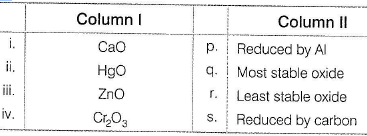
Detailed Solution: Question 17
Match the Column I with Column II and mark the correct option from the codes given below.
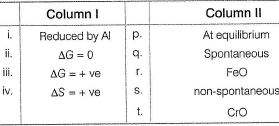
Detailed Solution: Question 18
One Integer Value Correct Type
Direction : This section contains 5 questions. When worked out will result in an integer from 0 to 9 (both inclusive).
Q.
In the Gibbs equation at equilibrium the value of ΔG is
Detailed Solution: Question 19
The reaction 3CaO + 2AI → Al2O3 + 3Ca is non-spontaneous. The number of electrons involved are
Detailed Solution: Question 20
The given reaction 2AI + Cr2O3 → Al2O3 + 2Cr is spontaneous. The number of electrons involved are
Detailed Solution: Question 21
Among PbO, ZnO, CaO, Al2O3, SnO2, Cr2O3, WO3, HgO the oxides reduced by carbon are
Detailed Solution: Question 22
Cu2+ + Fe → Cu + Fe2+ for this reaction to calculate ΔG° the formula ΔG° = - nFE° is used. Here, value of n is
Detailed Solution: Question 23
Statement Type
Direction : This section is based on Statement I and Statement II. Select the correct answer from the codes given below.
Q.
Statement I : Carbon is good reducing agent for sulphides.
Statement II : Carbon is poor reducing agent for iron oxide.
Detailed Solution: Question 24
Statement I : Carbon can reduce Fe2O3 to Fe at a temperature below 983 K.
Statement II : Iron has higher affinity toward oxygen than carbon.
Detailed Solution: Question 25
332 videos|699 docs|300 tests |
