
Emulsions and Gels. - Free MCQ Practice Test with solutions, JEE Chemistry
MCQ Practice Test & Solutions: Test: Emulsions and Gels. (15 Questions)
You can prepare effectively for JEE Chemistry for JEE Main & Advanced with this dedicated MCQ Practice Test (available with solutions) on the important topic of "Test: Emulsions and Gels.". These 15 questions have been designed by the experts with the latest curriculum of JEE 2026, to help you master the concept.
Test Highlights:
- - Format: Multiple Choice Questions (MCQ)
- - Duration: 20 minutes
- - Number of Questions: 15
Sign up on EduRev for free to attempt this test and track your preparation progress.

 white precipitate of
  is peptized with di.
  . The sol particle will carry
Detailed Solution: Question 1

 (Positive charge)
The gold numbers of protective colloids  and
and  are
are  and 40 respectively. The protective powers of
  and
and  are in the order :
and are and 40 respectively. The protective powers of and are in the order :Detailed Solution: Question 2

In an experiment, addition of  of
of 
 to
to  of arsenius sulphide sol just causes the complete coagulation in
  . The flocculating value of the effective ion is
of to of arsenius sulphide sol just causes the complete coagulation in . The flocculating value of the effective ion isDetailed Solution: Question 3
 sol is negatively charged owing to preferential adsorption of
  ions. Cation would be the effective ion in coagulation. Flocculating value
  minimum milli mol of the effective ion per litre of sol =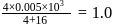
Arrange the following electrolytes in the increasing order of coagulating power for ferric hydroxide sol

Detailed Solution: Question 4
Detailed Solution: Question 5
Given below are a few electrolytes, indicate which one among them will bring about the coagulation of a gold sol quickest and in the least of concentration?
Detailed Solution: Question 6
 is most effective for coagulation.
Under the influence of an electric field, the particles in a sol migrate towards cathode. The coagulation of the same sol is studied using  ,
,  and
and  solutions. Their coagulating values will be in maximum for:
Detailed Solution: Question 7
The process of converting a precipitate into colloidal solution is known as
Detailed Solution: Question 8
 colloidal solution
 precipitate
 sol, the most effective coagulating agent is
Detailed Solution: Question 9
 is a negatively charged sol, therefore positively charged ion is required to coagulate it. Hence,
  has the maximum coagulating power.
Coagulation value of the electrolytes  and
and  for
for  sol are
  and 52 respectively. How many times
  has greater coagulating power than
  ?
?
Detailed Solution: Question 10



The protecting power of lyophilic colloidal sol is expressed in terms of :
Detailed Solution: Question 11
Which property of colloids is not dependent on the charge of colloidal particles?
Detailed Solution: Question 12
Detailed Solution: Question 13
Which of the following is most powerful to coagulate the negative colloid?
Detailed Solution: Question 14

Detailed Solution: Question 15
335 videos|699 docs|300 tests |
