MCAT Exam  >  MCAT Test  >  Biochemistry  >  Test: Enzyme Kinetics - 1 - MCAT MCQ

Enzyme Kinetics - 1 - Free MCQ Practice Test with solutions, MCAT Biochemistry


MCQ Practice Test & Solutions: Test: Enzyme Kinetics - 1 (10 Questions)

You can prepare effectively for MCAT Biochemistry for MCAT with this dedicated MCQ Practice Test (available with solutions) on the important topic of "Test: Enzyme Kinetics - 1". These 10 questions have been designed by the experts with the latest curriculum of MCAT 2026, to help you master the concept.

Test Highlights:

  • - Format: Multiple Choice Questions (MCQ)
  • - Duration: 10 minutes
  • - Number of Questions: 10

Sign up on EduRev for free to attempt this test and track your preparation progress.

Test: Enzyme Kinetics - 1 - Question 1

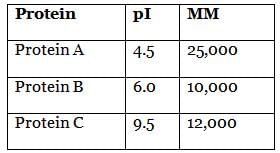
At what pH can protein A best be obtained through electrophoresis? (Note: MM = molar mass)
Detailed Solution: Question 1

In most electrophoresis experiments, we attempt to separate out one component from the others. Because we are attempting to isolate protein A only, a pH that causes protein A to be negative while proteins B and C are neutral or positive will be best. pH 5.5 accomplishes this goal; proteins B and C will be positively charged. A pH of 4.5, choice (C), would make protein A neutral, and it would thus not migrate across the gel. Any neutral impurities would also remain in the well with protein A, making this pH not the best choice.

Test: Enzyme Kinetics - 1 - Question 2

Which of the following is NOT involved in cell migration?

Detailed Solution: Question 2

From the given choices, all of them are involved in cell movement with the exception of choice (D). Centrioles are composed of microtubules, but are involved in mitosis, not cell motility.

Test: Enzyme Kinetics - 1 - Question 3

Hormones are found in the body in very low concentrations, but tend to have a strong effect. What type of receptor are hormones most likely to act on?
I. Ligand-gated ion channels
II. Enzyme-linked receptors
III. G protein-coupled receptors

Detailed Solution: Question 3

For a ligand present in low quantities to have a strong action, we expect it to initiate a second messenger cascade system. Second messenger systems amplify signals because enzymes can catalyze a reaction more than once while they are active, and often activate other enzymes. Both enzyme-linked receptors and G protein-coupled receptors use second messenger systems, while ion channels do not.

Test: Enzyme Kinetics - 1 - Question 4

Which of the following characteristics is NOT attributed to antibodies?

Detailed Solution: Question 4

Antibodies are specific to a single antigen. Each B-cell produces a single type of antibody with a constant region that is specific to the host and a variable region that is specific to an antigen.

Test: Enzyme Kinetics - 1 - Question 5

Which of the following is NOT a component of all trimeric G proteins?

Detailed Solution: Question 5

All trimeric G proteins have αβ, and γ subunits—choices (A), (B), and (C), respectively. Gs, Gi, and Gq are subtypes of the Gα subunit of the trimeric G protein and differ depending on the G protein-coupled receptor’s function.

Test: Enzyme Kinetics - 1 - Question 6

Which amino acids contribute most significantly to the pI of a protein?
I. Lysine
II. Glycine
III. Arginine

Detailed Solution: Question 6

The overall pI of a protein is determined by the relative number of acidic and basic amino acids. The basic amino acids arginine, lysine, and histidine, and the acidic amino acids aspartic acid and glutamic acid will therefore contribute most significantly. Glycine’s side chain is a hydrogen atom, so it will have the least contribution of all the amino acids.

Test: Enzyme Kinetics - 1 - Question 7

Which protein properties allow UV spectroscopy to be used as a method of determining concentration?

Detailed Solution: Question 7

UV spectroscopy is best used with conjugated systems of double bonds. While the double bond in the peptide bond does display resonance, this is not adequate for UV absorption. However, aromatic systems are conjugated, and phenylalanine, tyrosine, and tryptophan all contain aromatic ring structures.

Test: Enzyme Kinetics - 1 - Question 8

What property of protein-digesting enzymes allows for a sequence to be determined without fully degrading the protein?

Detailed Solution: Question 8

The selective cleavage of proteins by digestive enzymes allows fragments of different lengths with known amino acid endpoints to be created. By cleaving the protein with several different enzymes, a basic outline of the amino acid sequence can be created.

Test: Enzyme Kinetics - 1 - Question 9

What is the function of sodium dodecyl sulfate (SDS) in SDS-PAGE?

Detailed Solution: Question 9

Sodium dodecyl sulfate is a detergent and will digest proteins to form micelles with uniform negative charges. Because the protein is sequestered within the micelle, other factors such as charge of the protein and shape have minimal roles during separation. In essence, the protein micelles can be modeled as being spheres, dependent only on size.

Test: Enzyme Kinetics - 1 - Question 10

Which of the following proteins is most likely to be found extracellularly?

Detailed Solution: Question 10

The most prevalent extracellular proteins are keratin, elastin, and collagen. Tubulin and actin are the primary cytoskeletal proteins, while myosin is a motor protein.

138 videos|22 docs|26 tests
Information about Test: Enzyme Kinetics - 1 Page
In this test you can find the Exam questions for Test: Enzyme Kinetics - 1 solved & explained in the simplest way possible. Besides giving Questions and answers for Test: Enzyme Kinetics - 1, EduRev gives you an ample number of Online tests for practice
138 videos|22 docs|26 tests
Download as PDF