
General Properties of Group-16 - Free MCQ Practice Test with solutions,
MCQ Practice Test & Solutions: Test: General Properties of Group-16 (14 Questions)
You can prepare effectively for JEE Chemistry for JEE Main & Advanced with this dedicated MCQ Practice Test (available with solutions) on the important topic of "Test: General Properties of Group-16". These 14 questions have been designed by the experts with the latest curriculum of JEE 2026, to help you master the concept.
Test Highlights:
- - Format: Multiple Choice Questions (MCQ)
- - Duration: 20 minutes
- - Number of Questions: 14
Sign up on EduRev for free to attempt this test and track your preparation progress.

Non-metals combine with oxygen to form usually
Detailed Solution: Question 1
 is
isDetailed Solution: Question 2


Detailed Solution: Question 3
Which one of the following statements is not correct?
Detailed Solution: Question 4
Tailing of mercury test can be used for which of the following gas?
Detailed Solution: Question 5
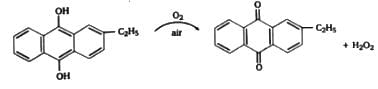
By which of the following methods,  can't synthesized?
can't synthesized?Detailed Solution: Question 6
 is not peroxy compound)


 .
.A green coloured solution of same salt changes its colour to light pink on passing ozone through it. Which of the following species represent pink and green colour respectively?
Detailed Solution: Question 7
 having manganate ion
  .
. having permangate ion
  ,
, (green in colour) to
  (Light pink in colour).
Which of the following on thermal decomposition gives oxygen gas ?
Detailed Solution: Question 8
Correct order of  bond length (increasing) in
  and
and  is
is
bond length (increasing) in and isDetailed Solution: Question 9
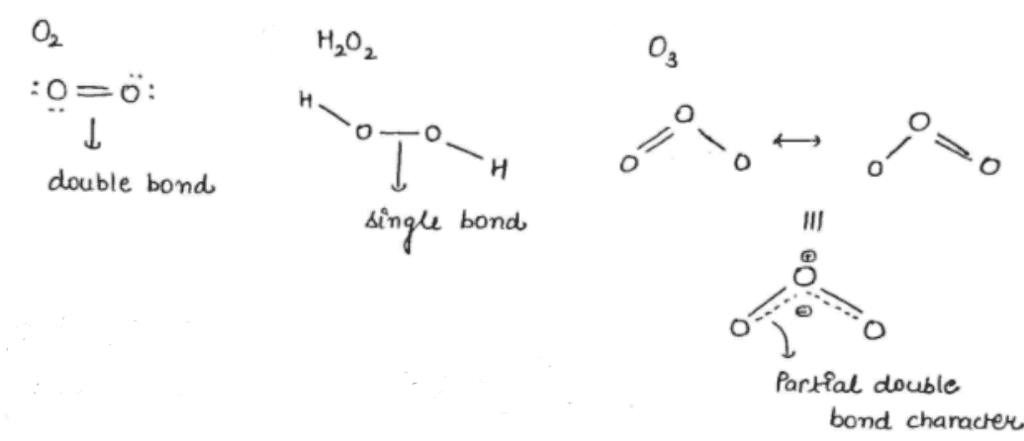
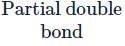 < Single bond
Which of the following statements regarding ozone is not correct?
Detailed Solution: Question 10
 and double
  bonds. The bond angle is
  is
is  with
with  distance
  .
.Which of the following oxidation state of oxygen is not observed in its compounds
Detailed Solution: Question 11
 do not show
  oxidation state because its valency is only
  .
.  electrons takes more energy to ionize.
An organic compound containing sulphur is estimated by Carius method in which fuming  is used to convert
  into :
Detailed Solution: Question 12
 is converted to
 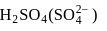 .
.Identify the correct statements from the following.
(i) Oxygen shows  and +2 oxidation states.
(ii) The thermal stability of  and
and  follows the order
  Se.
Se.
(iii) The reducing nature of  and
and  follows the order
(i) Oxygen shows
and +2 oxidation states.(ii) The thermal stability of
and follows the order Se.(iii) The reducing nature of
and follows the order Detailed Solution: Question 13
 and +2 oxidation states.
 ), +1 in
  and +2 in
  .
. and +2 oxidation states.
 and
and  follows the order
  This is because, on going down the group, the size of the central atom increases and therefore, its tendency to form stable covalent bond with hydrogen decreases. As a result, the
  bond strength decreases and therefore, thermal stability decreases.
 and
and  Te follows the order
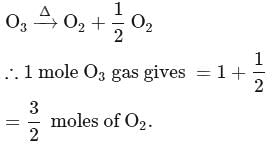
Photochemical smog consists of excessive amount of  , in addition to aldehydes, ketones, peroxy-acetyl nitrile (PAN), and so forth,
  is:
is:
Detailed Solution: Question 14
 .
.335 videos|697 docs|300 tests |
