Chemistry Exam  >  Chemistry Test  >  Organic   >  Test: Grignard Reagent - Chemistry MCQ

Grignard Reagent - Free MCQ Practice Test with solutions, Chemistry Organic


MCQ Practice Test & Solutions: Test: Grignard Reagent (10 Questions)

You can prepare effectively for Chemistry Organic Chemistry with this dedicated MCQ Practice Test (available with solutions) on the important topic of "Test: Grignard Reagent". These 10 questions have been designed by the experts with the latest curriculum of Chemistry 2026, to help you master the concept.

Test Highlights:

  • - Format: Multiple Choice Questions (MCQ)
  • - Duration: 30 minutes
  • - Number of Questions: 10

Sign up on EduRev for free to attempt this test and track your preparation progress.

Test: Grignard Reagent - Question 1

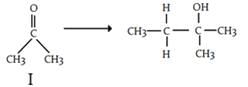
Which of the following reaction sequence that will best carry out the following preparation?
Detailed Solution: Question 1

In the first step, the Grignard forms the carbon-carbon bond. This results in an alkoxide (the conjugate base of an alcohol). To form the alcohol, it’s necessary to add acid at the end of the reaction and this reaction usually occurs in Et2O or THF followed by H3O+ work-ups.

Test: Grignard Reagent - Question 2

Which of the following reagents, when treated with phenylmagnesiuim bromide followed by acid workup, will yield 2-phenylethanol?

Detailed Solution: Question 2
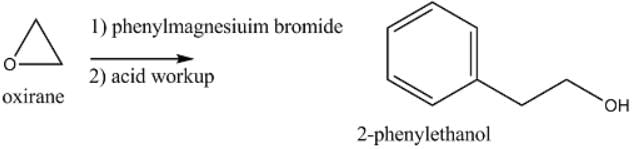
Oxirane (ethylene oxide or epoxide) when treated with phenylmagnesiuim bromide (C6​H5​−Mg−Br) followed by acid workup, will yield 2-phenylethanol.

Test: Grignard Reagent - Question 3

A Grignard’s reagent may be made by reacting magnesium with which of the following compound?

Detailed Solution: Question 3

A Grignard’s reagent can be formed by reacting magnesium with Ethyl iodide, as shown below;
C2H5I + Mg + Dryether → C2H5 − Mg − I (Ethylmagnesium iodide)

Test: Grignard Reagent - Question 4

Which of the following statements about Grignard reagent is false?

Detailed Solution: Question 4

It is supposed that the Mg-C bond is strongly polar covalent, not ionic. Grignard’s reagents are less reactive than organosodium, -potassium and -lithium compounds, that is the reason why it is more convenient to work with them.

Test: Grignard Reagent - Question 5

Which is not present in Grignard reagent?

Detailed Solution: Question 5

Grignard reagents are made from halogenoalkanes (haloalkanes or alkyl halides) and introduces some of their reactions. A Grignard reagent has a formula RMgX where X is a halogen, and R is an alkyl or aryl (based on a benzene ring) group.

Test: Grignard Reagent - Question 6

Which of the following compounds would not give tert-butyl alcohol when treated with excess methylmagnesium bromide?

Detailed Solution: Question 6

Acetaldehyde would not give tert-butyl alcohol when treated with excess methylmagnesium bromide, as the Grignard Reaction is the addition of an organomagnesium halide (Grignard reagent) to a ketone or aldehyde, to form a tertiary or secondary alcohol, respectively.

Test: Grignard Reagent - Question 7

Which of the following compounds gives a primary alcohol upon reaction with phenylmagnesium bromide?

Detailed Solution: Question 7

Ethylene oxide reacts with Grignard reagents to give, after protonation, primary alcohols with two additional carbon atoms.

Test: Grignard Reagent - Question 8

Which of the following compounds gives a secondary alcohol upon reaction with methylmagnesium bromide?

Detailed Solution: Question 8

Pentanal gives a secondary alcohol upon reaction with methylmagnesium bromide, as the Grignard Reaction is the addition of an organomagnesium halide (Grignard reagent) to a ketone or aldehyde, to form a tertiary or secondary alcohol, respectively.

Test: Grignard Reagent - Question 9

Which of the following compounds does not give a tertiary alcohol upon reaction with methylmagnesium bromide/?

Detailed Solution: Question 9

3-Methylpentanal does not give a tertiary alcohol upon reaction with methylmagnesium bromide (a Grignard reagent).


  • Grignard reagents react with carbonyl compounds to form alcohols.
  • Aldehydes (like 3-methylpentanal) react with Grignard reagents to form secondary alcohols.
  • Ketones react to form tertiary alcohols.
  • Esters react to form tertiary alcohols after two equivalents of Grignard reagent.

Since 3-methylpentanal is an aldehyde, it forms a secondary alcohol, not a tertiary one.

Test: Grignard Reagent - Question 10

Alkyl halides can be converted into Grignard reagents by _______________

Detailed Solution: Question 10

Alkyl halides can be converted into Grignard reagents by warming them with magnesium powder in dry ether.
RX + Mg + Dry ether → R−Mg−X

39 videos|96 docs|46 tests
Information about Test: Grignard Reagent Page
In this test you can find the Exam questions for Test: Grignard Reagent solved & explained in the simplest way possible. Besides giving Questions and answers for Test: Grignard Reagent, EduRev gives you an ample number of Online tests for practice
39 videos|96 docs|46 tests
Download as PDF