
Group 15 Elements: Nitrogen Group - Free MCQ Practice Test with solutions,
MCQ Practice Test & Solutions: Test: Group 15 Elements: Nitrogen Group (20 Questions)
You can prepare effectively for JEE Chemistry for JEE Main & Advanced with this dedicated MCQ Practice Test (available with solutions) on the important topic of "Test: Group 15 Elements: Nitrogen Group". These 20 questions have been designed by the experts with the latest curriculum of JEE 2026, to help you master the concept.
Test Highlights:
- - Format: Multiple Choice Questions (MCQ)
- - Duration: 20 minutes
- - Number of Questions: 20
Sign up on EduRev for free to attempt this test and track your preparation progress.

 dil.
dil. 

 and
and  are respectively
Detailed Solution: Question 1
In nitrogen family, the H-M-Hbond angle in the hydrides gradually becomes closer to  on going from
  to
to  . This shows that gradually
Detailed Solution: Question 2

 can be removed by
Detailed Solution: Question 3
 which is brown
A deep brown gas is formed by mixing two colourless gases which are
Detailed Solution: Question 4
 brown
brownWhich of the following compounds does not exist?
Detailed Solution: Question 5
The brown ring test for  and
and  is due to the formation of complex ion with a formula
Detailed Solution: Question 6
 ion is formed
An element  forms compounds of the formula
  and
and  but does not form
  .
.
Which of the following is the element 
forms compounds of the formula and but does not form .Which of the following is the element
Detailed Solution: Question 7
 and not
  since it has no
  atomic orbitals in valence shell
Detailed Solution: Question 8
 is a planar molecule whereas
  is pyramidal because
Detailed Solution: Question 9
 there is
  hybridisation (planar) whereas in
  hybridisation is
  hence shape is pyramidal
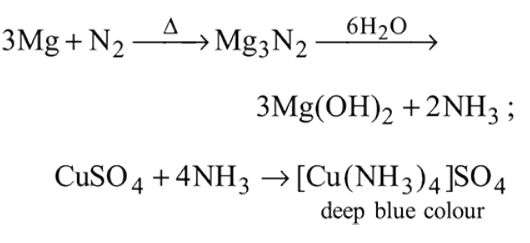
A metal  on heating in nitrogen gas gives
  on treatment with
  gives a colourless gas which when passed through
  solution gives a blue colour.
  is
is
Detailed Solution: Question 10
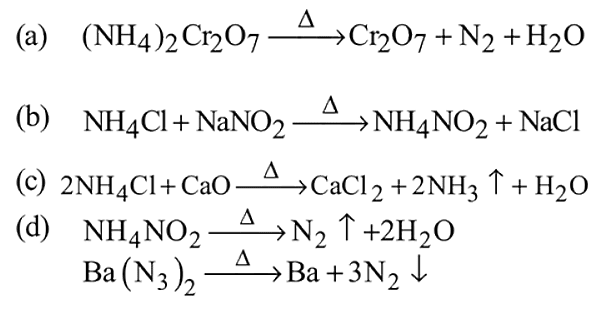
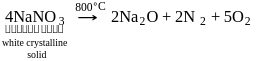
Which reaction(s) among the following produce dinitrogen?

Detailed Solution: Question 11
 on heating gives
  and
and  . This reaction is a source of pure nitrogen.

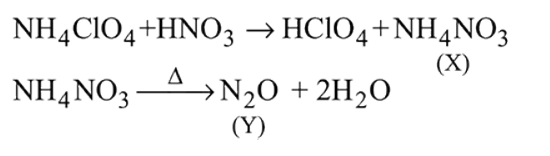
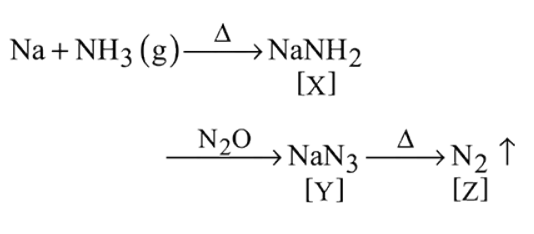
Consider the following sequence of reaction.

Identify  gas :
gas :
Identify
gas :Detailed Solution: Question 12
Among the following compounds, which on heating do not produce  ?
?
?Detailed Solution: Question 13
Which of the following statements is not true?
Detailed Solution: Question 14
 is paramagnetic and readily dimerises to
  which is diamagnetic.
The compounds formed by the reaction of ammonia with chlorine and iodine are respectively
Detailed Solution: Question 15
 and
and  respectively as follows

 on heating liberates a gas. The same gas will be obtained by
Detailed Solution: Question 16


Among the following elements which one can not form pentahalides.
Detailed Solution: Question 17
When sugar is treated with conc. sulphuric acid, the sugar is charred. In this process, sugar is
Detailed Solution: Question 18

Which of the following nitrogen oxide is a neutral oxide?
Detailed Solution: Question 19
 and
and  are acidic oxide while
  is a neutral oxide.
(I) 
(II)
The incorrect statement regarding above reactions is
Detailed Solution: Question 20
 , it is very polarizing and favours the formation of
  .
.

335 videos|699 docs|300 tests |
