
Group 17 Elements: Halogens - Free MCQ Practice Test with solutions, JEE
MCQ Practice Test & Solutions: Test: Group 17 Elements: Halogens (15 Questions)
You can prepare effectively for JEE Chemistry for JEE Main & Advanced with this dedicated MCQ Practice Test (available with solutions) on the important topic of "Test: Group 17 Elements: Halogens". These 15 questions have been designed by the experts with the latest curriculum of JEE 2026, to help you master the concept.
Test Highlights:
- - Format: Multiple Choice Questions (MCQ)
- - Duration: 20 minutes
- - Number of Questions: 15
Sign up on EduRev for free to attempt this test and track your preparation progress.

A white precipitate is obtained on hydrolysis of
Detailed Solution: Question 1

Which of the following arrangements gives the correct order of increasing oxidation number of iodine?
Detailed Solution: Question 2


Mark the element which shows only one oxdation state
Detailed Solution: Question 3

Which of the following is not correctly matched?
Detailed Solution: Question 4
 is
isDetailed Solution: Question 5
 , hence octahedral
What are the products formed when chlorine is passed through aqueous hypo solution?
Detailed Solution: Question 6

Which one of the following reactions does not occur?
Detailed Solution: Question 7
Of the interhalogen  compounds,
  is most reactive but
  has higher conductance
in liquid state. This is because
Detailed Solution: Question 8
 dissociates into
  and
and  ions most easily.
Which of the following is the best description for the behaviour of bromine in the reaction given below ? 
Detailed Solution: Question 9
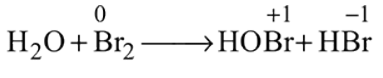
 and also decreases from 0 to
  . Thus it is oxidised as well as reduced.
Detailed Solution: Question 10
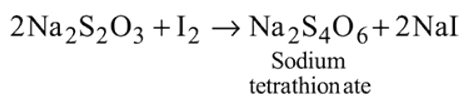
Which of the following is correct about the reaction?

Detailed Solution: Question 11
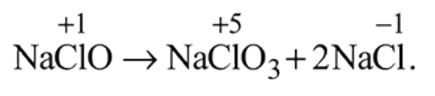
 and
and  results in
Detailed Solution: Question 12
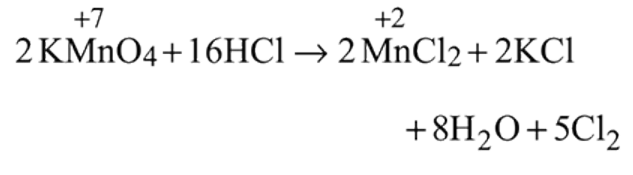
 to
to  hence reduction occurs and
  is formed.
The correct order of reactivity of halogens with alkalies is
Detailed Solution: Question 13

Among the following oxoacids, the correct order of acid strength is
Detailed Solution: Question 14

Which of the following species is not a pseudo halide :-
Detailed Solution: Question 15
 is not a pseudohlide ion. Remaining
  and
and  are pseudohlide ions.
332 videos|699 docs|300 tests |
