Civil Engineering (CE) Exam  >  Civil Engineering (CE) Test  >  GATE 2027 Mock Test Series  >  Test: Highway Geometric Design -1 - Civil Engineering (CE) MCQ

GATE Civil Engineering (CE) 2027 Test: Highway Geometric Design -1 Free


MCQ Practice Test & Solutions: Test: Highway Geometric Design -1 (10 Questions)

You can prepare effectively for Civil Engineering (CE) GATE Civil Engineering (CE) 2027 Mock Test Series with this dedicated MCQ Practice Test (available with solutions) on the important topic of "Test: Highway Geometric Design -1". These 10 questions have been designed by the experts with the latest curriculum of Civil Engineering (CE) 2026, to help you master the concept.

Test Highlights:

  • - Format: Multiple Choice Questions (MCQ)
  • - Duration: 30 minutes
  • - Number of Questions: 10

Sign up on EduRev for free to attempt this test and track your preparation progress.

Test: Highway Geometric Design -1 - Question 1

The shape of the camber, best suited for cement concrete pavements, is

Detailed Solution: Question 1

The camber is given a parabolic, elliptic or straight line shape in the cross-section. Parabolic or elliptic shape is given so that the profile is flat at the middle and steeper towards the edges, which is preferred by fast moving vehicles.
When very flat cross slope is provided as in cement concrete pavements, straight line shape of camber may be provided.

Test: Highway Geometric Design -1 - Question 2

For water bound macadam roads in localities of heavy rainfall, the recommended value of camber is

Detailed Solution: Question 2

For water bound macadam roads in areas with heavy rainfall, camber is crucial for effective drainage. The camber helps to direct water away from the road surface, reducing the risk of damage and improving safety.

The recommended camber values are as follows:

  • 1 in 30: This angle offers a steep gradient, which is effective in quickly draining water but may lead to stability issues.
  • 1 in 33: A balanced option, providing good drainage while maintaining road stability, making it a popular choice.
  • 1 in 48: This option has a gentler slope, which can enhance comfort for drivers but may not drain water as efficiently.
  • 1 in 60: The flattest camber, suitable for less prone areas to flooding but can allow water to accumulate on the surface.

In summary, for heavy rainfall conditions, the best recommendation is a camber of 1 in 33, as it combines effective drainage with road stability.

Test: Highway Geometric Design -1 - Question 3

When the path travelled along the road surface is more than the circumferential movement of the wheels due to rotation, then it results in

Detailed Solution: Question 3

Skid occurs when vehicles slide without revolving or when the wheels partially revolve i.e., when the path travelled along the road surface is more than the circumferential movements of the wheels due to their rotation. Slip occurs when a wheel revolves more than the corresponding longitudinal movement along the roads.

Test: Highway Geometric Design -1 - Question 4

Coefficient of friction is less when the pavement surface is

Detailed Solution: Question 4

The coefficient of friction reduces considerably when the pavement surface is smooth or wet. The coefficient of friction also decreases slightly with increase in temperature, tyre pressure and load. But on wet pavements new tyres with good treads give higher friction factors than worn out tyres.

Test: Highway Geometric Design -1 - Question 5

Compared to a level surface, on a descending gradient the stopping sight distance is

Detailed Solution: Question 5

When there is a descending gradient the component of gravity is subtracted from the braking distance and hence the stopping sight distance is more.

Test: Highway Geometric Design -1 - Question 6

The minimum length of overtaking zone as per IRC recommendation is equal to

Detailed Solution: Question 6

The minimum length of overtaking zone should be three times the safe overtaking distance i.e., 3(d1 + d2) for one-way roads and 3(d1 + d2 + d3) for two-way roads. It is desirable that the length of overtaking zone is kept five times the overtaking sight distance.

Test: Highway Geometric Design -1 - Question 7

If the stopping distance is 60 metres, then the minimum stopping sight distance for two lane, two way traffic is

Detailed Solution: Question 7

The minimum stopping sight distance should be equal to the stopping distance in one-way traffic lanes and also in two-way traffic roads when there are two or more traffic lanes.

Test: Highway Geometric Design -1 - Question 8

The ruling design speed on a National Highway in plain terrain as per IRC recommendation is

Detailed Solution: Question 8

100 kmph is the ruling design speed for National Highways in plain terrain as per IRC:73-1980 and other relevant IRC standards. Plain terrains allow for long, straight alignments with minimal curves, enabling safe and efficient travel at higher speeds.

Test: Highway Geometric Design -1 - Question 9

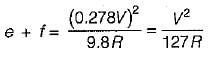
The equilibrium superelevation required to counteract the centrifugal force fully is given by

Detailed Solution: Question 9

As we know,

e = rate of superelevation
f = lateral friction coefficient = 0.15
V = speed of vehicle, m/s
R = radius of horizontal curve, m
g = acceleration due to gravity = 9.8 m/s2
If speed of vehicle is represented as \/kmph then,

If f = 0, the equilibrium superelevation required to counteract the centrifugal force fully will be given by,

Test: Highway Geometric Design -1 - Question 10

The attainment of superelevation by rotation of pavement about the inner edge of the pavement

Detailed Solution: Question 10

The method of rotating about inner edge is preferable in flat terrain in high rain fall area, when the road is not taken on embankment, in order to avoid the drainage problem.

33 docs|280 tests
Information about Test: Highway Geometric Design -1 Page
In this test you can find the Exam questions for Test: Highway Geometric Design -1 solved & explained in the simplest way possible. Besides giving Questions and answers for Test: Highway Geometric Design -1, EduRev gives you an ample number of Online tests for practice
Download as PDF