You can prepare effectively for NEET Biology Class 12 with this dedicated MCQ Practice Test (available with solutions) on the important topic of "Test: Human Reproduction - 1". These 22 questions have been designed by the experts with the latest curriculum of NEET 2026, to help you master the concept.
Test Highlights:
Sign up on EduRev for free to attempt this test and track your preparation progress.
Detailed Solution: Question 1
Topic in NCERT: Male reproductive system
Line in NCERT: "the secretions of these glands constitute the seminal plasma which is rich in fructose, calcium and certain enzymes."
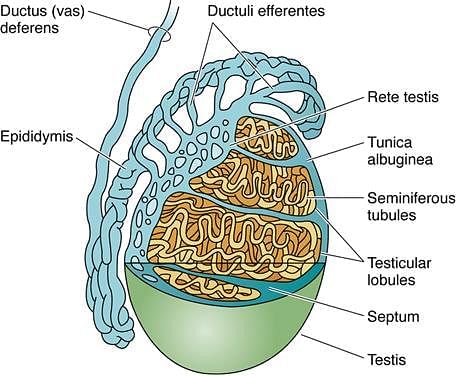
Each testes has about 250 compartments called as _________.
Detailed Solution: Question 2
Topic in NCERT: Human reproduction
Line in NCERT: "each testis has about 250 compartments called testicular lobules."
Detailed Solution: Question 3
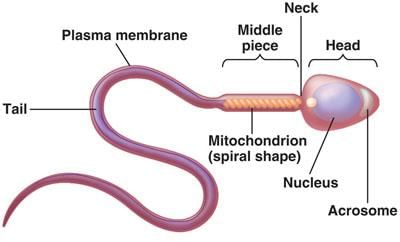
Topic in NCERT: Structure of a sperm
Line in NCERT: "the middle piece possesses numerous mitochondria, which produce energy for the movement of tail that facilitate sperm motility essential for fertilisation."
The conversion of spermatid into spermatozoa is called?
Detailed Solution: Question 4
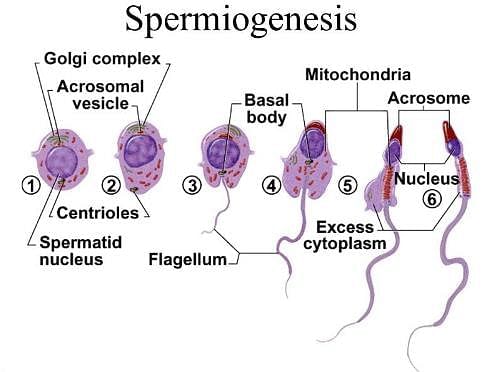
Topic in NCERT: Spermiogenesis
Line in NCERT: "the spermatids are transformed into spermatozoa (sperms) by the process called spermiogenesis."
The number of polar bodies formed during oogenesis (if first polar divides) in human being is:
Detailed Solution: Question 5
Topic in NCERT: Oogenesis
Line in NCERT: "the primary oocyte within the tertiary follicle grows in size and completes its first meiotic division. it is an unequal division resulting in the formation of a large haploid secondary oocyte and a tiny first polar body."
Detailed Solution: Question 6
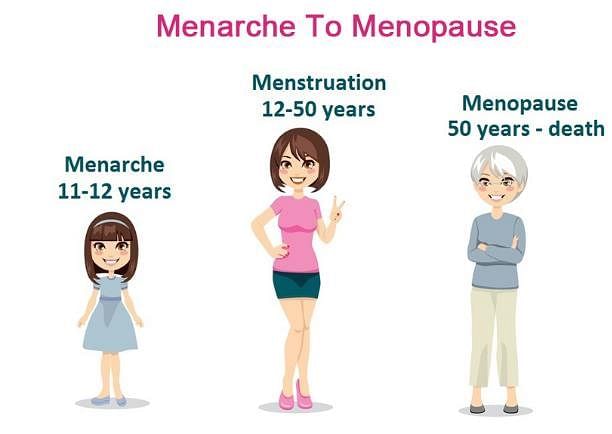
Topic in NCERT: Menstrual cycle
Line in NCERT: "the first menstruation begins at puberty and is called menarche."
Ovulation occurs on about_________ day of menstrual cycle.
Detailed Solution: Question 7
Topic in NCERT: Menstrual cycle
Line in NCERT: "one ovum is released (ovulation) during the middle of each menstrual cycle."
The cellular layer that disintegrates and regenerates again and again is _______.
Detailed Solution: Question 8
Topic in NCERT: Human reproduction
Line in NCERT: "the endometrium undergoes cyclical changes during menstrual cycle while the myometrium exhibits strong contraction during delivery of the baby."
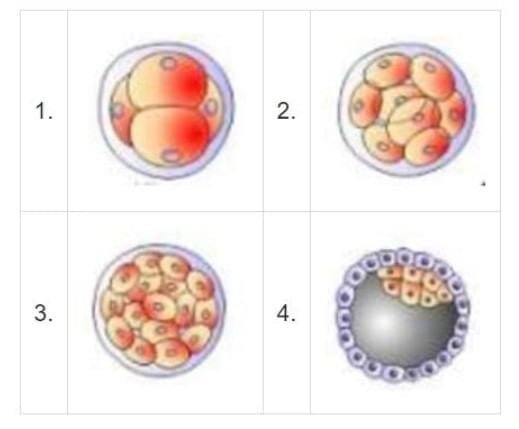
During which month of pregnancy the first movement of fetus is observed?
Detailed Solution: Question 9
Topic in NCERT: Embryonic development during pregnancy
Line in NCERT: "the first movements of the foetus and appearance of hair on the head are usually observed during the fifth month."
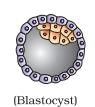
What structure gets implanted on the wall of the uterus during embryonic development?

Detailed Solution: Question 10
Topic in NCERT: Pregnancy and embryonic development
Line in NCERT: "the trophoblast layer then gets attached to the endometrium and the inner cell mass gets differentiated as the embryo."
Detailed Solution: Question 11
Topic in NCERT: Sperm structure and function
Line in NCERT: "the acrosome is filled with enzymes that help fertilisation of the ovum."
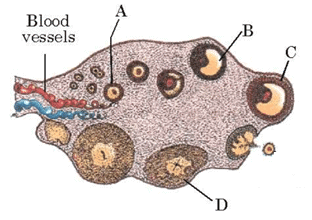
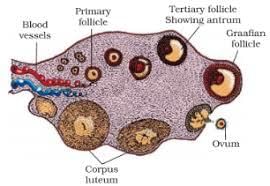
The figure below shows the development of follicles (A, B, C, D). Select the option giving correct identification together with its function?

Detailed Solution: Question 12
Topic in NCERT: Human reproduction
Line in NCERT: "the corpus luteum secretes large amounts of progesterone which is essential for maintenance of the endometrium."
Hormone responsible for milk ejection after the birth of baby is:
Detailed Solution: Question 13
Topic in NCERT: Parturition and lactation
Line in NCERT: "the process of childbirth is called parturition which is induced by a complex neuroendocrine mechanism involving cortisol, estrogens and oxytocin."
The yellowish coloured milk secreted from the breast shortly after birth of the baby is called?
Detailed Solution: Question 14
Topic in NCERT: Lactation
Line in NCERT: "the milk produced during the initial few days of lactation is called colostrum which contains several antibodies absolutely essential to develop resistance for the new-born babies."
Which of the following hormones are secreted by the placenta?
A. Human chorionic gonadotropin
B. Human placental lactogen
C. Estrogen
D. Progestogens
Detailed Solution: Question 15
The correct sequence of spermatogenetic stages leading to the formation of sperms in a mature human testis is:
Detailed Solution: Question 16
Topic in NCERT: Spermatogenesis
Line in NCERT: "the spermatogonia (sing. spermatogonium) present on the inside wall of seminiferous tubules multiply by mitotic division and increase in numbers. some of the spermatogonia called primary spermatocytes periodically undergo meiosis. a primary spermatocyte completes the first meiotic division (reduction division) leading to formation of two equal, haploid cells called secondary spermatocytes, which have only 23 chromosomes each. the secondary spermatocytes undergo the second meiotic division to produce four equal, haploid spermatids."
Detailed Solution: Question 17
Detailed Solution: Question 18
Which of the statements given above is/are correct?
i. Oogenesis is initiated during the embryonic development stage when oogonia are formed in the ovaries.
ii. A primary oocyte completes its first meiotic division before birth.
iii. The tertiary follicle develops a fluid-filled cavity known as the antrum.
iv. At puberty, approximately 100,000 primary follicles remain in each ovary.
Detailed Solution: Question 19
Topic in NCERT: Oogenesis
Line in NCERT: "the secondary follicle soon transforms into a tertiary follicle which is characterised by a fluid filled cavity called antrum."
"it is important to draw your attention that it is at this stage that the primary oocyte within the tertiary follicle grows in size and completes its first meiotic division."
"therefore, at puberty only 60,000-80,000 primary follicles are left in each ovary."
Which of the statements given above is/are correct?
i. LH and FSH both reach peak levels around the 14th day of the menstrual cycle.
ii. The LH surge causes the degeneration of the corpus luteum.
iii. Progesterone secreted by the corpus luteum is essential for maintaining the endometrium.
iv. Menstruation occurs if fertilization does not take place, leading to the start of a new cycle.
Detailed Solution: Question 20
Topic in NCERT: Menstrual cycle
Line in NCERT: "both lh and fsh attain a peak level in the middle of cycle (about 14th day). rapid secretion of lh leading to its maximum level during the mid-cycle called lh surge induces rupture of graafian follicle and thereby the release of ovum (ovulation)."
"the corpus luteum secretes large amounts of progesterone which is essential for maintenance of the endometrium."
"in the absence of fertilisation, the corpus luteum degenerates. this causes disintegration of the endometrium leading to menstruation, marking a new cycle."
Assertion (A): The male reproductive system includes the testes, which produce sperm and hormones.
Reason (R): The Leydig cells in the testes are responsible for the production of androgens, which are essential for sperm formation.
Detailed Solution: Question 21
Assertion (A): Oogenesis results in the formation of a single ovum during each menstrual cycle.
Reason (R): The cyclical changes in the ovaries are influenced solely by the levels of ovarian hormones, without any involvement from pituitary hormones.
Detailed Solution: Question 22
Topic in NCERT: Menstrual cycle
Line in NCERT: "the cyclical changes in the ovary and the uterus during menstrual cycle are induced by changes in the levels of pituitary and ovarian hormones."
69 videos|305 docs|161 tests |