
Hybrididation and VSEPR theory - Free MCQ Practice Test with solutions,
MCQ Practice Test & Solutions: Test: Hybrididation and VSEPR theory (20 Questions)
You can prepare effectively for JEE Chemistry for JEE Main & Advanced with this dedicated MCQ Practice Test (available with solutions) on the important topic of "Test: Hybrididation and VSEPR theory". These 20 questions have been designed by the experts with the latest curriculum of JEE 2026, to help you master the concept.
Test Highlights:
- - Format: Multiple Choice Questions (MCQ)
- - Duration: 20 minutes
- - Number of Questions: 20
Sign up on EduRev for free to attempt this test and track your preparation progress.

In compounds of type ECl3, where E = B,P, As or Bi, the angles Cl − E − Cl for different E are in the order.
Detailed Solution: Question 1
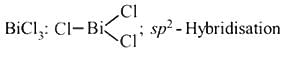
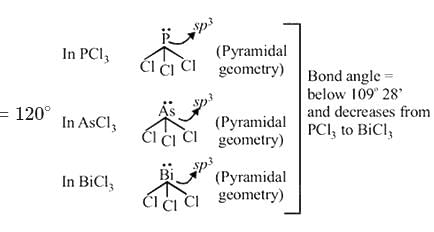
For which of the following sets of geometry, both axial and equatorial positions are present?
Detailed Solution: Question 2
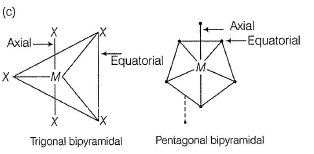

Detailed Solution: Question 3
Which one of the following is a correct pair with respect to molecular formula of xenon compound and hybridization state of xenon in it?
Detailed Solution: Question 4
 undergoes
  hybridisation, whereas
  undergoes
  hybridisation.
Chlorine atom, in its third excited state, reacts with fluorine to form a compound  . The formula and shape of
  are :
are :
Detailed Solution: Question 5



 . Its shape is pentagonal bipyramidal.
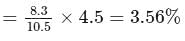
The bond angle between two hybrid orbitals is  Calculate the percentage of
  -character of hybrid orbital.
Calculate the percentage of -character of hybrid orbital.Detailed Solution: Question 6
Main axis of a diatomic molecule is Z. AO's  and
and  overlap to form which of the following orbitals?
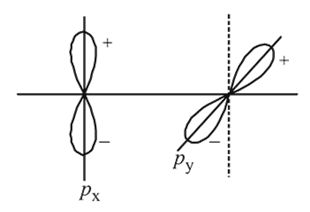
and overlap to form which of the following orbitals?Detailed Solution: Question 7
 and
and  orbitals do not have proper orientation to overlap and hence no bond is formed.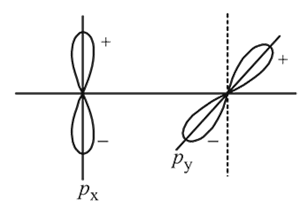
Observe the following statements:
i. According to VSEPR theory,  and
and  are shown
  and
and  type molecules respectively.
ii.  has "See-saw" shape.
iii.  and
and  have same shape.
The statements which are not correct are
Detailed Solution: Question 8
 has 3 bond pairs and 2 lone pairs thus it is
  type molecule whereas
  has
has  bond pairs and one lone pair so it is
  type molecule.
 has a linear shape because it has 2 bond pairs only whereas
  has 2 bond pairs with one lone pair thus it has a bent shape.
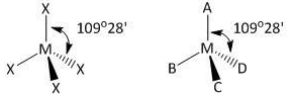
The compound MX4 is tetrahedral. The number of ∠XMX formed in the compound are
Detailed Solution: Question 9
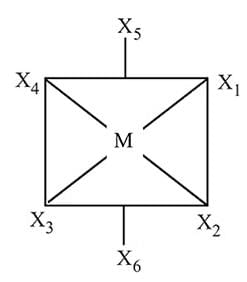
In a regular octahedral molecule, MX6 the number of X−M−X bonds at 180∘ is
Detailed Solution: Question 10



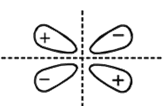
Which of the following molecular orbitals has two nodal planes?
Detailed Solution: Question 11

In the reaction  , the change in hybridisation is from
, the change in hybridisation is fromDetailed Solution: Question 12


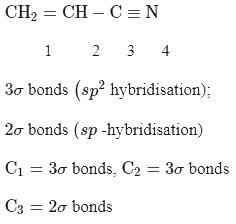
Which of the following represents the given mode of hybridisation sp2 − sp2 − sp − sp from left to right ?
Detailed Solution: Question 13
Which of the following statement is incorrect?
(i)  being an ionic compound is a good conductor of electricity in the solid state.
(ii) In canonical structures there is no difference in the arrangement of atoms.
(iii) Hybrid orbitals form stronger bonds than pure orbitals.
(iv) VSEPR theory can explain the square planar geometry of  .
.
Detailed Solution: Question 14
 dissolves in water, the bond is broken and sodium and chlorine separate forming ions like
  and
and  . Therefore, having free ions, it is able to conduct electricity. So, the option (1) is incorrect.
Detailed Solution: Question 15

 -bonds at
  -atom
-atom 
 -atom
-atom 

 .
. is linear
 bonds at
  -atom
-atom 


 .
. is tetrahedral.
Detailed Solution: Question 16
 does not obey octet rule as in it S-atom has 12 electrons in its valence shell.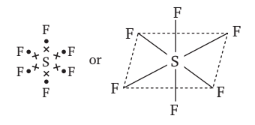
In which one of the following pairs the two species have identical shape, but differ in hybridisation?
Detailed Solution: Question 17
 in
in  undergoes
  hybridisation giving a linear shape with three lone pairs at equatorial positions. Beryllium chloride has linear structure with
  hybridisation of Be atom.
Which one of the following molecules will form a linear polymeric structure due to H-bonding?
Detailed Solution: Question 18
On hybridization of one  and one p-orbital we get
Detailed Solution: Question 19
 -hybrid orbitals is
  .
. is
isDetailed Solution: Question 20

335 videos|699 docs|300 tests |
