NEET Exam  >  NEET Test  >  Chemistry Class 11  >  Test: Importance & Scope Of Chemistry - NEET MCQ

Importance & Scope Of Chemistry - NEET Class 11 Free MCQ Test with solutions


MCQ Practice Test & Solutions: Test: Importance & Scope Of Chemistry (10 Questions)

You can prepare effectively for NEET Chemistry Class 11 with this dedicated MCQ Practice Test (available with solutions) on the important topic of "Test: Importance & Scope Of Chemistry". These 10 questions have been designed by the experts with the latest curriculum of NEET 2026, to help you master the concept.

Test Highlights:

  • - Format: Multiple Choice Questions (MCQ)
  • - Duration: 20 minutes
  • - Number of Questions: 10

Sign up on EduRev for free to attempt this test and track your preparation progress.

Test: Importance & Scope Of Chemistry - Question 1

The two effective drugs which act as life-saving drugs for cancer therapy and AIDS victims respectively are:

Detailed Solution: Question 1

  • Cisplatin is particularly effective against testicular cancer.
  • Taxol (paclitaxel) is a mitotic inhibitor used in cancer chemotherapy.
  • AZT is used for helping AIDS victims.

Additional Information: Its mode of action has been linked to its ability to crosslink with the purine bases on the DNA; interfering with DNA repair mechanisms, causing DNA damage, and subsequently inducing apoptosis in cancer cells. 

Test: Importance & Scope Of Chemistry - Question 2

Which of the following statements is/are correct?

Detailed Solution: Question 2

  • A molecule is made up of atoms bonded together. 
  • The law of definite proportions, sometimes called Proust's law, or the law of constant composition states that a given chemical compound always contains its component elements in a fixed ratio (by mass) and does not depend on its source and method of preparation.

Since both statements A and B are correct, the correct option is D. 

Test: Importance & Scope Of Chemistry - Question 3

10 g of calcium reacts with 10 g of oxygen to form calcium oxide.

2Ca+O2→2CaO

Maximum mass of CaO formed is:

Detailed Solution: Question 3

The correct answer is Option A - 14 g

Use Ca = 40 g mol-1, O = 16 g mol-1, so O2 = 32 g mol-1 and CaO = 56 g mol-1.

Moles of calcium = 10 g ÷ 40 g mol-1 = 0.25 mol.

Moles of oxygen (as O2) = 10 g ÷ 32 g mol-1 = 0.3125 mol.

The reaction consumes 2 mol Ca per 1 mol O2, so oxygen required for 0.25 mol Ca is 0.125 mol; available oxygen is greater, therefore calcium is the limiting reagent.

Moles of CaO formed = moles of limiting reagent Ca = 0.25 mol.

Mass of CaO = 0.25 mol × 56 g mol-1 = 14 g, which confirms the selected option.

Test: Importance & Scope Of Chemistry - Question 4

The number of significant figures in 3256 is:

Detailed Solution: Question 4

  • The significant figures of numbers are digits to convey the meaning that contributes to its measurement resolution.
  • Non-zero digits are always significant.
  • Here, 3256, this number has four non-zero numbers.
  • That's why it has four significant figures.

Test: Importance & Scope Of Chemistry - Question 5

A compound contains 40% carbon, 6.67% hydrogen, and 53.33% oxygen. Find empirical formula.

Detailed Solution: Question 5

Assume 100 g compound:

C = 40 g → 40/12 = 3.33 mol
H = 6.67 g → 6.67/1 = 6.67 mol
O = 53.33 g → 53.33/16 = 3.33 mol

Divide by smallest (3.33):

C = 1
H = 2
O = 1

Empirical formula = CH2O

Test: Importance & Scope Of Chemistry - Question 6

A 5 g mixture of Na2CO3 and NaHCO3 on heating gives 0.44 g CO2Find % of NaHCO3 in mixture.

Reaction:

2NaHCO→ Na2CO+ CO+H2O

Detailed Solution: Question 6

The correct answer is Option B - 33.6%

2 NaHCO3 → Na2CO3 + CO2 + H2O

M(NaHCO3) = 84 g mol-1 and M(CO2) = 44 g mol-1.

From the equation, 2 mol NaHCO3 (168 g) produce 1 mol CO2 (44 g).

Therefore, 1 g of NaHCO3 yields 44/168 g of CO2, and the mass of NaHCO3 that produced the observed CO2 is (168/44) × 0.44 = 1.68 g.

The percentage of NaHCO3 in the mixture is (1.68/5) × 100 = 33.6%, which corresponds to the stated option.

Test: Importance & Scope Of Chemistry - Question 7

If the true value for a result is 3.00 m and a student records two readings as 3.01 m and 2.99 m, then we can conclude that:​

Detailed Solution: Question 7

  • Precision indicates how closely repeated measurements match each other.
  • Accuracy indicates how closely a measurement matches the correct or expected value.

Since the readings closely match the result and the expected value, the correct answer is that the values are both accurate and precise. 

Test: Importance & Scope Of Chemistry - Question 8

The scientific notation for 0.00016 is:​

Detailed Solution: Question 8

Move the decimal point to the right of 0.00016 up to 4  places.

The decimal point was moved 7 places to the right to form the number 1.6

Since the numbers are less than 10 and the decimal is moved to the right, so we use a negative exponent here.

⇒ 0.00016 = 1.6 × 10⁻⁴

Explanation: 

  • Scientific notation is a form of presenting very large numbers or very small numbers in a simpler form.
  • Scientific notation is used to represent the numbers that are very huge or very tiny in a form of multiplication of a single-digit number and 10 raised to the power of the respective exponent.
  • The exponent is positive if the number is very large and it is negative if the number is very small. 

Test: Importance & Scope Of Chemistry - Question 9

Suppose the elements X and Y combine to form two compounds XY2 and X3Y2. When 0.1 mole of XY2 weighs 10 g and 0.05 mole of X3Y2 weighs 9 g, the atomic weights of X and Y are:

Detailed Solution: Question 9
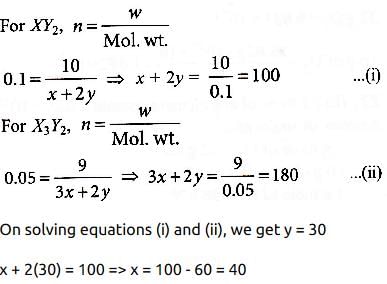
Let atomic weight of element X is x and that of element Y is y.

Test: Importance & Scope Of Chemistry - Question 10

Molecular mass of glucose molecule (C6H12O6) is:

Detailed Solution: Question 10

Molecular mass: The sum of the atomic masses of all the atoms in a molecule of a substance is called the molecular mass of the molecule.

Generally, we use relative atomic masses of atoms for calculating the molecular mass of 1 mole of any molecular or ionic substances.

The molecular formula of glucose is C6H12O6

  • The atomic mass of H = 1
  • The atomic mass of C = 12
  • The atomic mass of O = 16

Molecular mass of C6H12O6 = 12 (Atomic mass of Hydrogen) + 6(Atomic mass of carbon) + 6(Atomic mass of oxygen)

= 12 × 1 + 6 × 12 + 6 × 16

= 12 + 72 + 96 = 180 u.

97 videos|243 docs|71 tests
Information about Test: Importance & Scope Of Chemistry Page
In this test you can find the Exam questions for Test: Importance & Scope Of Chemistry solved & explained in the simplest way possible. Besides giving Questions and answers for Test: Importance & Scope Of Chemistry, EduRev gives you an ample number of Online tests for practice
97 videos|243 docs|71 tests
Download as PDF