UPSC Exam  >  UPSC Test  >  Geography CSE  >  Test: Industries - UPSC MCQ

Industries - Free MCQ Practice Test with solutions, UPSC Geography


MCQ Practice Test & Solutions: Test: Industries (15 Questions)

You can prepare effectively for UPSC Geography for UPSC CSE with this dedicated MCQ Practice Test (available with solutions) on the important topic of "Test: Industries". These 15 questions have been designed by the experts with the latest curriculum of UPSC 2026, to help you master the concept.

Test Highlights:

  • - Format: Multiple Choice Questions (MCQ)
  • - Duration: 15 minutes
  • - Number of Questions: 15

Sign up on EduRev for free to attempt this test and track your preparation progress.

Test: Industries - Question 1

The industry that uses iron ore, coal, and limestone as key inputs is the _____ industry.

Detailed Solution: Question 1

The iron and steel industry uses iron ore, coal, and limestone as key inputs for producing steel.

Test: Industries - Question 2

Which industry uses raw materials such as cotton, human labour, and transport costs in its industrial system?

Detailed Solution: Question 2

The textile industry uses raw materials like cotton, human labour, and transport costs in its industrial system to produce various textile products.

Test: Industries - Question 3

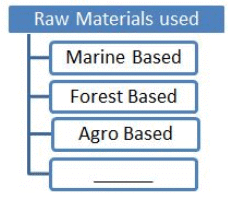
Classify the industries based on the Raw materials they use and complete the image given below:
Detailed Solution: Question 3

Industries are categorized into four types based on raw materials:-

1) Agro: based industries: Plant and animal-based products are used as raw materials in agro-based industries. For example : cotton textile, vegetable oil, food processing, dairy products and leather industries.

2) Mineral based industries: Mineral-based industries are built on mining and mineral ore is used as raw material. These industries also provide raw materials to other industries. They are used for heavy machinery and building materials. For example iron and steel industry, cement industry.

3) Marine based industries: Raw materials from the ocean or sea are used in marine-based industries. For example fish oil.

4) Forest-based industries: Raw materials from the forests like wood are used in forest-based industries. For example paper, pharmaceutical and furniture industries. 

Test: Industries - Question 4

The process of converting raw materials into finished products is part of the _____ system.

Detailed Solution: Question 4

The process of converting raw materials into finished products is part of the industrial system, which includes inputs, processes, and outputs.

Test: Industries - Question 5

Which type of industries are owned and operated by the producers or suppliers of raw materials, workers, or both?

Detailed Solution: Question 5

Cooperative sector industries are owned and operated by the producers or suppliers of raw materials, workers, or both. Examples include Anand Milk Union Limited and Sudha Dairy.

Test: Industries - Question 6

The industry that has emerged significantly in the Bangalore region is the _____ industry.

Detailed Solution: Question 6

The information technology industry has emerged significantly in the Bangalore region, making it a major hub for IT services and innovation.

Test: Industries - Question 7

The government often provides incentives like subsidized power and lower transport costs to industries in _____ areas.

Detailed Solution: Question 7

The government provides incentives to industries in backward areas to promote industrialization and economic growth in less developed regions.

Test: Industries - Question 8

Which industrial region in India includes the steel-producing centers of Bhilai, Durgapur, and Jamshedpur?

Detailed Solution: Question 8

The Chottanagpur Plateau region includes the steel-producing centers of Bhilai, Durgapur, Burnpur, Jamshedpur, Rourkela, and Bokaro.

Test: Industries - Question 9

State whether the following statement is True or False

Industries can be classified based on the size of the products they make.

Detailed Solution: Question 9

  • Industries are classified based on raw materials, size, and ownership, not on the size of the products they make.
  • For example, industries can be classified into small-scale and large-scale based on the amount of capital invested, the number of people employed, and the volume of production.
  • Small-scale industries produce goods on a smaller level compared to large-scale industries that produce goods on a larger scale.

Test: Industries - Question 10

The key factor affecting the location of industries, in addition to land, water, labour, power, and capital, is the _____.

Detailed Solution: Question 10

The market is a key factor affecting the location of industries, as industries need to be located where there is easy access to their market.

Test: Industries - Question 11

Which region is NOT a major industrial region of the world?

Detailed Solution: Question 11

Southern Africa is not considered a major industrial region of the world, unlike Eastern North America, W

Test: Industries - Question 12

Industries using products from the sea and oceans as raw materials are known as _____ industries.

Detailed Solution: Question 12

Marine-based industries use products from the sea and oceans as raw materials, such as seafood processing and fish oil manufacturing.

Test: Industries - Question 13

What is a key difference between small scale and large scale industries?

Detailed Solution: Question 13

Small scale industries often involve handmade products by artisans, such as basket weaving and pottery, and use less capital and simpler technology. Large scale industries focus on large volume production with higher capital and advanced machinery, such as automobile and heavy machinery production. Therefore, a key difference is that small scale uses simple tools and technology, while large scale uses advanced machinery.

Test: Industries - Question 14

Which of the following best describes an agro based industry?

Detailed Solution: Question 14

Agro-based industries: These industries use plants and animal-based products as their raw materials. Examples, food processing, vegetable oil, cotton textile, dairy products, and leather industries.

Test: Industries - Question 15

What is smelting?

Detailed Solution: Question 15

Smelting involves heating ores to a high temperature to separate metals from impurities. Other options do not describe this process accurately.

178 videos|643 docs|194 tests
Information about Test: Industries Page
In this test you can find the Exam questions for Test: Industries solved & explained in the simplest way possible. Besides giving Questions and answers for Test: Industries, EduRev gives you an ample number of Online tests for practice
178 videos|643 docs|194 tests
Download as PDF