Civil Engineering (CE) Exam  >  Civil Engineering (CE) Test  >  Foundation Engineering  >  Test: Infinite Slopes - Civil Engineering (CE) MCQ

Infinite Slopes - Free MCQ Practice Test with solutions, GATE Civil Foundation


MCQ Practice Test & Solutions: Test: Infinite Slopes (10 Questions)

You can prepare effectively for Civil Engineering (CE) Foundation Engineering with this dedicated MCQ Practice Test (available with solutions) on the important topic of "Test: Infinite Slopes". These 10 questions have been designed by the experts with the latest curriculum of Civil Engineering (CE) 2026, to help you master the concept.

Test Highlights:

  • - Format: Multiple Choice Questions (MCQ)
  • - Duration: 30 minutes
  • - Number of Questions: 10

Sign up on EduRev for free to attempt this test and track your preparation progress.

Test: Infinite Slopes - Question 1

Earth embankments or slopes are commonly required for which of the following purpose?

Detailed Solution: Question 1

Earth embankments are commonly required for railways, roadways, earth dams, levees and river training works.

Test: Infinite Slopes - Question 2

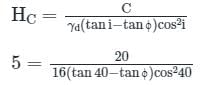
An infinitely long slope is made up of a c-φ soil having the properties: cohesion, C = 20 kPa, and dry unit weight, γd = 16 kN/m3. The angle of inclination and critical height of the slope are 40° and 5 m, respectively. To maintain the limiting equilibrium, the angle of internal friction of the soil (in degrees) is ________

Detailed Solution: Question 2
Stability analysis of an infinite slope of cohesive soils
Shear strength of cohesive soils is given by,
S = C + (γd H Cos2 i) tan ϕ
Shear stress of cohesive soil is given by,
τ = γd H cos i sin i
As the normal stress σ depends upon the height H of the slope, an expression for the height can be found by equating the shear stress and shear strength
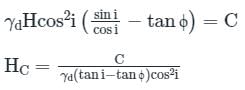
C + (γd H Cos2 i) tan ϕ = γ H cos i sin i

This the height at which the slope is just stable and is known as critical height (HC)
Calculation:
Given,
C = 20 kPa, γd = 16 kN/m3
i = 40°, H = 5 m

tan ϕ = 0.413
ϕ = 22.44° 

Test: Infinite Slopes - Question 3

The failure of slopes may take place due to _____

Detailed Solution: Question 3

The failure of slopes can occur due to a combination of factors, including:

  1. Forces between the soil particles and high water content:

    • The stability of a slope depends on the internal friction and cohesion between soil particles. High water content can reduce these forces by increasing pore water pressure, making the soil weaker and more prone to failure.

  2. Action of gravitational force:

    • Gravity acts on the mass of the soil, creating a driving force that can cause the slope to fail if the resisting forces (e.g., friction and cohesion) are insufficient.

Since both forces between soil particles and high water content and gravitational force contribute to slope failure, the correct answer is:

Test: Infinite Slopes - Question 4

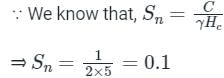
If an infinite slope of clay at a depth 5 m has cohesion of 1 t/m2 and unit weight of 2 t/m3, then the stability number will be

Detailed Solution: Question 4
Taylor's stability number method:
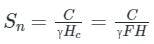
(i) Taylor introduced a dimensional parameter, called taylor's stability number, which is given by

Where, H = Effective height of slope
Hc = Critical height of slope
F = FOS
(ii) In this method, Taylor's stability number is read from taylor's chart in order to analyze the stability of slope for a given values of strength parameters of the soil.
(iii) Taylor's method is suitable for c-ϕ soils and for ϕ = 0 (pue clays)
Calculation:
Given, C = 1 t/m2, γ = 2 t/m2 and Hc = 5 m

Test: Infinite Slopes - Question 5

Slopes is classified into ______ types.

Detailed Solution: Question 5

Slopes may be of two types: i) infinite slopes and ii) finite slopes.

Test: Infinite Slopes - Question 6

Analysis of stability of slopes is used for determining ___________

Detailed Solution: Question 6

An analysis of stability of slopes consist of determining the most severely stressed internal surface and the magnitude of the shearing stress to which it is subjected and determining the shearing stress along the surface.

Test: Infinite Slopes - Question 7

A long natural slope of cohesion-less soil is inclined at 12° to the horizontal. What will be the factor of safety of the slope if φ = 30°?

Detailed Solution: Question 7

Given φ = 30° and i = 12°
Formula, F = tan φ /tan i
F = tan 30° / tan 12°
F = 2.72.

Test: Infinite Slopes - Question 8

In the limiting case of stability, the angle of slope is referred to as ______

Detailed Solution: Question 8

In the limiting case of stability, the angle of slope is known as the angle of repose φ.

Test: Infinite Slopes - Question 9

Which of the following is an example of slopes extending to infinity?

Detailed Solution: Question 9

Slopes extending to infinity do not exist in nature.

Test: Infinite Slopes - Question 10

 If the soil properties for all identical depths below the surface are constant, it is a _________

Detailed Solution: Question 10

If a slope represents the boundary surface of a semi-infinite soil mass, and the soil properties for all identical depths below the surface are constant, it is called an infinite slope.

18 videos|57 docs|27 tests
Information about Test: Infinite Slopes Page
In this test you can find the Exam questions for Test: Infinite Slopes solved & explained in the simplest way possible. Besides giving Questions and answers for Test: Infinite Slopes, EduRev gives you an ample number of Online tests for practice
18 videos|57 docs|27 tests
Download as PDF