NEET Exam  >  NEET Test  >  Biology Class 12  >  Test: Inheritance of One Gene - NEET MCQ

Inheritance of One Gene - Free MCQ Practice Test with solutions, NEET Biology


MCQ Practice Test & Solutions: Test: Inheritance of One Gene (10 Questions)

You can prepare effectively for NEET Biology Class 12 with this dedicated MCQ Practice Test (available with solutions) on the important topic of "Test: Inheritance of One Gene". These 10 questions have been designed by the experts with the latest curriculum of NEET 2026, to help you master the concept.

Test Highlights:

  • - Format: Multiple Choice Questions (MCQ)
  • - Duration: 10 minutes
  • - Number of Questions: 10

Sign up on EduRev for free to attempt this test and track your preparation progress.

Test: Inheritance of One Gene - Question 1

What process needs to be avoided for carrying of efficient crosses?

Detailed Solution: Question 1

Self-pollination leads to fertilization by the pollen from the same flower. A cross desires pollination and fertilization by pollen from a different plant. Hence self-pollination needs to be avoided.

Test: Inheritance of One Gene - Question 2

What are the possible phenotypes that can be observed after self-crossing violet flowered pea plants that are heterozygous for the flower color gene (Vv)?

Detailed Solution: Question 2
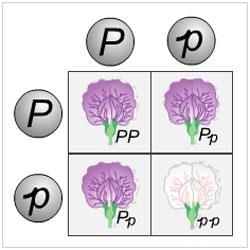
In a self-cross of heterozygous violet-flowered pea plants (Vv), the Punnett square for the flower color gene would yield the following genotypic and phenotypic ratios:

Punnett Squares | epfb

Genotypic Ratio: 25% VV (violet), 50% Vv (violet, but carrying the white allele), 25% vv (white)
Phenotypic Ratio: 75% violet and 25% white

This means that 75% of the offspring would have violet flowers, and 25% would have white flowers. Therefore, the correct answer is option D, "75% violet and 25% white.

Test: Inheritance of One Gene - Question 3

Which one of the following cannot be explained on the basis of Mendel's Law of Dominance?

Detailed Solution: Question 3

Mendel's Law of Dominance states that in a pair of alleles, one may mask the expression of the other. The third option (C) cannot be explained by this law because the Law of Dominance does not address the concept of blending or recovery of both characters in the F2 generation. Instead, it focuses on how dominant traits mask recessive traits, and the characters appear as distinct and separate in the F2 generation.
 

Test: Inheritance of One Gene - Question 4

In 1900 Mendel’s work was rediscovered by:

Detailed Solution: Question 4

Mendel’s work was rediscovered in 1900 by De Vries, Correns, and von Tschermak. They independently found Mendel’s principles of inheritance, which had been overlooked and forgotten after their original publication.

Test: Inheritance of One Gene - Question 5

The pure line round-seeded pea plant was crossed with a wrinkled-seeded pea plant. The F1 generation is ____ and it can be explained by _____.

Detailed Solution: Question 5

The F1 generation from crossing a pure line round-seeded pea plant with a wrinkled-seeded pea plant will be round-seeded. This can be explained by the Law of Dominance, where round seeds are dominant over wrinkled seeds.

Test: Inheritance of One Gene - Question 6

Which of the following was not observed in F2 progeny of true-breeding tall and dwarf plants?

Detailed Solution: Question 6

The F2 progeny has both dwarf and tall plants. 25% of them are homozygous tall, 50% are heterozygous tall, and 25% are homozygous dwarf. Dwarfness is a recessive trait and thus cannot be expressed in the heterozygous state.

Test: Inheritance of One Gene - Question 7

A cross between tall and dwarf plants was performed, and 120 offspring were produced in which 90 plants were tall and 30 were dwarf. Find out the genotype of their parents.

Detailed Solution: Question 7

The ratio of tall to dwarf plants in the offspring (90:30) indicates a 3:1 phenotypic ratio typical of a cross between two heterozygous tall plants (Tt x Tt). Thus, the parents must have been Tt and Tt.

Test: Inheritance of One Gene - Question 8

The presence of two different alleles at a particular locus results in _________

Detailed Solution: Question 8

Heterozygosity refers to different alleles present at a given locus. This is the condition that is of interest to the study of genetics. It can be used to test the nature of an allele.

Test: Inheritance of One Gene - Question 9

If F2 dwarf plants were self-pollinated, then the genotype of F3 & F4 plants is:

Detailed Solution: Question 9

If F2 dwarf plants (genotype tt) are self-pollinated, all the offspring (F3 and F4) will also be dwarf with the genotype tt.

Test: Inheritance of One Gene - Question 10

With green pods as a dominant trait over yellow, which of the following crosses will result in all progeny having yellow pods?

Detailed Solution: Question 10

Yellow being recessive will express only when both alleles are present. That occurs only when both parents can contribute an allele encoding for the yellow pod. For all progeny to have yellow pods, both parents have to be homozygous for yellow pods.

69 videos|305 docs|161 tests
Information about Test: Inheritance of One Gene Page
In this test you can find the Exam questions for Test: Inheritance of One Gene solved & explained in the simplest way possible. Besides giving Questions and answers for Test: Inheritance of One Gene, EduRev gives you an ample number of Online tests for practice
69 videos|305 docs|161 tests
Download as PDF