
Ionic structure, Electrical and Magnetic properties - Free MCQ Practice
MCQ Practice Test & Solutions: Test: Ionic structure, Electrical and Magnetic properties (10 Questions)
You can prepare effectively for JEE Chemistry for JEE Main & Advanced with this dedicated MCQ Practice Test (available with solutions) on the important topic of "Test: Ionic structure, Electrical and Magnetic properties". These 10 questions have been designed by the experts with the latest curriculum of JEE 2026, to help you master the concept.
Test Highlights:
- - Format: Multiple Choice Questions (MCQ)
- - Duration: 20 minutes
- - Number of Questions: 10
Sign up on EduRev for free to attempt this test and track your preparation progress.

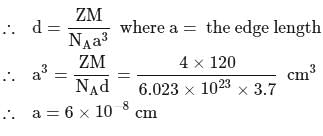
KBr has rock salt type structural arrangements and has a density of 3.70 g/cm3. The edge length of the unit cell is approximately [molecular weight of KBr = 120 g/mol]
Detailed Solution: Question 1
The radii of  and
and  ions are
  and 181 pm respectively. The edge length of
  unit cell is
and ions are and 181 pm respectively. The edge length of unit cell isDetailed Solution: Question 2
 lattice, the distance between the cation and anion is equal to the sum of their radii, which is equal to half of the edge length of unit cell,


CsBr has bcc structure with edge length 4.3. The shortest interionic distance in between Cs+ and Br− is
Detailed Solution: Question 3

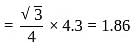
 half the distance between two nearest neighbouring atoms.
Which set of following characteristics for  crystal is correct?
Detailed Solution: Question 4
 has cubic close packed
  structure. The
  ions are present at the corners of the cube and at the centre of each face. Zinc ions occupy half of the tetrahedral sites. Each zinc ion is surrounded by four sulphide ions which are disposed towards the corners of a regular tetrahedron. Similarly,
  ion is surrounded by four
  ions.
ions.In  type structure, the co-ordination number of
  and
and  respectively are
Detailed Solution: Question 5
 for
for  and
and 
CsBr crystallises in a body centered cubic lattice. The unit cell length is 436.6pm. Given that the atomic mass of Cs = 133 and that of Br = 80amu and Avogadro number being 6.02 × 10²³ mol−1 the density of CsBr is
Detailed Solution: Question 6
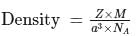
 two formula unit of
  in 1 cubic unit
  and edge length,

 .
.
How many unit cells are present in 4.0gm of crystal AB (formula mass of AB = 40) having rock salt type structure? (NA = Avogadro's no.)
Detailed Solution: Question 7
 are present in a unit cell
The  ratio of
  is
is  . Pick out the incorrect statements from the following?
Detailed Solution: Question 8
 ion is too small to fit into the octahedral voids of
  ions.
ions.For  , if
, if  is just like the rock salt like structure then,
  and
and  are located at
Detailed Solution: Question 9
 is just like
  . Thus twelve
  are at edges and 1 within body of
  i.e. in octahedral voids and
  at faces and 8 at corner.
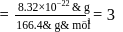
A molecule A2 B(Mwt. = 166.4) occupies triclinic lattice with a 5Å,b = 8Å, and c = 4Å If the density of AB2 is 5.2 g cm−3, the number of molecules present in one unit cell is
Detailed Solution: Question 10

335 videos|699 docs|300 tests |
