JEE Exam  >  JEE Test  >  Chapter-wise Tests Main & Advanced  >  Test: Isolation of Elements - 1 (Old NCERT) - JEE MCQ

Isolation of Elements - 1 (Old NCERT) - Free MCQ Practice Test with solutions,


MCQ Practice Test & Solutions: Test: Isolation of Elements - 1 (Old NCERT) (25 Questions)

You can prepare effectively for JEE Chapter-wise Tests for JEE Main & Advanced with this dedicated MCQ Practice Test (available with solutions) on the important topic of "Test: Isolation of Elements - 1 (Old NCERT)". These 25 questions have been designed by the experts with the latest curriculum of JEE 2026, to help you master the concept.

Test Highlights:

  • - Format: Multiple Choice Questions (MCQ)
  • - Duration: 35 minutes
  • - Number of Questions: 25

Sign up on EduRev for free to attempt this test and track your preparation progress.

Test: Isolation of Elements - 1 (Old NCERT) - Question 1

The common impurity present in most of the ores is

Detailed Solution: Question 1

Silica is most common impurity present in ores.

Test: Isolation of Elements - 1 (Old NCERT) - Question 2

Which metal is also found in sea beds ?

Detailed Solution: Question 2

Manganese is found in sea beds.

Test: Isolation of Elements - 1 (Old NCERT) - Question 3

The sulphide ore of iron is

Detailed Solution: Question 3

FeS2 is iron pyrites.

Test: Isolation of Elements - 1 (Old NCERT) - Question 4

Carbonate ore of iron is

Detailed Solution: Question 4

FeCO3 is siderite.

Test: Isolation of Elements - 1 (Old NCERT) - Question 5

The process of separating gangue and other impurities from the metals is known as

Detailed Solution: Question 5

Process of removal of impurities from ore is known as concentration of ore or benefication of ore.

Test: Isolation of Elements - 1 (Old NCERT) - Question 6

Which technique utilizes the density difference between the ore and the impurity to concentrate the ore is

Detailed Solution: Question 6

Levigation is process of grinding an insoluble substance to a fine powder while wet. The material is introduced into mill together with water. It is based on the density difference between ore and impurity.

Test: Isolation of Elements - 1 (Old NCERT) - Question 7

Gravity separation technique is mainly applicable to

Detailed Solution: Question 7

Gavity separation is done maily for oxide ores.

Test: Isolation of Elements - 1 (Old NCERT) - Question 8

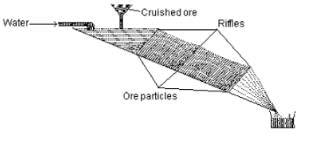
The diagram shows schematic representation of 
Detailed Solution: Question 8

This is hydraulic washing or gravity separation. Here whwn stream of water is passed it takes away all the impurity with it.

Test: Isolation of Elements - 1 (Old NCERT) - Question 9

In extraction of gold and silver, the metals is leached into aqueous solution using

Detailed Solution: Question 9

CN- forms complex with gold or silver.

Test: Isolation of Elements - 1 (Old NCERT) - Question 10

Liquation method is used for the metals which have

Detailed Solution: Question 10

Liquification is purification technique used for metals having low melting points.

Test: Isolation of Elements - 1 (Old NCERT) - Question 11

Ultrapurification method is used for

Detailed Solution: Question 11

Fact

Test: Isolation of Elements - 1 (Old NCERT) - Question 12

Which metal is used in paints and lacquers?

Detailed Solution: Question 12

Al is generally used in paints and lacquers.

Test: Isolation of Elements - 1 (Old NCERT) - Question 13

Extraction process of Bauxite is known as

Detailed Solution: Question 13

Hall – Heroult process of extraction of Al from Bauxite.

Test: Isolation of Elements - 1 (Old NCERT) - Question 14

Which among the following ores are not found on earth’s crust?

Detailed Solution: Question 14

Nitrides are not found in Earth crust.

Test: Isolation of Elements - 1 (Old NCERT) - Question 15

In the froth floatation process for the concentration of ore, the particles float because

Detailed Solution: Question 15

In froth floatation ore particles get wetted with oil and comes to the surface with froath.

Test: Isolation of Elements - 1 (Old NCERT) - Question 16

Which among the following act as froth stabilizer?

Detailed Solution: Question 16

Aniline stabalises the froath.

Test: Isolation of Elements - 1 (Old NCERT) - Question 17

Impurities associated with Bauxite ore is/are

Detailed Solution: Question 17


Bauxite ore have silica, Fe2O3, TiO2 as impurity.

Test: Isolation of Elements - 1 (Old NCERT) - Question 18

At 1123 K temperature in the blast furnace, CO reduces

Detailed Solution: Question 18

At this Temp range free energy for the process is negative.

Important Questions for Class 12 Chemistry Chapter 6 General ...

Hence A is correct.

Test: Isolation of Elements - 1 (Old NCERT) - Question 19

In the extraction of nickel by Mond’s process, the metal is obtained by

Detailed Solution: Question 19

Ni is first reacted with CO to form Nickel tetracarbonyl which is volatile. From this complex Nickel is extracted by thermal decomposition.

Test: Isolation of Elements - 1 (Old NCERT) - Question 20

Blister copper is about

Detailed Solution: Question 20

Blistter Cu is 98% Cu.

Test: Isolation of Elements - 1 (Old NCERT) - Question 21

Refining of silver is done by

Detailed Solution: Question 21

Cupellation is a process where ores are treated under high temperatures and controlled operations to separate noble metals like gold and silver, from base metals like led, copper, zinc, and others present in the ore or alloyed metal.

Test: Isolation of Elements - 1 (Old NCERT) - Question 22

Which of the following ore contains both Mg and Ca?

Detailed Solution: Question 22

Dolomite is MgCO3.CaCO3

Test: Isolation of Elements - 1 (Old NCERT) - Question 23

Leaching of gold is done by

Detailed Solution: Question 23

Cyanide forms soluble complex with the gold.

Test: Isolation of Elements - 1 (Old NCERT) - Question 24

Which among the following reaction takes place in zone of heat absorption?

Detailed Solution: Question 24

Reduction of CO2 to CO involves heat absorption.

Test: Isolation of Elements - 1 (Old NCERT) - Question 25

Calamine is an ore of

Detailed Solution: Question 25

Calamine is ore of zinc.

446 docs|929 tests
Information about Test: Isolation of Elements - 1 (Old NCERT) Page
In this test you can find the Exam questions for Test: Isolation of Elements - 1 (Old NCERT) solved & explained in the simplest way possible. Besides giving Questions and answers for Test: Isolation of Elements - 1 (Old NCERT), EduRev gives you an ample number of Online tests for practice
Download as PDF