
JEE Previous Year Questions- Classification of Elements & Periodicity
MCQ Practice Test & Solutions: Test: JEE Previous Year Questions- Classification of Elements & Periodicity in Properties (24 Questions)
You can prepare effectively for JEE Chapter-wise Tests for JEE Main & Advanced with this dedicated MCQ Practice Test (available with solutions) on the important topic of "Test: JEE Previous Year Questions- Classification of Elements & Periodicity in Properties". These 24 questions have been designed by the experts with the latest curriculum of JEE 2026, to help you master the concept.
Test Highlights:
- - Format: Multiple Choice Questions (MCQ)
- - Duration: 24 minutes
- - Number of Questions: 24
Sign up on EduRev for free to attempt this test and track your preparation progress.

Which is the correct order of ionic sizes (At. No. : Ce = 58, Sn = 50, Yb = 70 and Lu = 71) [AIEEE-2002]
Detailed Solution: Question 1
Ce3+, La3+, Pm3+ and Yb3+ have ionic radii in the increasing order as - [AIEEE-2002]
Detailed Solution: Question 2

According to the Periodic Law of elements, the Variation in properties of elements is related to their ?
[AIEEE-2003]
Detailed Solution: Question 3
The reduction in atomic size with increase in atomic number is a characteristic of elements of - [AIEEE-2003]
Detailed Solution: Question 4
Which one of the following groups represent a collection of isoelectronic species ?
(At. no. Cs = 55, Br = 35) [AIEEE-2003]
Detailed Solution: Question 5
The atomic numbers of vanadium (V). Chromium (Cr), manganese (Mn) and iron (Fe) respectively 23, 24, 25 and 26. Which one of these may be expected to have the higher second ionization enthalpy ?
[AIEEE-2003]
Detailed Solution: Question 6
Which one of the following sets of ions represents the collection of isoelectronic species ? [AIEEE-2004]
Detailed Solution: Question 7
Which one of the following ions has the highest value of ionic radius ? [AIEEE-2004]
Detailed Solution: Question 8
Among Al2O3, SiO2, P2O3 and SO2 the correct order of acid strength is :
[AIEEE-2004]
Detailed Solution: Question 9
The formation of the oxide ion  requires first an exothermic and then an endothermic step as shown below:
O(g) + e- = O-(g) ΔH° = -142 kJ mol-1
O-(g) + e- = O2-(g) ΔH° = 844 kJ mol-1
This is because of :
[AIEEE-2004]
requires first an exothermic and then an endothermic step as shown below:Detailed Solution: Question 10

In which of the following arrangements the order is NOT according to the property indicated against it?
[AIEEE-2005]
Detailed Solution: Question 11
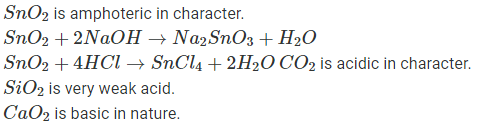
Which of the following oxides is amphoteric in character ? [AIEEE-2005]
Detailed Solution: Question 12
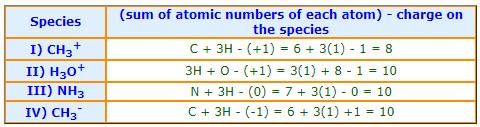
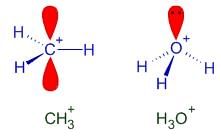
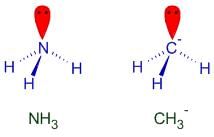
Pick out the isoelectronic structure from the following : [AIEEE-2005]
I. +CH3
II. H3O+
III. NH3
IV. CH3-
Detailed Solution: Question 13
The lanthanide contraction is responsible for the fact that [AIEEE-2005]
Detailed Solution: Question 14
Which of the following factors may be regarded as the main cause the lanthanide contraction ?
[AIEEE-2005]
Detailed Solution: Question 15
The increasing order of the first ionization enthalpies of the elements B, P, S and F (lowest first) is–
[AIEEE-2006]
Detailed Solution: Question 16
Which one of the following sets of ions represents a collection of isoelectronic species ? [AIEEE-2006]
Detailed Solution: Question 17
lanthanoid contraction is caused due to - [AIEEE-2006]
Detailed Solution: Question 18
Which one of the following constitutes a group of the isoelectronic species? [AIEEE-2008]
Detailed Solution: Question 19
In which of the following arrangements, the sequence is not strictly according to the property written against it ?
[AIEEE-2009]
Detailed Solution: Question 20
The correct sequence which shows decreasing order of the ionic radii of the elements is [AIEEE-2010]
Detailed Solution: Question 21
Which one of the following order represents the correct sequence of the increasing basic nature of the given oxides ?
[AIEEE-2011]
Detailed Solution: Question 22
The outer electron configuration of Gd (Atomic No : 64 is : [AIEEE-2006]
Detailed Solution: Question 23
The increasing order of the ionic radii of the given isoelectronic species is:
Detailed Solution: Question 24
446 docs|929 tests |
