JEE Exam  >  JEE Test  >  Chemistry Main & Advanced  >  Test: JEE Previous Year Questions- Electrochemistry - JEE MCQ

JEE Previous Year Questions- Electrochemistry with solutions - Free MCQ


MCQ Practice Test & Solutions: Test: JEE Previous Year Questions- Electrochemistry (21 Questions)

You can prepare effectively for JEE Chemistry for JEE Main & Advanced with this dedicated MCQ Practice Test (available with solutions) on the important topic of "Test: JEE Previous Year Questions- Electrochemistry". These 21 questions have been designed by the experts with the latest curriculum of JEE 2026, to help you master the concept.

Test Highlights:

  • - Format: Multiple Choice Questions (MCQ)
  • - Duration: 30 minutes
  • - Number of Questions: 21

Sign up on EduRev for free to attempt this test and track your preparation progress.

Test: JEE Previous Year Questions- Electrochemistry - Question 1

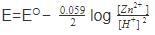
For the following cell with hydrogen electrodes at two different pressure p1 and p2 

Pt(H2)|H+ (aq.)|Pt(H2)| H+ (aq.) emf is given by – pp2           

[AIEEE-2002]

Test: JEE Previous Year Questions- Electrochemistry - Question 2

Which of the following reactions is possible at anode ?           

[AIEEE-2002]

Detailed Solution: Question 2

The correct answer is Option C.

The anode is the electrode where oxidation (loss of electrons) takes place; in a galvanic cell, it is the negative electrode, as when oxidation occurs, electrons are left behind on the electrode. 
 
The cathode is the electrode where reduction (gain of electrons) takes place; in a galvanic cell, it is the positive electrode, as less oxidation occurs, fewer ions go into solution, and fewer electrons are left on the electrode.
So, in the reaction 
2Cr3+ +7H2O→Cr2O72−+14H+
 
Cr is getting oxidised as the oxidation state is changing from +3 to +6 and hence this reaction is possible at anode.
 

*Multiple options can be correct
Test: JEE Previous Year Questions- Electrochemistry - Question 3

For a cell given below Ag | Ag+ || Cu2+ | Cu 

—              + 

Ag+ + e- → Ag,      Eº = x 

Cu2+ +2e- → Cu,    Eº = y 

Eº cell is –                   

 [AIEEE-2002]

Detailed Solution: Question 3

The correct answer is Option C.

The left portion of the salt bridge(| |)  is anode and the right portion of the salt bridge(| |) is cathode.

Since, Ag | Ag+ is half-cell oxidation and Cu2+ | Cu is half-cell reduction. Thus,
Eo cell = E cathode - E anode
           = y - x

*Multiple options can be correct
Test: JEE Previous Year Questions- Electrochemistry - Question 4

For a cell reaction involving a two-electron change the standard e.m.f. of the cell is found to be 0.295 V at 25ºC. The equilibrium constant of the reaction at 25º C will be –  

[AIEEE-2003]

Detailed Solution: Question 4

The correct answer is Option B.
Eocell = (0.0591/n) log Kc
0.259 = (0.0591/2) log Kc    
0.259 = 0.0295 log Kc
Kc = antilog 10
Kc = 1 x 10¹⁰

*Multiple options can be correct
Test: JEE Previous Year Questions- Electrochemistry - Question 5

 Standard reduction electrode potentials of three metals A, B and C are respectively +0.5 V, – 3.0V and – 1.2 V. The reducing powers of these metals are -

[AIEEE-2003]

Detailed Solution: Question 5

The correct answer is option C       
         A       B        C
red +0.5V –3.0V –1.2V
More is the value of reduction potential, more is the tendency to get reduced, i.e. less is the reducing power. The reducing power follows the following order: B > C > A.

*Multiple options can be correct
Test: JEE Previous Year Questions- Electrochemistry - Question 6

For the redox reaction :

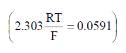
Zn (s) + Cu2+ (0.1M) → Zn2+ (1M) + Cu(s) taking place in a cell, Eºcell is 1.10 volt. Ecell for the cell will be
   [AIEEE-2003]

Detailed Solution: Question 6

The correct answer is Option A.
Eocell =  Ecell – (0.0591/n) log (Zn2+/ Cu2+)
= 1.10 – (0.0591/n) log (1 / 0.1)
= 1.10 – 0.02955
= 1.070 Volt

Test: JEE Previous Year Questions- Electrochemistry - Question 7

When during electrolysis of a solution of AgNO3 9650 coulombs of charge pass through the electroplating bath, the mass of silver deposited on the cathode will be – 

[AIEEE-2003]

Detailed Solution: Question 7

The correct answer is Option D.
Ag+ + e- ---> Ag
So, no. of the moles of Ag = Q / F
                                           = 9650 / 96500
                                           =1 / 10 moles
∴ Mass of Ag produced :->
                                  (1/10) × 108
                                        = 10.8 g

*Multiple options can be correct
Test: JEE Previous Year Questions- Electrochemistry - Question 8

Consider the following E° values          

[AIEEE-2004]
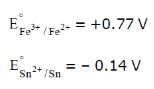
under standard conditions the potential for the reaction

Sn(s) + 2Fe3+ (aq) → 2Fe2+ (aq) + Sn2+ (aq) is

Detailed Solution: Question 8

The correct answer is option C
E0cell ​= Eooxd ​+ Eored​
         = Eo Sn/Sn2+ ​+ EoFe3+/Fe2+​
Given : Eo​Sn2+/Sn = −0.14 ⇒EoSn/Sn2+​=−(−0.14)
=0.14V
∴ Eocell ​= 0.14 + 0.77 = 0.91V

Test: JEE Previous Year Questions- Electrochemistry - Question 9

The standard e.m.f. of a cell, involving one electron change is found to be 0.591 V at 25°C. The equilibrium constant of the reaction is (F = 96500 C mol-1 ; R = 8.314 JK-1mol-1)      

[AIEEE-2004]

Detailed Solution: Question 9

The correct answer is option C
For a cell reaction in equilibrium at 298 K,
Eocell =0.0591/nlogKc
(Ke = equilibrium constant)
Give,     Eocell = 0.591V
Now, log Kc = (Eocell x n )/ 0.0591
                   =(0.0591 x n )/ 0.0591
log Kc = 10
Kc = antilog 10

  1. Kc = 1 x 10¹⁰

Test: JEE Previous Year Questions- Electrochemistry - Question 10

The limiting molar conductivities ^° for NaCl, KBr and KCl are 126, 152 and 150 S cm2 mol-1 respectively. The ^° for NaBr is –

[AIEEE-2004]

Detailed Solution: Question 10

The correct answer is Option A.

The limiting molar conductivities of NaCl, KBr and KCl are 126, 152 and 150 Scm2mol−1 respectively. 
The limiting molar conductivity  Λo for NaBr is calculated by the following expression.
λNaBr = λNaCl + λKBr + λKCl
λNaBr = 126+152−150=128 Scm.2mol−1

Test: JEE Previous Year Questions- Electrochemistry - Question 11

 In a cell that utilises the reaction 

Zn(s) + 2H+ (aq)  Zn2+ (aq) + H2(g) 

addition of H2SO4 to cathode compartment, will–         

 [AIEEE-2004]

Detailed Solution: Question 11

The correct answer is Option C.

Zn(s) +2H+ (aq) →Zn2+(aq)+H2(g)

So as we add sulphuric acid, conc. of hydrogen ion increases and equilibrium shifts to right.
Also according to the equation emf of the cell will be increased by adding acid.

Test: JEE Previous Year Questions- Electrochemistry - Question 12

Aluminium oxide may be electrolysed at 1000ºC to furnish aluminium metal (At. Mass=27 amu ; 1 Faraday = 96,500 Coulombs). The cathode reaction is

Al3+ + 3e-→ Alº 

To prepare 5.12 kg of aluminium metal by this method would require -    

[AIEEE-2005]

Detailed Solution: Question 12
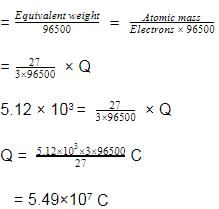
The correct answer is option B
Al3+ + 3e− → Al
w = zQ
where w = amount of metal
=5.12kg = 5.12 × 10³g
z = electrochemical equivalent

Test: JEE Previous Year Questions- Electrochemistry - Question 13

 Calculate using appropriate molar conductance of the electrolytes listed above at infinite dilution in H2O at 25ºC

[AIEEE-2005]

Detailed Solution: Question 13

The correct answer is option D

 = 91.0 +426.2 - 126.5
= 390.7 S cm2 mol-1 .

Test: JEE Previous Year Questions- Electrochemistry - Question 14

For a spontaneous reaction the ΔG, equilibrium constant (K) and Ecell will be respectively -     

[AIEEE-2005]

Detailed Solution: Question 14

The correct answer is option B
we know  ΔG=−RTlnK=−nFE∘
We know for a spontaneous reaction
ΔG<0.
∴−RTlnK<0
∴lnK>0
∴K>1
and  −nFE∘<0
∴Ecell∘​>0
 

Test: JEE Previous Year Questions- Electrochemistry - Question 15

Given the data at 25ºC,

Ag + I- → AgI + e-                     Eº = 0.152 V

Ag → Ag+ + e-                          Eº = -0.800 V

What is the value of log Ksp for AgI ?

(2.303 RT/F = 0.059 V)                            

[AIEEE 2006]

Detailed Solution: Question 15
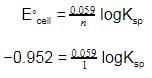
The correct answer is option C
AgI (s) + e ⇌ Ag(s) + I;
E∘ = −0.152 + Ag(s) → Ag+ + e
E∘ = −0.8
Agl (s) → Ag+ + I
E∘ = −0.952

Test: JEE Previous Year Questions- Electrochemistry - Question 16

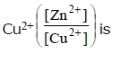
The cell, Zn | Zn2+ (1M) | | Cu2+(1M)|Cu (Eºcell)=1.10 V), was allowed to be completely discharged at 298 K.

the relative concentration of zn2+ to 
Detailed Solution: Question 16
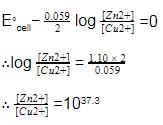
The correct answer is option C
If it is allowed to completely discharge, Ecell​=0

Test: JEE Previous Year Questions- Electrochemistry - Question 17

The equivalent conductance of two strong electrolytes at infinite dilution in H2O (where ions move freely through a solution) at 25ºC are given below -

^°CH3COONa= 91.0 S cm2/equiv

HCl = 426.2 S cm2/equiv

What additional information/quantity one needs to calculate Lº of an aqueous solution of acetic acid ?

[AIEEE 2007]

Test: JEE Previous Year Questions- Electrochemistry - Question 18

Given EºCr3+/Cr = – 0.72 V, EºFe2+/Fe= – 0.42 V. The potential for the cell Cr |Cr3+ (0.1 M)| |Fe2+ (0.01 M) | Fe is -

[AIEEE 2008]

Detailed Solution: Question 18
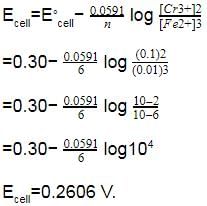
The correct answer is option D
Cr∣Cr3+(0.1 M)∣∣Fe2+(0.01 M)∣Fe
Oxidation half-cell
Cr→Cr3++3e]×2
Reduction half-cell
Fe2++2e−→Fe]×3
Net cell reaction
2Cr+3Fe2+→2Cr3++3Fe, n=6
E∘​cell​= Eoxi​+E​red
=0.72−0.42 = 0.30 V


Test: JEE Previous Year Questions- Electrochemistry - Question 19

The standard reduction potentials for Zn2+/Zn, Ni2+ /Ni, and Fe2+/Fe are – 0.76, – 0.23 and – 0.44 V respectively. The reaction X + Y2+ → X2+ + Y will be spontaneous when –  

[AIEEE 2012]

Detailed Solution: Question 19

The correct answer is option C
The elements with high negative value of standard reduction potential are good reducing agents and can be easily oxidised. ltbRgt Thus X should have a high negative value of standard potential then Y, so that it will be oxidised to X2+ by reducing Y2+ to Y.
X= Zn, Y= Ni
Zn + Ni2+ → Zn2+ + Ni
Alternatively, for a spontaneous reaction E∘ must be positive.
E∘=E∘reduced−E∘oxidised
=−0.23−(0.76)
implies E∘=+0.53V
 

Test: JEE Previous Year Questions- Electrochemistry - Question 20

Given

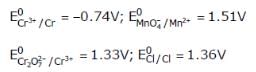
Based on the data given above, strongest oxidisting agent will be  

[AIEEE 2013]

Detailed Solution: Question 20

Higher the SRP, better is oxidizing agent hence 
MnO−4
MnO4- is the strongest oxidizing agent.
 

Test: JEE Previous Year Questions- Electrochemistry - Question 21

Refining of impure copper with zinc impurity is to be done by electrolysis using electrods as –

[AIEEE-2002]

Detailed Solution: Question 21

Cathode is always taken of pure substance because cathode is for reduction. at anode oxidation takes place and the metal oxidises itself into cation and moves to cathode, and gets deposited there. Whereas the impurities settle down below anode as anode mud.

335 videos|699 docs|300 tests
Information about Test: JEE Previous Year Questions- Electrochemistry Page
In this test you can find the Exam questions for Test: JEE Previous Year Questions- Electrochemistry solved & explained in the simplest way possible. Besides giving Questions and answers for Test: JEE Previous Year Questions- Electrochemistry, EduRev gives you an ample number of Online tests for practice
Download as PDF