JEE Exam  >  JEE Test  >  Chapter-wise Tests Main & Advanced  >  Test: JEE Previous Year Questions- General Principles & Processes of Isolation of Elements - JEE MCQ

JEE Previous Year Questions- General Principles & Processes of Isolation


MCQ Practice Test & Solutions: Test: JEE Previous Year Questions- General Principles & Processes of Isolation of Elements (8 Questions)

You can prepare effectively for JEE Chapter-wise Tests for JEE Main & Advanced with this dedicated MCQ Practice Test (available with solutions) on the important topic of "Test: JEE Previous Year Questions- General Principles & Processes of Isolation of Elements". These 8 questions have been designed by the experts with the latest curriculum of JEE 2026, to help you master the concept.

Test Highlights:

  • - Format: Multiple Choice Questions (MCQ)
  • - Duration: 10 minutes
  • - Number of Questions: 8

Sign up on EduRev for free to attempt this test and track your preparation progress.

Test: JEE Previous Year Questions- General Principles & Processes of Isolation of Elements - Question 1

The metal extracted by leaching with cyanide is :

 [AIEEE-2002]

Detailed Solution: Question 1

The correct answer is option B
The metal extracted by leaching with a cyanide is silver.
The reactions involved in the process are shown below.
Ag2​S + 4NaCN ⇌ 2Na[Ag(CN)2​] + Na2​S
2Na[Ag(CN)2​]+ Zn → Na2​[Zn(CN)4​] + 2Ag↓

Test: JEE Previous Year Questions- General Principles & Processes of Isolation of Elements - Question 2

When the sample of Cu with Zn impurity is to be purfied by electrolysis, the appropriate electrodes are :

Cathode Anode

[AIEEE-2002]

Detailed Solution: Question 2

The correct answer is Option D.
Impure sample is made of the anode and pure copper acts as the cathode.

Test: JEE Previous Year Questions- General Principles & Processes of Isolation of Elements - Question 3

Aluminium is industrially prepared by -  

[AIEEE-2002]

Detailed Solution: Question 3

The correct answer is Option D.
The Hall–Héroult process is the major industrial process for smelting aluminium. It involves dissolving aluminium oxide (alumina) (obtained most often from bauxite, aluminium's chief ore, through the Bayer process) in molten cryolite, and electrolysing the molten salt bath, typically in a purpose-built cell.
 

Test: JEE Previous Year Questions- General Principles & Processes of Isolation of Elements - Question 4

The substance not likely to contain CaCO3 is –

[AIEEE-2003]

Detailed Solution: Question 4

The correct answer is option D
A) On heating, gypsum loses water and gives the hemihydrate (CaSO4. 1/2H2O) or the anhydrite. The hemihydrate known as Calcined gypsum/ Plaster of Paris / stucco is an important building material.
B) Seashells are the exoskeletons of mollusks such as snails, clams, oysters and many others. Such shells have three distinct layers and are composed mostly of calcium carbonate(CaCO​3).
C) Dolomite is an anhydrous carbonate mineral composed of calcium magnesium carbonate, ideally CaMg(CO3​)2​. 
D) A marble statue typically consists of calcium carbonate.
So Calcined gypsum does not have calcium carbonate.

Test: JEE Previous Year Questions- General Principles & Processes of Isolation of Elements - Question 5

Which one of the following ores is best concentrated by froath-flotation method ?

[AIEEE-2004]

Detailed Solution: Question 5

The correct answer is Option C.

Galena (PbS)  is best concentrated by a froth-floatation method.
This method is used for the concentration of sulphide ores such as galena (PbS), zinc blende (ZnS) and copper pyrite (CuFeS2).

Test: JEE Previous Year Questions- General Principles & Processes of Isolation of Elements - Question 6

During the process of electrolytic refining of copper, some metals present as impurity settle as 'anode mud'. These are –  

[AIEEE-2005]

Detailed Solution: Question 6

The correct answer is option D
In Electrolytic refining, the impure metal is made to act as an anode. A strip of the same metal in pure form is used as a cathode. 
They are put in a suitable electrolytic bath containing a soluble salt of the same metal. 
The more basic metal remains in the solution and the less basic ones go to the anode mud.
Copper is refined using an electrolytic method.
Impurities from the blister copper deposit as anode mud which contains antimony, selenium, tellurium, silver, gold, and platinum; recovery of these elements may meet the cost of refining.

Test: JEE Previous Year Questions- General Principles & Processes of Isolation of Elements - Question 7

Heating mixture of Cu2O and Cu2S will give –

[AIEEE-2005]

Detailed Solution: Question 7

The correct answer is Option B.

Heating a mixture of Cu2O and Cu2S will give Cu+SO2
 
2Cu2O+Cu2S→6Cu+SO2

This reaction takes place during bessemerization and is an auto reduction process to give copper metal.

Test: JEE Previous Year Questions- General Principles & Processes of Isolation of Elements - Question 8

Which of the following factors is of no significance for roasting sulphide ores to the oxides and not subjecting the sulphide ores to carbon reduction directly ?  

[AIEEE-2008]

Detailed Solution: Question 8
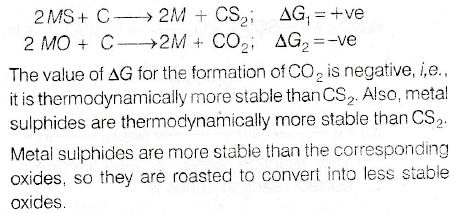
Metal sulphides are less stable than the corresponding oxides
Explanation:

446 docs|929 tests
Information about Test: JEE Previous Year Questions- General Principles & Processes of Isolation of Elements Page
In this test you can find the Exam questions for Test: JEE Previous Year Questions- General Principles & Processes of Isolation of Elements solved & explained in the simplest way possible. Besides giving Questions and answers for Test: JEE Previous Year Questions- General Principles & Processes of Isolation of Elements, EduRev gives you an ample number of Online tests for practice
Download as PDF