CBSE Class 5  >  Class 5 Test  >  Mathematics  >  Test: Lines, Angles & Triangles - 1 - Class 5 MCQ

Lines, Angles & Triangles - 1 - Free MCQ Practice Test with solutions,


MCQ Practice Test & Solutions: Test: Lines, Angles & Triangles - 1 (10 Questions)

You can prepare effectively for Class 5 Mathematics for Class 5 with this dedicated MCQ Practice Test (available with solutions) on the important topic of "Test: Lines, Angles & Triangles - 1". These 10 questions have been designed by the experts with the latest curriculum of Class 5 2026, to help you master the concept.

Test Highlights:

  • - Format: Multiple Choice Questions (MCQ)
  • - Duration: 10 minutes
  • - Number of Questions: 10

Sign up on EduRev for free to attempt this test and track your preparation progress.

Test: Lines, Angles & Triangles - 1 - Question 1

How many of the following figures have parallel lines?

Detailed Solution: Question 1

  • In the provided figures, figure 2, figure 4, and figure 5 each contain a pair of parallel lines.
  • Therefore, the correct answer is option C.

Test: Lines, Angles & Triangles - 1 - Question 2

A straight angle measures:

Detailed Solution: Question 2

A straight angle is formed when two rays point in exactly opposite directions, forming a straight line.

By definition, a straight angle measures 180°.

Hence the correct option is A: 180°.

Test: Lines, Angles & Triangles - 1 - Question 3

How many perpendicular lines are present in the letter "H"?

Detailed Solution: Question 3

The letter "H" has two vertical lines and one horizontal line joining them.

The horizontal line is perpendicular to each of the two vertical lines, so there are two perpendicular relationships.

Therefore, the correct answer is 2 (Option C).

Test: Lines, Angles & Triangles - 1 - Question 4

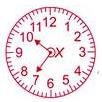
The clock shows the time in the morning. ∠X represents ____ angle.
Detailed Solution: Question 4

  • The angle shown is a reflex angle. Here’s why:

  • A reflex angle is larger than 180° but smaller than 360°.
  • The angle in the image fits this description, being more than 180° and less than 360°.
  • Therefore, it is classified as a reflex angle.
  • Therefore, option C is correct.

Test: Lines, Angles & Triangles - 1 - Question 5

At 3:25, the smaller angle formed between the two hands of a clock is ____.


Detailed Solution: Question 5

  • To determine the angle, note that each hour mark on a clock represents 30 degrees (360 degrees/12 hours).
  • At 3:25, the minute hand is at the 5th mark (25 minutes), meaning 150 degrees (5 marks x 30 degrees).
  • The hour hand moves 30 degrees per hour, plus 0.5 degrees per minute. At 3:25, it has moved 102.5 degrees
  • (3 x 30 + 25 x 0.5).
  • The angle between the hands is 150 - 102.5 = 47.5 degrees, which is acute.
  • As we can see , it is an acute angle

Test: Lines, Angles & Triangles - 1 - Question 6

Which type of angle best describes angle Q?

Detailed Solution: Question 6

  • Measure of angle Q is more thaan 90º but less than 180º.
  • An angle that measures more than 90° and less than 180° is called an obtuse angle.
  • Therefore, angle Q is an obtuse angle.

Test: Lines, Angles & Triangles - 1 - Question 7

There are six angles below. How many of them are greater than a right angle?

Detailed Solution: Question 7
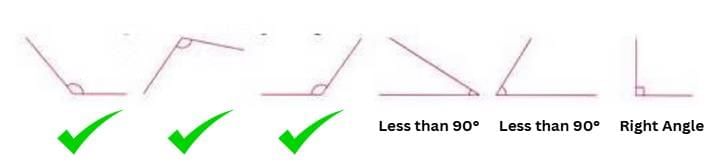
An obtuse angle is an angle which is greater than 90° and less than 180°. In other words, an obtuse angle is between a right angle and a straight angle.

Test: Lines, Angles & Triangles - 1 - Question 8

Which of the following is greater than a right angle?

Detailed Solution: Question 8
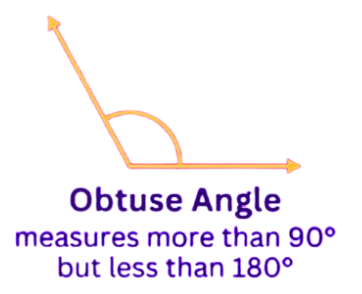

A right angle forms a perfect "L" shape and measures 90 degrees. Any angle greater than this is called an obtuse angle, which appears more open or wider than a right angle. 

Test: Lines, Angles & Triangles - 1 - Question 9

An angle which measures more than 90° but less than 180° is called_____.

Detailed Solution: Question 9

Definition: An obtuse angle measures more than 90° and less than 180°.

Therefore, the correct answer is Obtuse.

  • Acute: measures less than 90°.
  • Right: measures exactly 90°.

Test: Lines, Angles & Triangles - 1 - Question 10

Intersecting lines cut each other at:

Detailed Solution: Question 10

Two lines are called intersecting when they meet at a common point.

Two distinct straight lines in a plane can meet at at most one point; coincident lines share infinitely many points and parallel lines have none.

Therefore, intersecting lines cut each other at one point.

76 videos|469 docs|47 tests
Information about Test: Lines, Angles & Triangles - 1 Page
In this test you can find the Exam questions for Test: Lines, Angles & Triangles - 1 solved & explained in the simplest way possible. Besides giving Questions and answers for Test: Lines, Angles & Triangles - 1, EduRev gives you an ample number of Online tests for practice
76 videos|469 docs|47 tests
Download as PDF