CBSE Class 5  >  Class 5 Test  >  Mathematics  >   Test: Lines, Angles & Triangles - 2 - Class 5 MCQ

Lines, Angles & Triangles - 2 - Free MCQ Practice Test with solutions,


MCQ Practice Test & Solutions: Test: Lines, Angles & Triangles - 2 (10 Questions)

You can prepare effectively for Class 5 Mathematics for Class 5 with this dedicated MCQ Practice Test (available with solutions) on the important topic of " Test: Lines, Angles & Triangles - 2". These 10 questions have been designed by the experts with the latest curriculum of Class 5 2026, to help you master the concept.

Test Highlights:

  • - Format: Multiple Choice Questions (MCQ)
  • - Duration: 10 minutes
  • - Number of Questions: 10

Sign up on EduRev for free to attempt this test and track your preparation progress.

Test: Lines, Angles & Triangles - 2 - Question 1

When it is 10 : 30, what kind of angle is formed by the hands of the clock?

Detailed Solution: Question 1

Here the angle between any two consecutive numbers in a clock is 30.
Now we know that when time is 30 minutes, then the minute clock will be at 6.
And when time is 10:30, the hour clock will be between 10 and 11. Let us draw a clock here for better understanding.

Now the number of parts (number) between 6 to 10 are 4. So an angle between 6 and 10 will be 4×30=1204×30=120. Similarly, there are 5 parts between 6 to 11. So the angle between 6 and 11 will be 5×30=1505×30=150.
Hence our angle will be between 120 and 150120 and 150∘ and it will be exactly in middle of 10 and 11, so angle will be equal to 120+1502=2702=135120+1502=2702=135.
Hence our required angle between the hands of a clock as 10:30 is 135.
Since 135 is greater than 90 so it is an obtuse angle.

Test: Lines, Angles & Triangles - 2 - Question 2

At what time given below do the minute and hour hands of a clock make a right angle?

Detailed Solution: Question 2

At 3 O'clock the minute hand points at 12 (0°) and the hour hand points at 3 (90°).

The angle between them is |90° − 0°| = 90°.

Therefore, the hands make a right angle at 3 O'clock.

Test: Lines, Angles & Triangles - 2 - Question 3

How many angles in the given figure are less than a right angle?

Detailed Solution: Question 3

  1. A star has both acute angles (less than 90°) and obtuse angles (greater than 90° but less than 180°).
  2. In a standard 5-pointed star, the tips of the star have acute angles (less than 90°).

Since the star in the image is a 5-pointed star, all 5 tip angles are acute.

Test: Lines, Angles & Triangles - 2 - Question 4

An angle which measures more than 0° but less than 90° is called ____.

Detailed Solution: Question 4

An angle greater than 0° and less than 90° is called an acute angle.

For reference: a right angle measures 90°; an obtuse angle measures more than 90° and less than 180°.

Test: Lines, Angles & Triangles - 2 - Question 5

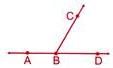
Which of the following is NOT drawn in the diagram?
Detailed Solution: Question 5

In the diagram, ray BD and line AD are clearly drawn. The angle at point B is more accurately referred to as ∠ABC (the angle formed by points A, B, and C), which is shown in the diagram. However, the line segment CD is not present anywhere in the diagram. Therefore, the correct answer is option d) Line segment CD.

Test: Lines, Angles & Triangles - 2 - Question 6

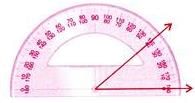
Danish drew an angle as shown here. What was the measure of Manish's angle?
Detailed Solution: Question 6

Measure of angle drawn by Danish = 40
∴Measure of angle drawn by Manish = 40

Test: Lines, Angles & Triangles - 2 - Question 7

How many angles are there in a triangle?

Detailed Solution: Question 7

A triangle has three vertices and three sides; there is one interior angle at each vertex.

The sum of the interior angles of a triangle is 180°-a standard property of triangles.

Therefore, a triangle has 3 angles.

Test: Lines, Angles & Triangles - 2 - Question 8

How many angles are less than 90  in the given figures?


Detailed Solution: Question 8

There are 0 acute angles in the given figures. As all the angles are 900.

Test: Lines, Angles & Triangles - 2 - Question 9

Two parallel lines:

Detailed Solution: Question 9

Parallel lines are two distinct coplanar lines that never meet; they have no point in common.

In Euclidean geometry this means they do not intersect, so option C is correct.

Note: coincident lines (the same line) meet at infinitely many points, but in school geometry coincident lines are not considered parallel.

Test: Lines, Angles & Triangles - 2 - Question 10

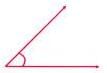
What is the approximate measure of this angle in degrees?
Detailed Solution: Question 10

The given angle is a acute angle, so option D and option C is not correct

The approximate value of above angle is 45o, as the angle of 20o would be very small than the given angle

Hence the correct answer is option B.

76 videos|469 docs|47 tests
Information about Test: Lines, Angles & Triangles - 2 Page
In this test you can find the Exam questions for Test: Lines, Angles & Triangles - 2 solved & explained in the simplest way possible. Besides giving Questions and answers for Test: Lines, Angles & Triangles - 2, EduRev gives you an ample number of Online tests for practice
76 videos|469 docs|47 tests
Download as PDF