JEE Exam  >  JEE Test  >  Crack with 35 Years of Previous Year Solved Papers  >  Test: MCQs (One or More Correct Option): Limits, Continuity and Differentiability | JEE Advanced - JEE MCQ

MCQs (One or More Correct Option): Limits, Continuity and Differentiability


MCQ Practice Test & Solutions: Test: MCQs (One or More Correct Option): Limits, Continuity and Differentiability | JEE Advanced (25 Questions)

You can prepare effectively for JEE Crack JEE with 35 Years of Previous Year Solved Papers with this dedicated MCQ Practice Test (available with solutions) on the important topic of "Test: MCQs (One or More Correct Option): Limits, Continuity and Differentiability | JEE Advanced". These 25 questions have been designed by the experts with the latest curriculum of JEE 2026, to help you master the concept.

Test Highlights:

  • - Format: Multiple Choice Questions (MCQ)
  • - Duration: 50 minutes
  • - Number of Questions: 25

Sign up on EduRev for free to attempt this test and track your preparation progress.

*Multiple options can be correct
Test: MCQs (One or More Correct Option): Limits, Continuity and Differentiability | JEE Advanced - Question 1

If x+ | y | = 2y , then y as a function of x is

Detailed Solution: Question 1
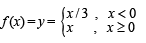
Given that x + | y | = 2y
If y < 0 then x – y = 2y
⇒ y = x/3 ⇒ x < 0
If y = 0 then x = 0. If y > 0 then x + y = 2y
⇒ y = x ⇒ x > 0

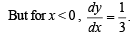
Thus we can define 
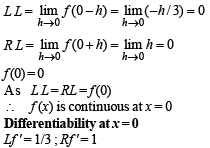
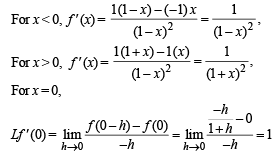
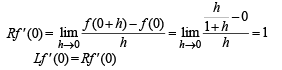
Continuity at x = 0

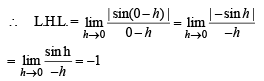
As Lf ' ≠ Rf ' ⇒ f (x) is not differentiable at x = 0

*Multiple options can be correct
Test: MCQs (One or More Correct Option): Limits, Continuity and Differentiability | JEE Advanced - Question 2

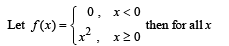
Detailed Solution: Question 2

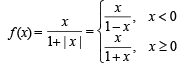
We have 

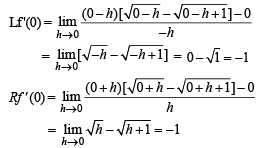
Let us check differentiability of f (x) at x = 0

Since Lf ' (0) = Rf ' (0)
∴ f is differentiable at x = 0.

*Multiple options can be correct
Test: MCQs (One or More Correct Option): Limits, Continuity and Differentiability | JEE Advanced - Question 3

The function f (x) = 1 + | sin x | is

Detailed Solution: Question 3
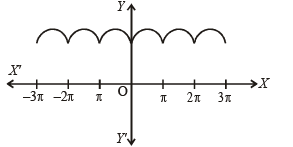
The graph of f (x) = 1 + | sin x | is as shown in the fig.

From graph it is clear that function is continuous every where but not differentiable at integral multiples of π (∴ at these points curve has sharp turnings)

*Multiple options can be correct
Test: MCQs (One or More Correct Option): Limits, Continuity and Differentiability | JEE Advanced - Question 4

Let [x] denote the greatest integer less than or equal to x. If f(x) = [x sin π x], then f(x) is

Detailed Solution: Question 4

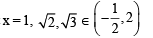
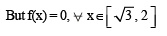
We have, for  – 1 < x < 1 ⇒  0 < x sin π x < 1/2
∴ f (x) = [x sin π x] = 0
Also x sin p x becomes negative and numerically less than 1 when x is slightly greater than 1 and so by definition of [x],
f (x) = [x sin π x] = – 1 when 1 < x < 1 + h
Thus f (x) is constant and equal to 0 in the closed interval [– 1, 1] and so f (x) is continuous and differentiable in the open interval (– 1, 1).
At x = 1, f (x) is clearly discontinuous, since f (1– 0) = 0 and f (1 + 0) = – 1 and f (x) is non-differentiable at x = 1

*Multiple options can be correct
Test: MCQs (One or More Correct Option): Limits, Continuity and Differentiability | JEE Advanced - Question 5

The set of all points where the function    differentiable, is

Detailed Solution: Question 5

The given function is,


⇒ f is differentiable at x = 0
Hence f is differentiable in (– ∞, ∞).

*Multiple options can be correct
Test: MCQs (One or More Correct Option): Limits, Continuity and Differentiability | JEE Advanced - Question 6

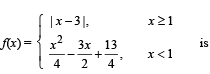
The function 

Detailed Solution: Question 6
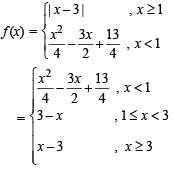

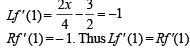
∴ f is differentiable at x = 1 and hence continuous at x = 1.
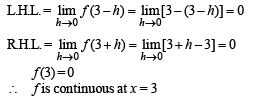
Again,  Lf ' (3) = – 1 and Rf ' (3) = 1
⇒ Lf ' (3) ≠ Rf ' (3)
⇒ f is not differentiable at x = 3

*Multiple options can be correct
Test: MCQs (One or More Correct Option): Limits, Continuity and Differentiability | JEE Advanced - Question 7

 then on the interval [0, π]

Detailed Solution: Question 7

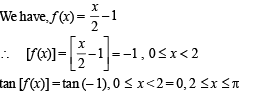
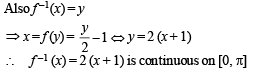
∴ The function tan [f (x)] is discontinuous at x = 2.

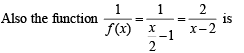
discontinuous at x = 2.
Thus both the given functions tan [f (x)] as well as
 are discontinuous on the interval [0, π].
*Multiple options can be correct
Test: MCQs (One or More Correct Option): Limits, Continuity and Differentiability | JEE Advanced - Question 8

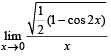
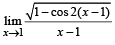
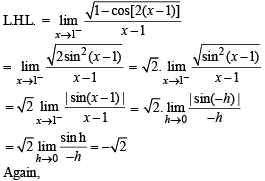
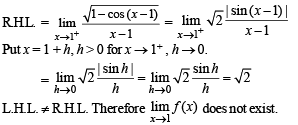
The value of 

Detailed Solution: Question 8
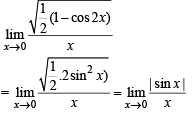


∴ The given limit does not exist.

*Multiple options can be correct
Test: MCQs (One or More Correct Option): Limits, Continuity and Differentiability | JEE Advanced - Question 9

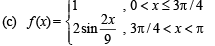
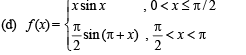
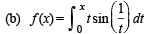
The following functions are continuous on (0, π).

Detailed Solution: Question 9
On (0, π)
(a) tan x = f (x)
We know that tan x is discontinuous at x = π/2

which exists on (0, π)
∴ f (x), being differentiable, is continuous on (0, π).

Clearly f (x) is continuous on (0, π) except


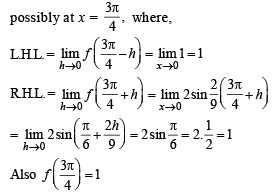
Here f (x) will be continuous on (0, π) if it is continuous at x = π/2.
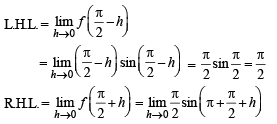
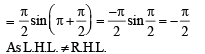
At x =π/2,


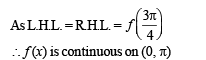
∴ f (x) is not continuous on (0, π).

*Multiple options can be correct
Test: MCQs (One or More Correct Option): Limits, Continuity and Differentiability | JEE Advanced - Question 10

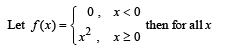
Detailed Solution: Question 10
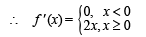


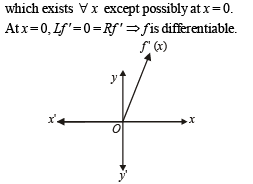
From graph of f ' (x), it is clear that f ' (x) is continuous but not differentiable at x = 0.

*Multiple options can be correct
Test: MCQs (One or More Correct Option): Limits, Continuity and Differentiability | JEE Advanced - Question 11

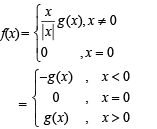
Let g(x) = x f(x), where 

Detailed Solution: Question 11
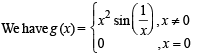


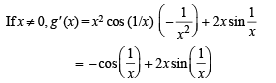
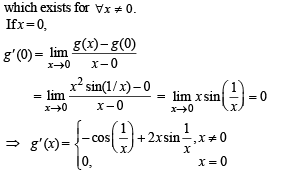
  is not continuous, therefore g' (x) is not continuous at x = 0.
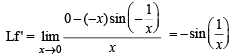
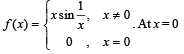
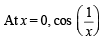
At x = 0

which does not exist.
∴ f is not differentiable at x = 0.

*Multiple options can be correct
Test: MCQs (One or More Correct Option): Limits, Continuity and Differentiability | JEE Advanced - Question 12

The function f(x) = max {(1 – x), (1 + x), 2}, x ∈ ( -∞,∞) is

Detailed Solution: Question 12
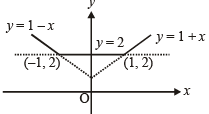
From graph it is clear that f (x) is continuous every where and also differentiable everywhere except at  x = 1 and – 1.

*Multiple options can be correct
Test: MCQs (One or More Correct Option): Limits, Continuity and Differentiability | JEE Advanced - Question 13

Let h(x) = min {x, x2}, for every real number of x, Then

Detailed Solution: Question 13
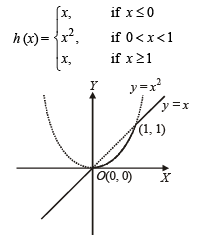
From the figure it is clear that

From the graph it is clear that h is continuous for all x ∈ R , h' (x) = 1 for all x > 1 and h is not differentiable at x = 0 and 1.

*Multiple options can be correct
Test: MCQs (One or More Correct Option): Limits, Continuity and Differentiability | JEE Advanced - Question 14

Detailed Solution: Question 14


*Multiple options can be correct
Test: MCQs (One or More Correct Option): Limits, Continuity and Differentiability | JEE Advanced - Question 15

If f(x) = min {1, x2, x3}, then

Detailed Solution: Question 15
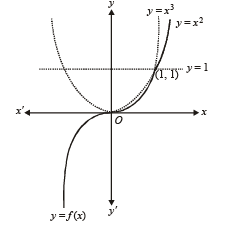
From graph, f (x) is continuous everywhere but not differentiable at x = 1.

*Multiple options can be correct
Test: MCQs (One or More Correct Option): Limits, Continuity and Differentiability | JEE Advanced - Question 16

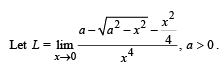
If L is finite, then

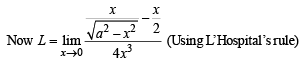
Detailed Solution: Question 16
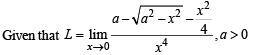

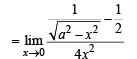
and L is finite.

∴ L is finite, limiting value of numerator zero which is so when should be 

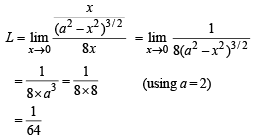
i.e. a = 2 (∴ a > 0)

Applying L ‘Hospital’s rule again, we ge

*Multiple options can be correct
Test: MCQs (One or More Correct Option): Limits, Continuity and Differentiability | JEE Advanced - Question 17

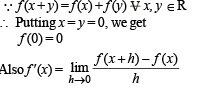
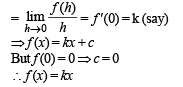
Let f : R → R be a function such that  f (x + y) =  f (x) +  f (y),  If  f (x) is differentiable at x = 0, then

Detailed Solution: Question 17


Which is continuous and differentiable
∴ b and c are the correct options.

*Multiple options can be correct
Test: MCQs (One or More Correct Option): Limits, Continuity and Differentiability | JEE Advanced - Question 18

Detailed Solution: Question 18


Also at x  = 0
Lf '(0) = sin 0 = 0; Rf '(0) = 1 – 0 = 1
∴ Lf '(0) ≠ Rf '(0)
⇒ f is not differentiable at x = 0
At x = 1
Lf '(1) = R'f (1) ⇒ f is differentiable at x = 1.
which is differentiable.
∴ All four options are correct.

*Multiple options can be correct
Test: MCQs (One or More Correct Option): Limits, Continuity and Differentiability | JEE Advanced - Question 19

For every integer n, let an and bn be real numbers. Let function f : IR → IR be given by

for all integers n. If f is continuous, then which of the following hold(s) for all n ?

Detailed Solution: Question 19


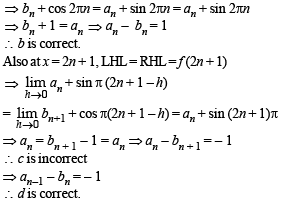
As f is continuous for all n
∴At x = 2n, LHL = RHL = f (2n)

*Multiple options can be correct
Test: MCQs (One or More Correct Option): Limits, Continuity and Differentiability | JEE Advanced - Question 20

(the set of all real numbers), a ≠ –1,
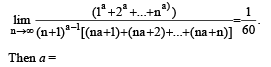
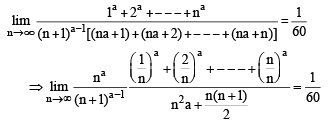
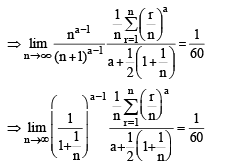
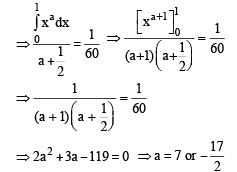
Detailed Solution: Question 20


*Multiple options can be correct
Test: MCQs (One or More Correct Option): Limits, Continuity and Differentiability | JEE Advanced - Question 21

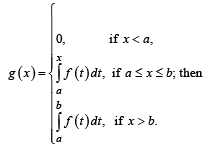
  a continuous function and let g :  R → R be defined as
Detailed Solution: Question 21

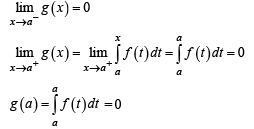
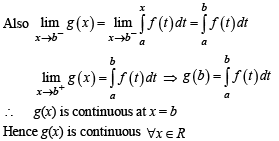
g(x) may be discontinuous at x = a or x = b.
Let us check the continuity of g(x) at x = a and x = b


∴ g (x) is continuous at x = a


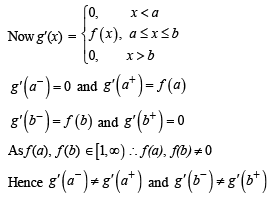
∴ g is not differentiable at a and b

*Multiple options can be correct
Test: MCQs (One or More Correct Option): Limits, Continuity and Differentiability | JEE Advanced - Question 22

For every pair of continuous functions f, g : [0, 1] → R such that max {f ( x) :x ∈[ 0,1]} = max {g (x) :x ∈[ 0,1]} , the correct statement(s) is (are):

Detailed Solution: Question 22
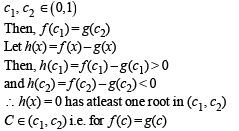
Let f and g be maximum at c1 and c2 respectively,

which shows that (a) and (d) are correct.

*Multiple options can be correct
Test: MCQs (One or More Correct Option): Limits, Continuity and Differentiability | JEE Advanced - Question 23

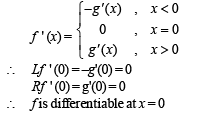
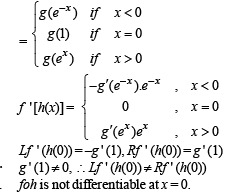
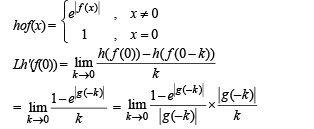
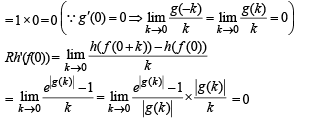
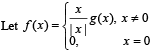
Let g : R → R be a differentiable function with g(0) = 0, g'(0) = 0 and g'(1) ≠ 0. Let   and  Let (foh)(x) denote f(h(x)) and (hof)(x) denote h(f(x)). Then which of the following is (are) true?
Detailed Solution: Question 23


∴ hof is differentiable at x = 0.

*Multiple options can be correct
Test: MCQs (One or More Correct Option): Limits, Continuity and Differentiability | JEE Advanced - Question 24

Let   be defined by f (x) = a cos (|x3 –x|) + b |x| sin (|x3 +x|). 

Then f is

Detailed Solution: Question 24

 f(x) = a cos3(|x3 –x|) + b |x| sin (|x3 + x|)
(a) If a = 0, b = 1
⇒ f(x) = |x| sin |x3 + x|
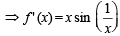
= x sin (x3 + x), x ∈ R
∴ f is differentiable every where.
(b), (c) If a = 1, b = 0 ⇒ f(x) = cos3 (|x3 – x|)
= cos3(x3 – x)
which is differentiable every where.
(d) when a = 1, b = 1, f(x) = cos(x3 – x) + x sin (x3 + x) which is differentiable at x = 1
∴ Only a and b are the correct options.

*Multiple options can be correct
Test: MCQs (One or More Correct Option): Limits, Continuity and Differentiability | JEE Advanced - Question 25

 be fun ctions defined by f (x) = [x2–3] and g(x) = |x| f (x) + |4x–7 | f (x), where [y] denotes the greatest integer less than or equal to y for y ∈ R. Then

Detailed Solution: Question 25

f(x) = [x2 – 3] is discontinuous at all integral points in 

∴ f is discontinuous exactly at four points in 

Also g (x) = (|x| + |4x- 7|)f (x)

Here f is not differentiable at   

and |x| + |4x – 7| is not differentiable at 0 and 7/4

∴ g(x) becomes differentiable at x = 7/4

Hence g(x) is non-differentiable at four points i.e.

347 docs|185 tests
Information about Test: MCQs (One or More Correct Option): Limits, Continuity and Differentiability | JEE Advanced Page
In this test you can find the Exam questions for Test: MCQs (One or More Correct Option): Limits, Continuity and Differentiability | JEE Advanced solved & explained in the simplest way possible. Besides giving Questions and answers for Test: MCQs (One or More Correct Option): Limits, Continuity and Differentiability | JEE Advanced, EduRev gives you an ample number of Online tests for practice
Download as PDF