
MCQs (One or More Correct Option): Waves | JEE Advanced - Free MCQ Practice
MCQ Practice Test & Solutions: Test: MCQs (One or More Correct Option): Waves | JEE Advanced (25 Questions)
You can prepare effectively for JEE Crack JEE with 35 Years of Previous Year Solved Papers with this dedicated MCQ Practice Test (available with solutions) on the important topic of "Test: MCQs (One or More Correct Option): Waves | JEE Advanced". These 25 questions have been designed by the experts with the latest curriculum of JEE 2026, to help you master the concept.
Test Highlights:
- - Format: Multiple Choice Questions (MCQ)
- - Duration: 50 minutes
- - Number of Questions: 25
Sign up on EduRev for free to attempt this test and track your preparation progress.

A wave equation which gives the displacement along the y-direction is given by y = 10–4 sin (60t + 2x) where x and y are in metres and t is time in seconds. This represents a wave
Detailed Solution: Question 1

A transver se wave is described by the equation 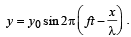 The maximum particle velocity is equal to four times the wave velocity if
The maximum particle velocity is equal to four times the wave velocity if Detailed Solution: Question 2
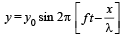

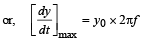


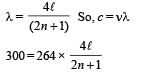
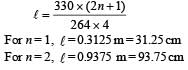
An air column in a pipe, which is closed at one end, will be in resonance with a vibrating tuning fork of frequency 264 Hz if the length of the column in cm is :
Detailed Solution: Question 3
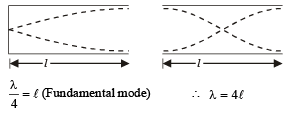
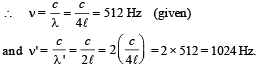
A tube, closed at one end and containing air, produces, when excited, the fundamental note of frequency 512 Hz. If the tube is open at both ends the fundamental frequency that can be excited is (in Hz)
Detailed Solution: Question 4

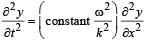
The displacement of particles in a string stretched in the x-direction is represented by y. Among the following expressions for y, those describing wave motion are :
Detailed Solution: Question 5
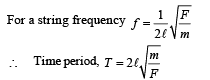
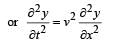 ....(i)
An organ pipe P1 closed at one end vibrating in its first harmonic and another pipe P2 open at ends vibrating in its third harmonic are in resonance with a given tuning fork.
The ratio of the length of P1 to that of P2 is
The ratio of the length of P1 to that of P2 is
Detailed Solution: Question 6
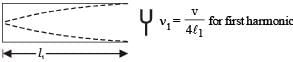
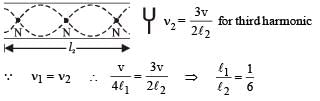
Velocity of sound in air is 320 m/s. A pipe closed at one end has a length of 1 m. Neglecting end corrections, the air column in the pipe can resonate for sound of frequency :
Detailed Solution: Question 7

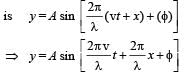
A wave is represented by the equation

where x is in meters and t is in seconds. The expression represents :
Detailed Solution: Question 8
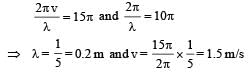
Two identical straight wires are stretched so as to produce 6 beats per second when vibrating simultaneously. On changing the tension slightly in one of them, the beat frequency remains unchanged. Denoting by T1 , T2 the higher and the lower initial tension in the strings, then it could be said that while making the above changes in tension,
Detailed Solution: Question 9
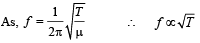

The displacement y of a particle executing periodic motion is given by 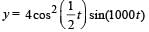
This expression may be considereed to be a result of the superposition of
Detailed Solution: Question 10

A sound wave of frequency f travels horizontally to the right. It is reflected from a large vertical plane surface moving to left with a speed v. The speed of sound in medium is C
Detailed Solution: Question 11

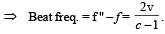

A string of length 0.4 m and mass 10–2 kg is tightly clamped at its ends. The tension in the string is 1.6 N. Identical wave pulses are produced at one end at equal intervals of time, Δt. The minimum value of Δt which allows constructive interference between successive pulses is
Detailed Solution: Question 12


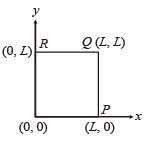
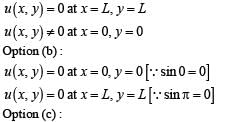
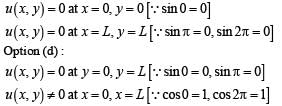
The (x, y) co-ordinates of the corners of a square plate are (0, 0), (L, 0), (L, L) and (0, L). The edges of the plate are clamped and transverse standing waves are set up in it. If u(x, y) denotes the displacement of the plate at the point (x, y) at some instant of time, the possible expression(s) for u is (are) (a = positive constant)
Detailed Solution: Question 13
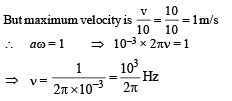
A transverse sinusoidal wave of amplitude a, wavelength l and frequency f is travelling on a stretched string. The maximum speed of any point on the string is v/10, where v is the speed of propagation of the wave. If a = 10–3m and v = 10 m s–1, then λ and f are given by
Detailed Solution: Question 14

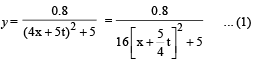
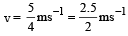
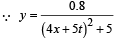
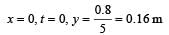
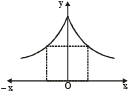
y(x, t) = 0.8/[4x+5t)2+5] represents a moving pulse, where x and y are in meter and t in second. Then
Detailed Solution: Question 15
In a wave motion y = a sin (kx - ωt), y can represent
Detailed Solution: Question 16
Standing waves can be produced
Detailed Solution: Question 17
As a wave propagates,
Detailed Solution: Question 18


A student performed the experiment to measure the speed of sound in air using resonance air-column method. Two resonances in the air-column were obtained by lowering the water level. The resonance with the shorter air-column is the first resonance and that with the longer air-column is the second resonance. Then,
Detailed Solution: Question 19
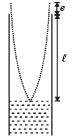

A person blows into open-end of a long pipe. As a result, a high pressure pulse of air travels down the pipe.
When this pulse reaches the other end of the pipe,
When this pulse reaches the other end of the pipe,
Detailed Solution: Question 20
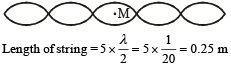
A horizontal stretched string, fixed at two ends, is vibrating in its fifth harmonic according to the equation, y(x, t) = (0.01 m) sin [(62.8 m–1)x] cos[(628 s–1)t]. Assuming π = 3.14, the correct statement(s) is (are)
Detailed Solution: Question 21

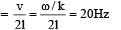
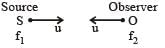
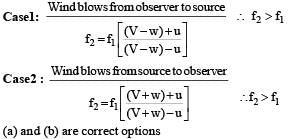
Two vehicles, each moving with speed u on the same horizontal straight road, are approaching each other. Wind blows along the road with velocity w. One of these vehicles blows a whistle of frequency f1. An observer in the other vehicle hears the frequency of the whistle to be f2. The speed of sound in still air is V. The correct statement(s) is (are)
Detailed Solution: Question 22
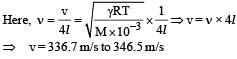
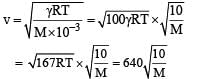
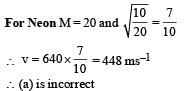
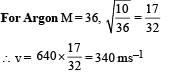
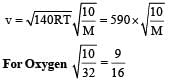
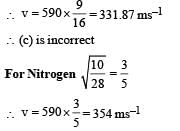
A student is performing an experiment using a resonance column and a tuning fork of frequency 244 s–1. He is told that the air in the tube has been replaced by another gas (assume that the column remains filled with the gas). If the minimum height at which resonance occurs is (0.350 ± 0.005) m, the gas in the tube is
(Useful information: 
 The molar masses M in grams are given in the options. Take the values of
  for eachgas as given there.)
The molar masses M in grams are given in the options. Take the values of for eachgas as given there.)Detailed Solution: Question 23
One end of a taut string of length 3 m along the x-axis is fixed at x = 0. The speed of the waves in the string is 100 ms–1. The other end of the string is vibrating in the y-direction so that stationary waves are set up in the string. The possible waveform (s) of these stationary waves is(are)
Detailed Solution: Question 24

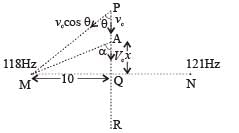
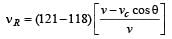
Two loudspeakers M and N are located 20 m apart and emit sound at frequencies 118 Hz and 121 Hz, respectively. A car is initially at a point P , 1800 m away from the midpoint Q of the line MN and moves towards Q constantly at 60 km/hr along the perpendicular bisector of MN. It crosses Q and eventually reaches a point R, 1800 m away from Q. Let v(t) represent the beat frequency measured by a person sitting in the car at time t. Let vP , vQ and vR be the beat frequencies measured at locations P, Q and R, respectively. The speed of sound in air is 330 ms–1. Which of the following statement(s) is(are) true regarding the sound heard by the person?
Detailed Solution: Question 25
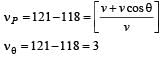
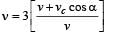

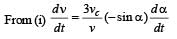 … (ii)
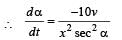 …(iii)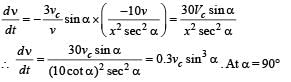

347 docs|185 tests |
