CBSE Class 10  >  Class 10 Test  >  Online MCQ Tests  >  Test: Magnetic Effects of Electric Current - Class 10 MCQ

Magnetic Effects of Electric Current - Free MCQ Practice Test with solutions,


MCQ Practice Test & Solutions: Test: Magnetic Effects of Electric Current (10 Questions)

You can prepare effectively for Class 10 Online MCQ Tests for Class 10 with this dedicated MCQ Practice Test (available with solutions) on the important topic of "Test: Magnetic Effects of Electric Current". These 10 questions have been designed by the experts with the latest curriculum of Class 10 2026, to help you master the concept.

Test Highlights:

  • - Format: Multiple Choice Questions (MCQ)
  • - Duration: 10 minutes
  • - Number of Questions: 10

Sign up on EduRev for free to attempt this test and track your preparation progress.

Test: Magnetic Effects of Electric Current - Question 1

The magnetic field lines inside a long current-carrying solenoid are near-

Detailed Solution: Question 1
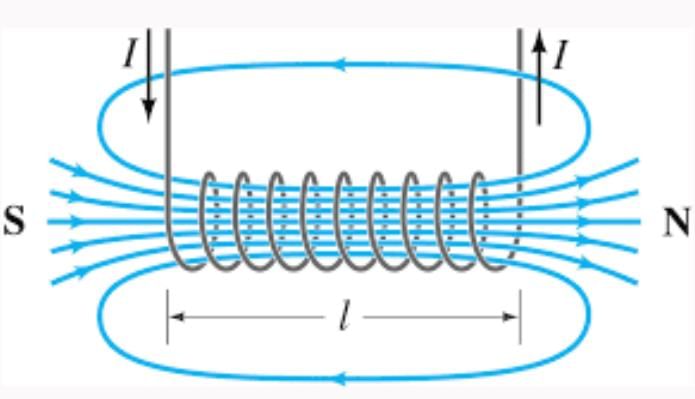
The field lines inside the solenoid are in the form of parallel straight lines. This indicates that the magnetic field is the same at all points inside the solenoid. That is, the field is uniform inside the solenoid.

Test: Magnetic Effects of Electric Current - Question 2

Moving two like poles together usually causes a magnet resting on a table to repel and rotate. This occurs because:

Detailed Solution: Question 2
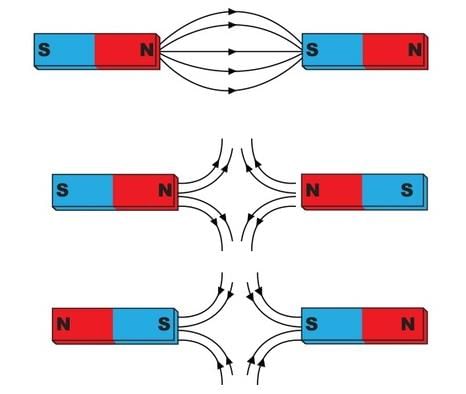
Like poles of magnet repel each other and unlike poles of magnet attract each other.

Test: Magnetic Effects of Electric Current - Question 3

An electric current flowing through a conductor produces

Detailed Solution: Question 3

An electric current through a metallic conductor produces a magnetic field around it. A long straight wire carrying a current is the simplest example of a moving charge that generates a magnetic field.

Test: Magnetic Effects of Electric Current - Question 4

Magnetic lines of force originate from the

Detailed Solution: Question 4

The direction of magnetic line of force is the direction of force on a North Pole, so the magnetic lines of force always begin on the North Pole of a magnet and end on the South Pole of the magnet. When a small magnetic compass is placed along a lie of force, it sets itself along the line tangential to it. Hence, the line drawn from the South Pole of the compass to its North pole shows the direction of the magnetic field.

Test: Magnetic Effects of Electric Current - Question 5

Electromagnet works on

Detailed Solution: Question 5

When large current passes through a fuse, it melts quickly and breaks the circuit. Working of an electromagnet is based on the magnetic effect of electric current. An electromagnet behaves as a magnet when current passes through it. Hence, it will attract a piece of iron.

Test: Magnetic Effects of Electric Current - Question 6

A magnetic field existing around a magnet can be represented by magnetic field lines. Magnetic field lines always form:

Detailed Solution: Question 6
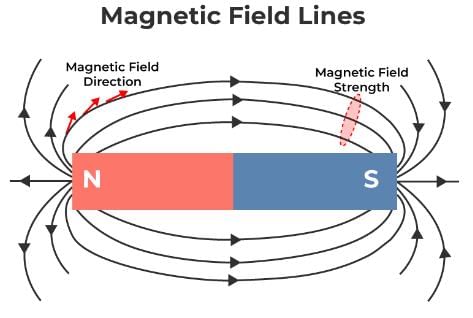
Magnetic field lines can never cross, meaning that the field is unique at any point in space. Magnetic field lines are continuous, forming closed loops without beginning or end.

Test: Magnetic Effects of Electric Current - Question 7

Which of the following statement concerning magnetic field is correct ?
(1) The part of a bar magnet, at which the magnetic field is the strongest, is called its pole.
(2) A magnetic field is present near a compass needle.
(3) There is no magnetic field inside a current-carrying solenoid.​

Detailed Solution: Question 7

Statement (1) is correct: A bar magnet has two poles - a north pole and a south pole. The magnetic field is strongest near these poles.
Statement (2) is also correct: A compass needle aligns itself with the Earth's magnetic field, and it points towards the Earth's magnetic north. This indicates the presence of a magnetic field around the Earth.
Statement (3) is incorrect: In fact, a current-carrying solenoid produces a strong magnetic field inside it. The direction of the magnetic field can be determined using the right-hand thumb rule.

Test: Magnetic Effects of Electric Current - Question 8

A vertical wire carries a current straight down. To the east of this wire, the magnetic field points:

Detailed Solution: Question 8

Use the right hand rule. Point your thumb down. Your fingers curl toward the south when you look on the east side of the wire.

Note: An electric current cross through a straight wire. When the thumb is faced in the direction of conventional current, the curled fingers will then show in the direction of the magnetic flux lines around the conductor—the direction of the magnetic field results from this convention.

Test: Magnetic Effects of Electric Current - Question 9

Which of the following metal is not attracted by a magnet ?

Detailed Solution: Question 9

In the natural states, metals such as brass, copper , gold and silver will not attract magnets. This is because they are weak metals to start with. Magnets only attach themselves to strong metals such as iron and cobalt and that is why not all types of metals can make magnets stick to them.

Test: Magnetic Effects of Electric Current - Question 10

In which direction does a freely suspended compass needle align itself ?

Detailed Solution: Question 10

A freely suspended magnet always points in north - south direction. This is because its south pole is attracted by earth's north pole and the north pole of the magnet is attracted by the earth's south pole. when we hang it freely it automatically starts pointing in north-south direction. The magnetic compass also works on the same principle.

459 tests
Information about Test: Magnetic Effects of Electric Current Page
In this test you can find the Exam questions for Test: Magnetic Effects of Electric Current solved & explained in the simplest way possible. Besides giving Questions and answers for Test: Magnetic Effects of Electric Current, EduRev gives you an ample number of Online tests for practice
Download as PDF