UPSC Exam  >  UPSC Test  >  Indian Economy CSE  >  Test: Market Equilibrium - 2 - UPSC MCQ

Market Equilibrium - 2 - Free MCQ Practice Test with solutions, UPSC Indian


MCQ Practice Test & Solutions: Test: Market Equilibrium - 2 (20 Questions)

You can prepare effectively for UPSC Indian Economy for UPSC CSE with this dedicated MCQ Practice Test (available with solutions) on the important topic of "Test: Market Equilibrium - 2". These 20 questions have been designed by the experts with the latest curriculum of UPSC 2026, to help you master the concept.

Test Highlights:

  • - Format: Multiple Choice Questions (MCQ)
  • - Duration: 20 minutes
  • - Number of Questions: 20

Sign up on EduRev for free to attempt this test and track your preparation progress.

Test: Market Equilibrium - 2 - Question 1

Deficient demand occurs when

Detailed Solution: Question 1

Deficient demand refers to the situation when aggregate demand (AD) is less than the aggregate supply (AS) corresponding to full employment level of output in the economy.

Test: Market Equilibrium - 2 - Question 2

At Equilibrium price

Test: Market Equilibrium - 2 - Question 3

The equilibrium price is determined by

Test: Market Equilibrium - 2 - Question 4

Market equilibrium is a situation when

Test: Market Equilibrium - 2 - Question 5

The factor that causes a change in quantity demanded is

Test: Market Equilibrium - 2 - Question 6

The factor that causes a change in quantity supplied is

Test: Market Equilibrium - 2 - Question 7

The factor that causes a change in demand is

Test: Market Equilibrium - 2 - Question 8

The factor that causes a change in supply is

Detailed Solution: Question 8

c) Price of the inputs

Explanation:

change in supply (shift of the supply curve) occurs due to non-price determinants of supply, such as:

  1. Price of inputs (e.g., raw materials, labor, machinery):

    • If input prices rise, production costs increase, reducing supply (curve shifts left).

    • If input prices fall, supply increases (curve shifts right).

Why Not the Other Options?

  • a) Price of the substitute good: Affects demand, not supply.

  • b) Price of the given good: Causes a movement along the supply curve (quantity supplied changes), not a shift.

  • d) Price of the complementary good: Also impacts demand, not supply.

Final Answer: c) Price of the inputs

Key Insight:

Supply shifts only when production conditions change (e.g., input costs, technology, taxes). Price changes of the good itself cause movements along the curve.

Test: Market Equilibrium - 2 - Question 9

A rise in the price of the complementary good leads to

Detailed Solution: Question 9

Complementary good or complement is a good with a negative cross elasticity of demand, in contrast to a substitute good. This means a good's demand is increased when the price of another good is decreased. ... When two goods are complements, they experience joint demand.
A complementary good is a good whose use is related to the use of an associated or paired good. Two goods (A and B) are complementary if using more of good A requires the use of more of good B. For example, the demand for one good (printers) generates demand for the other (ink cartridges).

Test: Market Equilibrium - 2 - Question 10

An imposition of tax on a good leads to

Detailed Solution: Question 10

When a tax is imposed on a good, the cost of production increases for producers. This makes supplying the good less profitable at every price, so the supply curve shifts leftward (upward).

  • Demand does not shift because consumers’ preferences and income remain unchanged.
  • There is movement along the demand curve due to higher prices, but no shift.
  • A rightward shift of supply would happen if costs fell, not when a tax is imposed.

So, the tax affects supply conditions, not demand. Therefore , correct answer is Option C.

Test: Market Equilibrium - 2 - Question 11

A fall in the price of the good for a seller leads to

Detailed Solution: Question 11

Price is what the producer receives for selling one unit of a good or service. A rise in price almost always leads to an increase in the quantity supplied of that good or service, while a fall in price will decrease the quantity supplied.

Test: Market Equilibrium - 2 - Question 12

Unfavorable change in the taste for a good leads to

Detailed Solution: Question 12

The demand curve contracts due to changes in price.The correct option is D.

Test: Market Equilibrium - 2 - Question 13

Market for a good is in equilibrium. An increase in demand for the good will

Detailed Solution: Question 13

The correct option is A.

Market for a good is in equilibrium . This means that demand for good is equal to supply of good at a given price. So if the demand increases then the supply fails to meet the whole demand, as a result the supply is less than demand. So the prices will increase so that demand decreases and demand is met by supply.

Test: Market Equilibrium - 2 - Question 14

Market for a good is in equilibrium. A decrease in demand for the good will

Test: Market Equilibrium - 2 - Question 15

Market for a good is in equilibrium. An increase in supply for the good will

Detailed Solution: Question 15

According to basic economic theory, the supply of a good will increase when its price rises. Conversely, the supply of a good will decrease when its price decreases. There's also price elasticity of demand. This measures how responsive the quantity demanded is affected by a price change.

Test: Market Equilibrium - 2 - Question 16

Market for a good is in equilibrium. A decrease in supply for the good will

Detailed Solution: Question 16

A decrease in demand and an increase in supply will cause a fall in equilibrium price, but the effect on equilibrium quantity cannot be determined. ... For any quantity, consumers now place a lower value on the good, and producers are willing to accept a lower price; therefore, price will fall.

Test: Market Equilibrium - 2 - Question 17

Market for a good is in equilibrium. An increase in demand for the good will

Detailed Solution: Question 17

Increases in demand are shown by a shift to the right in the demand curve. This could be caused by a number of factors, including a rise in income, a rise in the price of a substitute or a fall in the price of a complement.

Test: Market Equilibrium - 2 - Question 18

Market for a good is in equilibrium. An increase in supply for the good will

Test: Market Equilibrium - 2 - Question 19

Market for a good is in equilibrium. An increase in the price of the good will

Detailed Solution: Question 19
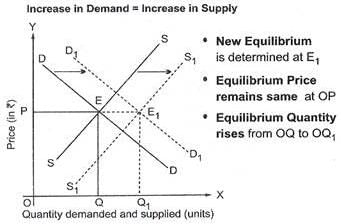
Test: Market Equilibrium - 2 - Question 20

Market for a good is in equilibrium. A decrease in price for the good will

Detailed Solution: Question 20

When only price will decrease or increase then moment will occur and other factors being constant.

136 videos|428 docs|127 tests
Information about Test: Market Equilibrium - 2 Page
In this test you can find the Exam questions for Test: Market Equilibrium - 2 solved & explained in the simplest way possible. Besides giving Questions and answers for Test: Market Equilibrium - 2, EduRev gives you an ample number of Online tests for practice
136 videos|428 docs|127 tests
Download as PDF