NEET Exam  >  NEET Test  >  Biology Class 11  >  Test: Muscular System - NEET MCQ

Muscular System - NEET Biology Class 11 Free MCQ Test with solutions


MCQ Practice Test & Solutions: Test: Muscular System (15 Questions)

You can prepare effectively for NEET Biology Class 11 with this dedicated MCQ Practice Test (available with solutions) on the important topic of "Test: Muscular System". These 15 questions have been designed by the experts with the latest curriculum of NEET 2026, to help you master the concept.

Test Highlights:

  • - Format: Multiple Choice Questions (MCQ)
  • - Duration: 15 minutes
  • - Number of Questions: 15

Sign up on EduRev for free to attempt this test and track your preparation progress.

Test: Muscular System - Question 1

During contraction of muscles :-

Detailed Solution: Question 1

Sliding Filament Theory of Contraction:
During muscle contraction, the thin actin filaments slide over the thick myosin filament. The actin filament slides over myosin filament thus reduces the length of the sarcomere and contracts the muscle fibre.
When Calcium is present the blocked active site of the actin clears.

Topic in NCERT: Muscle Contraction and the Sliding Filament Theory

Line in NCERT: "These cross bridges pull the actin filaments causing them to slide over the myosin filaments and thereby causing contraction."

Test: Muscular System - Question 2

 Contractile unit of muscle fibres :-

Detailed Solution: Question 2

sarcomere is the basic contractile unit of muscle fiber.

Each sarcomere is composed of two main protein filaments, actin and myosin, which are the active structures responsible for muscular contraction.

Topic in NCERT: Sarcomere

Line in NCERT: "The portion of the myofibril between two successive 'Z' lines is considered as the functional unit of contraction and is called a sarcomere."

Test: Muscular System - Question 3

Assertion (A): Myasthenia gravis is primarily characterized by the rapid degeneration of skeletal muscle fibers.
Reason (R): Myasthenia gravis affects the neuromuscular junction, leading to fatigue and weakness in skeletal muscles.

Detailed Solution: Question 3

  • The Assertion (A) is false because myasthenia gravis does not primarily involve the degeneration of muscle fibers; rather, it is an autoimmune disorder affecting the communication at the neuromuscular junction.
  • The Reason (R) is true as it correctly describes the mechanism of myasthenia gravis, which indeed leads to fatigue and weakness in skeletal muscles due to the disruption at the neuromuscular junction.
  • Therefore, since the Assertion is false and the Reason is true, the correct answer is If Assertion is false and Reason is true

Test: Muscular System - Question 4

Choose the letter from the figure that most appropriately corresponds to the structure:
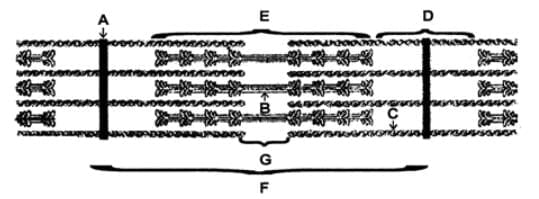
I.A-band       II. I-band           III.    Sarcomere         IV.     H-zone

V.Myosin       VI.Actin, Troponin, Tropomyosin             VII.   Z –line

Detailed Solution: Question 4
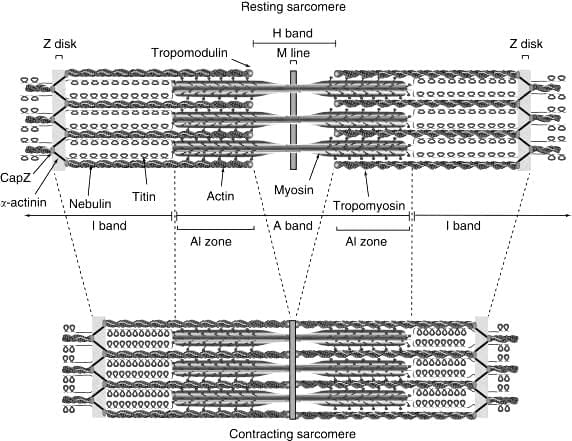
Option A is correct.

A corresponds to the Z-line, the dark line that marks the boundary of a sarcomere where thin (actin) filaments are attached.

F spans from one Z-line to the next and therefore represents the whole sarcomere.

B is positioned in the central dark region and denotes the myosin (thick) filament.

E and C lie within the central dark band where thick and thin filaments overlap; this region is part of the A-band. Hence I (A-band) maps to E, and the overlap region labelled C contains thin-filament components as well.

D marks the lighter region adjacent to the Z-line composed of only thin filaments and so corresponds to the I-band (IID).

G is the lighter central portion inside the A-band where only thick filaments occur; this is the H-zone (IVG).

Thin filament proteins actin, troponin, tropomyosin are present in the overlap/A-I zone (labelled C), so VIC. The thick filament (myosin) is B, giving VB. The full verified correspondence is therefore I → E, II → D, III → F, IV → G, V → B, VI → C, VII → A, which matches Option A.

Test: Muscular System - Question 5

Which of these is not a characteristic of cardiac muscles?

Detailed Solution: Question 5

  • Cardiac muscles are the muscles of the heart.
  • Cardiac muscles are involuntary muscles that work continuously to pump blood throughout the body.
  • They are branched and are striated in appearance.

Topic in NCERT: LOCOMOTION AND MOVEMENT

Line in NCERT: "Based on appearance, cardiac muscles are striated."

Test: Muscular System - Question 6

What is fascia made of?

Detailed Solution: Question 6

Fascia is a layer of connective tissue that surrounds the fascicles or muscle bundles in a muscle. It is made out of collagen. Each muscle bundle contains a number of muscle fibres or muscle cells.

Test: Muscular System - Question 7

ATP-ase activity found in :-

Detailed Solution: Question 7

In all myosins, the head domain is a specialized ATP-ase that is able to couple the hydrolysis of ATP with motion. A critical feature of the myosin ATP-ase activity is that it is actin-activated. In the absence of actin, solutions of myosin slowly convert ATP into ADP and phosphate.

Topic in NCERT: Structure of Contractile Proteins

Line in NCERT: "The globular head is an active ATPase enzyme and has binding sites for ATP and active sites for actin."

Test: Muscular System - Question 8

Which of these structures has alternate dark and light bands on it?

Detailed Solution: Question 8

Each muscle cell or muscle fibre contains filaments in its sarcoplasm which are arranged in a parallel manner. These filaments are known as myofibrils and they have alternate dark and light bands.

Topic in NCERT: myofibrils

Line in NCERT: "Each myofibril has alternate dark and light bands on it."

Test: Muscular System - Question 9

Cardiac muscles fibres :-

Detailed Solution: Question 9

Cardiac muscle is found only in the walls of the heart. When cardiac muscle contracts, the heartbeats and pumps blood.

  • Cardiac muscle contains many contains a great many mitochondria, which produce ATP for energy. This helps the heart resist fatigue.
  • Contractions of cardiac muscle are involuntary, like those of smooth muscle.
  • Cardiac muscle, like skeletal muscle, is arranged in bundles, so it appears striated, or striped.

Hence, option D is correct.

Topic in NCERT: CARDIAC MUSCLES

Line in NCERT: "Based on appearance, cardiac muscles are striated. They are involuntary in nature as the nervous system does not control their activities directly."

Test: Muscular System - Question 10

Which of the statements given above is/are correct?

i. Muscle contraction begins with a signal from the central nervous system transmitted through a motor neuron.

ii. The neuromuscular junction is the site where the motor neuron and muscle fibre communicate.

iii. Calcium ions released into the sarcoplasm directly bind to myosin to initiate contraction.

iv. Troponin plays a critical role in exposing active sites on actin filaments for myosin binding.

Detailed Solution: Question 10

- Statement i is correct because muscle contraction is initiated by a neural signal from the CNS through a motor neuron.

- Statement ii is correct as the neuromuscular junction is indeed where the motor neuron connects to the muscle fibre.

- Statement iii is incorrect because calcium ions do not bind to myosin; they bind to troponin, which then allows myosin to attach to actin.

- Statement iv is correct as troponin binds calcium, causing a conformational change that exposes the active sites on actin.

Thus, the correct statements are i, ii, and iv.

Topic in NCERT: Muscle Contraction

Line in NCERT: "Muscle contraction is initiated by a signal sent by the central nervous system (CNS) via a motor neuron. The junction between a motor neuron and the sarcolemma of the muscle fibre is called the neuromuscular junction or motor-end plate. This causes the release of Ca** from sarcoplasmic reticulum. Ca** activates actin which binds to the myosin head to form a cross bridge."

Test: Muscular System - Question 11

Which of the following statements regarding muscle structure and contraction are correct?

i. The light bands in muscle fibers, known as I-bands, contain actin filaments.

ii. Cardiac muscles are voluntary muscles controlled directly by the nervous system.

iii. Each functional unit of contraction in a muscle fiber is called a sarcomere, defined by Z-lines.

iv. Myosin filaments are thinner than actin filaments and are referred to as thick filaments.

Detailed Solution: Question 11

- Statement i is correct because the I-band is indeed composed of actin filaments, which are thinner than myosin filaments.

- Statement ii is incorrect; cardiac muscles are involuntary and are not directly controlled by the nervous system.

- Statement iii is correct as the sarcomere is defined as the segment between two Z-lines and is the functional unit of contraction.

- Statement iv is incorrect; myosin filaments are actually thicker than actin filaments.

Thus, the correct statements are i and iii, making Option A the correct answer.

Topic in NCERT: Structure of Myofibrils and Sarcomeres

Line in NCERT: "The light bands contain actin and is called I-band or Isotropic band, whereas the dark band called 'A' or Anisotropic band contains myosin." "Each functional unit of contraction and is called a sarcomere (Figure 17.2)." "Actin filaments are thinner as compared to the myosin filaments, hence are commonly called thin and thick filaments respectively."

Test: Muscular System - Question 12

Which of the statements given above is/are correct regarding the structure and function of actin filaments?

i. Each actin filament is composed of two helically wound 'F' (filamentous) actins.

ii. 'G' (Globular) actins are monomers that polymerize to form 'F' actins.

iii. Tropomyosin runs parallel to the 'F' actins and does not interact with them.

iv. Troponin is attached to tropomyosin at regular intervals and regulates the binding sites for myosin on the actin filaments.

Detailed Solution: Question 12

- Statement i is correct: Each actin filament is indeed composed of two helically wound 'F' actins.

- Statement ii is also correct: 'G' (Globular) actins serve as monomers that polymerize to form filamentous 'F' actins.

- Statement iii is incorrect: Tropomyosin runs parallel to 'F' actins and interacts with them, playing a crucial role in muscle contraction by regulating access to the binding sites on actin for myosin.

- Statement iv is correct: Troponin is distributed at regular intervals along the tropomyosin and is essential for regulating the binding sites for myosin on actin filaments during muscle contraction.

Thus, the correct statements are i, ii and iv, making Option c the right answer.

Topic in NCERT: Structure of Contractile Proteins

Line in NCERT: "Each actin (thin) filament is made of two 'F' (filamentous) actins helically wound to each other. Each 'F' actin is a polymer of monomeric 'G' (Globular) actins. Two filaments of another protein, tropomyosin also run close to the 'F' actins throughout its length. A complex protein Troponin is distributed at regular intervals on the tropomyosin. In the resting state a subunit of troponin masks the active binding sites for myosin on the actin filaments."

Test: Muscular System - Question 13

Which of the statements given above is/are correct?

i. Each myosin filament is composed of many monomeric proteins known as Meromyosins.

ii. The heavy meromyosin (HMM) consists of a tail and a globular head.

iii. The cross arm of the myosin filament projects outwards at a regular distance and angle.

iv. The globular head of myosin serves as an inactive enzyme with no binding sites for ATP.

Detailed Solution: Question 13

- Statement i is correct. Myosin filaments are indeed composed of multiple monomeric proteins called Meromyosins.

- Statement ii is incorrect. The heavy meromyosin (HMM) refers specifically to the globular head and short arm, while the light meromyosin (LMM) refers to the tail.

- Statement iii is correct. The cross arm of the myosin filament does project outwards at a regular distance and angle.

- Statement iv is incorrect. The globular head of myosin is an active ATPase enzyme with binding sites for ATP and active sites for actin.

Thus, the correct statements are i and iii, making the correct answer Option A.

Topic in NCERT: Structure of Contractile Proteins

Line in NCERT: "Each myosin (thick) filament is also a polymerised protein. Many monomeric proteins called Meromyosins constitute one thick filament. Each meromyosin has two important parts, a globular head with a short arm and a tail, the former being called the heavy meromyosin (HMM) and the latter, the light meromyosin (LMM). The HMM component, i.e.; the head and short arm projects outwards at regular distance and angle from each other from the surface of a polymerised myosin filament and is known as cross arm."

Test: Muscular System - Question 14

Assertion (A): Muscle fibers are classified as red and white fibers based on the amount of myoglobin present in them.

Reason (R): Red fibers contain more myoglobin, which enhances their ability to store oxygen and sustain aerobic metabolism.

Detailed Solution: Question 14

- Assertion (A) is true: Muscle fibers are indeed classified into red and white fibers based on myoglobin content.

- Reason (R) is also true: Red fibers do contain more myoglobin, which allows for better oxygen storage and supports aerobic metabolism.

-Reason is just describing about red fibres.If it would have mentioned description of white fibres then the reason would have become the correct explanation of the assertion 

Topic in NCERT: MUSCLE FIBRES

Line in NCERT: "Muscles are classified as Red and White fibres based primarily on the amount of red coloured myoglobin pigment in them."

Test: Muscular System - Question 15

What sequence of events correctly describes the role of calcium ions in muscle contraction?

Detailed Solution: Question 15

The sequence begins when a motor neuron's signal generates an action potential in the muscle fiber. This event triggers the release of calcium ions from the sarcoplasmic reticulum. These calcium ions then activate actin, allowing it to bind to myosin heads, forming cross bridges. The formation of these cross bridges enables the actin filaments to slide over the myosin filaments, causing the muscle to contract. Once contraction is completed, calcium ions are reabsorbed into the sarcoplasmic reticulum, actin becomes inactivated, cross bridges are broken, and the muscle relaxes.
Topic in NCERT: Muscle Contraction
Line in NCERT: "Upon an action potential in the muscle fiber, calcium ions are released from the sarcoplasmic reticulum, activating actin to bind with myosin and form cross bridges, resulting in muscle contraction."

142 videos|410 docs|135 tests
Information about Test: Muscular System Page
In this test you can find the Exam questions for Test: Muscular System solved & explained in the simplest way possible. Besides giving Questions and answers for Test: Muscular System, EduRev gives you an ample number of Online tests for practice
142 videos|410 docs|135 tests
Download as PDF