UPSC Exam  >  UPSC Test  >  General Science(Prelims) by IRS Divey Sethi  >  Test: Natural Resources - 2 - UPSC MCQ

Natural Resources - 2 - Free MCQ Practice Test with solutions, UPSC General


MCQ Practice Test & Solutions: Test: Natural Resources - 2 (10 Questions)

You can prepare effectively for UPSC General Science(Prelims) by IRS Divey Sethi with this dedicated MCQ Practice Test (available with solutions) on the important topic of "Test: Natural Resources - 2". These 10 questions have been designed by the experts with the latest curriculum of UPSC 2026, to help you master the concept.

Test Highlights:

  • - Format: Multiple Choice Questions (MCQ)
  • - Duration: 10 minutes
  • - Number of Questions: 10

Sign up on EduRev for free to attempt this test and track your preparation progress.

Test: Natural Resources - 2 - Question 1

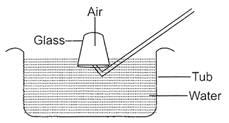
Study the given figure carefully. What will happen to the water level in the tub when some air is sucked out of the glass? 
Detailed Solution: Question 1

When the air is sucked out of the glass, the water will enter into the glass and thus, the level of water in the tub will go down.

Test: Natural Resources - 2 - Question 2

Fossil fuels formed over a long period of time when heat and pressure were applied to

Detailed Solution: Question 2

Fossil fuels are the most important sources of energy for human beings. Coal and petroleum are kinds of sedimentary rock fossil fuels formed from the remains of plants and animals that lived million of years ago.

Test: Natural Resources - 2 - Question 3

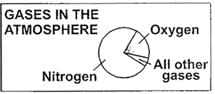
Which of these is the most accurate description of air, based on the pie-chart? 
Detailed Solution: Question 3

Air is a mixture of gases. About 78% is nitrogen, 21% is oxygen and the remaining 1% is mainly argon and carbon dioxide. Air also contains varying amounts of water vapour, dust particles and smoke.

Test: Natural Resources - 2 - Question 4

Select the option that groups rocks of two different kinds as shown in the box.

Sandstone : Pumice

Detailed Solution: Question 4

The relationship in the box pairs a sedimentary rock (sandstone) and an igneous rock (pumice) together. Similarly, conglomerate is a sedimentary rock and obsidian is an igneous rock.

Test: Natural Resources - 2 - Question 5

Select the correct statement out of the following.

Detailed Solution: Question 5

Clayey soil holds large amounts of water. On drying, this water escapes and cracks develop. These cracks break plant roots making clayey soil not suitable for plant growth.

Test: Natural Resources - 2 - Question 6

Beena performed an experiment in which she took four beakers containing different amounts of water at different temperatures. She added equal amount of salt into each beaker.
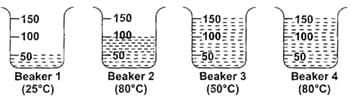

Identify the beaker in which salt takes the shortest time to dissolve.

Detailed Solution: Question 6

Rate of dissolution of solute increases with increase in temperature and quantity of solvent. Beaker 4 has both, more amount of water and higher temperature which help in fast dissolution of salt in water.

Test: Natural Resources - 2 - Question 7

Take a glass and fill it with water up to the brim. Make sure that there are no air bubbles. Take a thick, stiff piece of cardboard and put it over the glass. Place your hand over the card and quickly turn the glass upside down. Now slowly remove your hand.
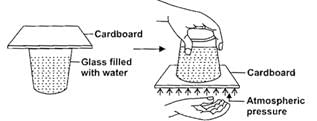

Q. What does this experiment show?

Detailed Solution: Question 7

When you will remove your hand, you will find that the card stays in place and the water does not flow out. This is because air exerts pressure on the card from below to keep the card in place. Here, the pressure exerted by air upwards is more than the pressure exerted by water downwards.

Test: Natural Resources - 2 - Question 8

Monty fully filled a glass bottle with water, put a stopper on it and placed it upright in the freezer overnight. When he looked at it in the morning, the stopper was out of the bottle and a column of ice had emerged through the opening of the bottle.

Q. Which one of the following is the best explanation for what Monty had observed?

Detailed Solution: Question 8

Water expands (increase in volume) upon freezing. This is due to the fact that upon freezing, water molecules crystallize  into an open hexagonal lattice form in which molecules enclose more space among themselves than in the liquid state. Thus, in the given case, volume of water increased when the water froze, forcing the stopper out of the bottle and forming the column of ice.

Test: Natural Resources - 2 - Question 9

The U-tube shown below is immersed in ice water. X and Y are the red ink droplets present inside the tube.


Q. What will you observe after some time?

Detailed Solution: Question 9

Due to the cooling effect of ice water, the air in the U-tube contracts, due to which the red ink X and Y move downwards.

Test: Natural Resources - 2 - Question 10

The graph below shows the temperature of a beaker of water as it is subjected to various treatments.
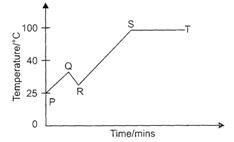
Q. What could have taken place at point Q?

Detailed Solution: Question 10

At point Q, there occurs a gradual decrease in temperature of water, which could have been possible due to addition of ice cubes into the beaker of water.

9 videos|110 docs|262 tests
Information about Test: Natural Resources - 2 Page
In this test you can find the Exam questions for Test: Natural Resources - 2 solved & explained in the simplest way possible. Besides giving Questions and answers for Test: Natural Resources - 2, EduRev gives you an ample number of Online tests for practice
Download as PDF