
Planck’s Law - Free MCQ Practice Test with solutions, GATE ME Heat Transfer
MCQ Practice Test & Solutions: Test: Planck’s Law (10 Questions)
You can prepare effectively for Mechanical Engineering Heat Transfer with this dedicated MCQ Practice Test (available with solutions) on the important topic of "Test: Planck’s Law". These 10 questions have been designed by the experts with the latest curriculum of Mechanical Engineering 2026, to help you master the concept.
Test Highlights:
- - Format: Multiple Choice Questions (MCQ)
- - Duration: 10 minutes
- - Number of Questions: 10
Sign up on EduRev for free to attempt this test and track your preparation progress.

The energy emitted by a black surface should not vary in accordance with
Detailed Solution: Question 1
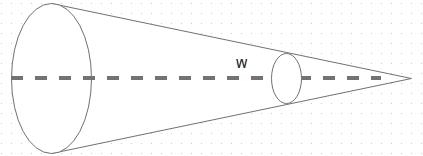
In the given diagram let r be the length of the line of propagation between the radiating and the incident surfaces. What is the value of solid angle W?
Detailed Solution: Question 2

Likewise the amount of emitted radiation is strongly influenced by the wavelength even if temperature of the body is
Detailed Solution: Question 3
A small body has a total emissive power of 4.5 kW/m2. Determine the wavelength of emission maximum
Detailed Solution: Question 4
The sun emits maximum radiation of 0.52 micron meter. Assuming the sun to be a black body, Calculate the emissive ability of the sun’s surface at that temperature
Detailed Solution: Question 5
The law governing the distribution of radiant energy over wavelength for a black body at fixed temperature is referred to as
Detailed Solution: Question 6
Detailed Solution: Question 7
Detailed Solution: Question 8
A furnace emits radiation at 2000 K. Treating it as a black body radiation, calculate the monochromatic radiant flux density at 1 micron m wavelength
Detailed Solution: Question 9
A metal sphere of surface area 0.0225 m2 is in an evacuated enclosure whose walls are held at a very low temperature. Electric current is passed through resistors imbedded in the sphere causing electrical energy to be dissipated at the rate of 75 W. If the sphere surfaces temperature is measured to be 560 K, while in steady state, calculate emissivity of the sphere surface
Detailed Solution: Question 10
55 videos|110 docs|86 tests |
